What Bicycle Gears Actually Do
Gears exist to solve a straightforward mechanical problem: your legs can only push so hard and so fast. When you encounter a steep climb, a headwind, or a fast descent, a fixed resistance would either exhaust you or leave your legs spinning uselessly. Gears let you adjust the relationship between pedaling effort and wheel speed so you can sustain a comfortable, efficient rhythm across wildly different conditions.
Think of it like adjusting the resistance on a stationary bike - easier settings let you spin quickly with less force, harder settings require more force but move the wheel farther per stroke. On the road or trail, you are constantly making small adjustments to stay in that productive zone. See our full drivetrain overview for a deeper look at how pedaling force translates into forward motion.
Chainring
The large toothed ring attached to the bike's crank arms. It drives the chain and is the starting point of the gearing system.
Cassette
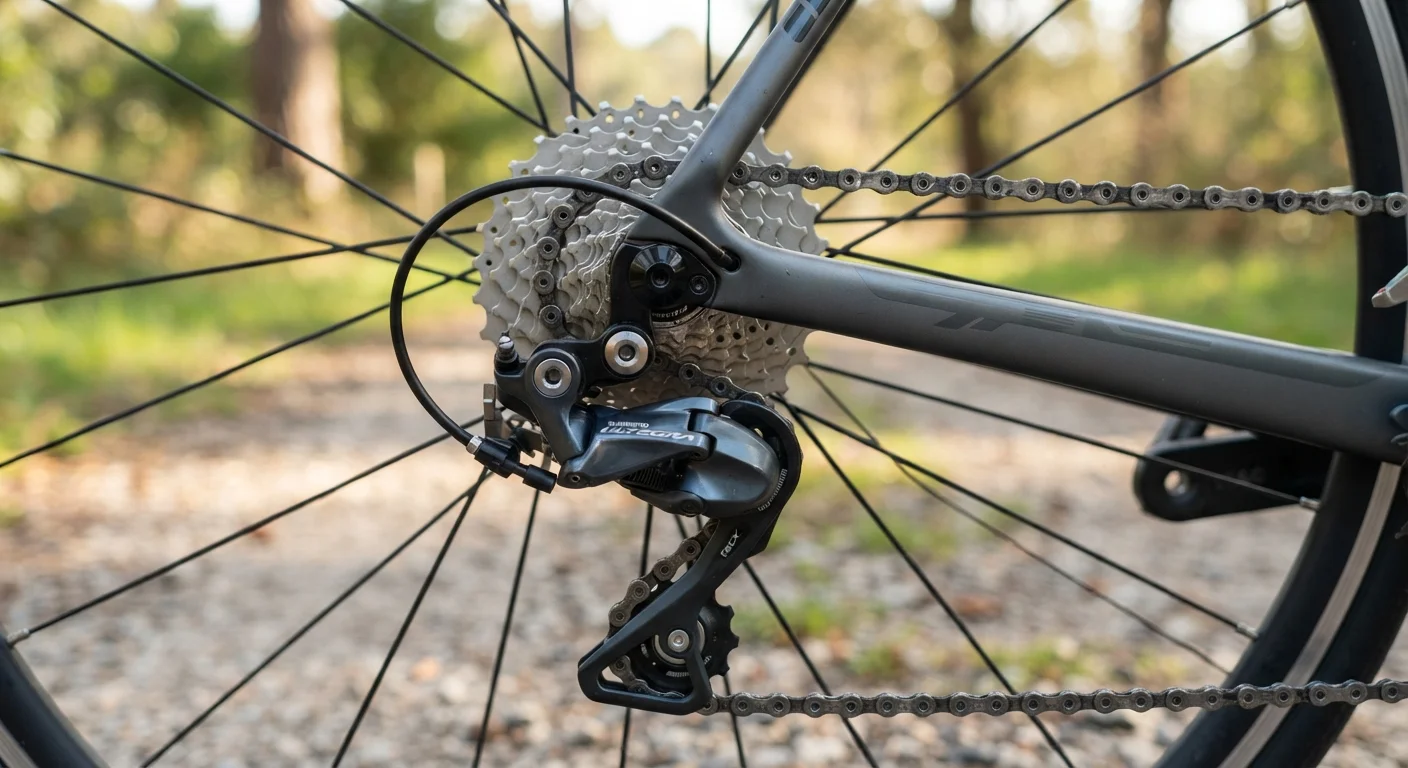
A set of sprockets mounted on the rear wheel hub. More teeth on a sprocket means easier pedaling; fewer teeth means more speed per pedal stroke.
Derailleur
A mechanical device that moves the chain from one sprocket or chainring to another when you shift. Rear and front derailleurs handle different parts of the system.
Gear Ratio
The mathematical relationship between chainring teeth and rear sprocket teeth. It determines how far your bike travels with each pedal revolution.
Cadence
The speed at which you pedal, measured in revolutions per minute (RPM). Choosing the right gear helps you maintain a cadence that is efficient and sustainable.
1x / 2x / 3x
Shorthand for the number of chainrings on a drivetrain - one, two, or three. The number affects how many distinct gear combinations are available and how the bike is shifted.
The Key Components of a Gearing System
A bicycle's gearing system involves several interdependent parts. Understanding each one makes the whole system easier to grasp.
- Chainring: The large toothed ring attached to the crank arms where your pedals connect. Bikes may have one, two, or three chainrings.
- Chain: Transfers power from the chainring to the rear cassette. Chain length and width must match your specific drivetrain speed standard.
- Cassette: The cluster of sprockets on the rear wheel hub, ranging from small (high gear, fast) to large (low gear, easier climbing). A cassette's range is described by its smallest and largest sprocket tooth count, such as 11-32T.
- Rear Derailleur: Moves the chain laterally across cassette sprockets when you shift. It also maintains chain tension through a spring-loaded cage.
- Front Derailleur: Present on 2x and 3x drivetrains, this component shifts the chain between chainrings. Many modern setups omit it entirely.
- Shifters: Mounted on the handlebars, these controls actuate the derailleurs via cables or wireless electronics.
For a broader look at how these parts connect to the rest of the bicycle, the complete bicycle components guide covers the full picture.
How Gear Ratios Work
A gear ratio describes how many times the rear wheel rotates for each full pedal stroke. It is calculated by dividing the number of teeth on the chainring by the number of teeth on the rear sprocket currently engaged.
For example: a 44-tooth chainring paired with an 11-tooth sprocket produces a ratio of 4.0 - meaning the wheel turns four times per pedal revolution. That is a high gear suited to flat roads or descents. The same chainring paired with a 32-tooth sprocket gives a ratio of roughly 1.4, a much lower gear ideal for climbing.
Shift Before You Need To
New riders often wait until they are struggling to shift gears - by which point it is too late to shift smoothly. Watch the road ahead and select your gear before the terrain changes. This protects your drivetrain and keeps your pedaling rhythm steady.
The practical takeaway is simple: smaller rear sprockets = harder pedaling, more speed. Larger rear sprockets = easier pedaling, less speed per stroke. Learning to anticipate terrain and shift before you need to - rather than struggling mid-climb - is one of the most valuable habits a new rider can develop.
Drivetrain Configurations: 1x, 2x, and 3x
Modern drivetrains are classified by the number of front chainrings. Each configuration reflects a different philosophy around range, simplicity, and weight.
- 1x (Single Chainring)
- One chainring up front paired with a wide-range cassette - often 10 or 12 sprockets spanning a large tooth-count spread. The result is a clean cockpit with no front derailleur, fewer adjustments, and simpler shifting. Common on mountain bikes and gravel bikes. The tradeoff is slightly larger jumps between gears.
- 2x (Double Chainring)
- Two front chainrings plus a rear cassette. Provides a broad overall range with finer incremental steps. Widely used on road bikes. Requires coordinating both front and rear shifting, which takes a little practice to learn smoothly.
- 3x (Triple Chainring)
- Three front chainrings offer the widest possible gear range, historically common on touring and entry-level mountain bikes. Less common today as wide-range 1x cassettes cover similar territory with less complexity.
Avoid Mixing Incompatible Components
Drivetrain components are engineered to work within specific speed standards - an 11-speed cassette requires an 11-speed chain, compatible shifters, and a matched derailleur. Mixing components from different speed standards often results in poor shifting or component damage. Always verify compatibility before purchasing replacement or upgrade parts.
Choosing a configuration depends on your riding style and terrain. If you are still identifying the right bike style for your needs, that decision will naturally inform which drivetrain makes the most sense.
Gearing on E-Bikes
Electric bikes add a motor to assist your pedaling, but they do not eliminate the value of gears. Most e-bikes use standard multi-speed drivetrains, and shifting correctly still matters - both for efficiency and component longevity.
Motor torque places considerably more stress on the chain and cassette than leg power alone. Shifting under heavy load (while the motor is working hard) accelerates component wear and can cause premature chain damage. Good e-bike shifting technique involves momentarily easing pedal pressure when changing gears, just as you would on a conventional bike.
The e-bikes resource hub covers motor classes, battery considerations, and what to look for when evaluating electric drivetrains specifically.
Practical Tips for New Riders
Knowing the theory is useful, but these habits will serve you well from your first ride:
- Shift before the hill, not on it. Anticipate climbs and select a lower gear while you still have momentum. Shifting under extreme load strains the chain and derailleur.
- Avoid cross-chaining. Running the chain on the largest chainring and the largest rear sprocket simultaneously - or the smallest chainring with the smallest sprocket - creates excessive chain angle and wear. Stay within reasonable combinations.
- Keep your chain clean and lubricated. A dirty or dry chain wears out the cassette and chainrings significantly faster. Light cleaning after muddy rides and periodic lubrication with a cycling-specific chain lube are the minimum.
- Learn the feel of your bike's range. Spend time in a low-traffic area exploring all your gears. Notice what each combination feels like so shifting becomes instinctive.
- Have a mechanic set up your derailleurs. Incorrect derailleur adjustment leads to poor shifting and dropped chains. A professional setup is worthwhile, especially on a new bike.
For more on how the bottom bracket interacts with your drivetrain, including signs of wear that affect shifting feel, that component deserves its own attention as you grow more familiar with your bike.
Drivetrain Basics: How Power Gets from Your Legs to the Wheel
A deeper dive into how chainrings, cassettes, derailleurs, and chains work as an integrated system to move a bicycle forward.
Bicycle Anatomy: Every Component Explained
A comprehensive reference covering every major bicycle part - useful context for understanding where the gearing system fits within the whole machine.
Bottom Brackets: The Hidden Component That Affects Everything
Explains the bottom bracket's role at the heart of your drivetrain, including how wear at this component affects shifting feel and efficiency.