What Suspension Actually Does
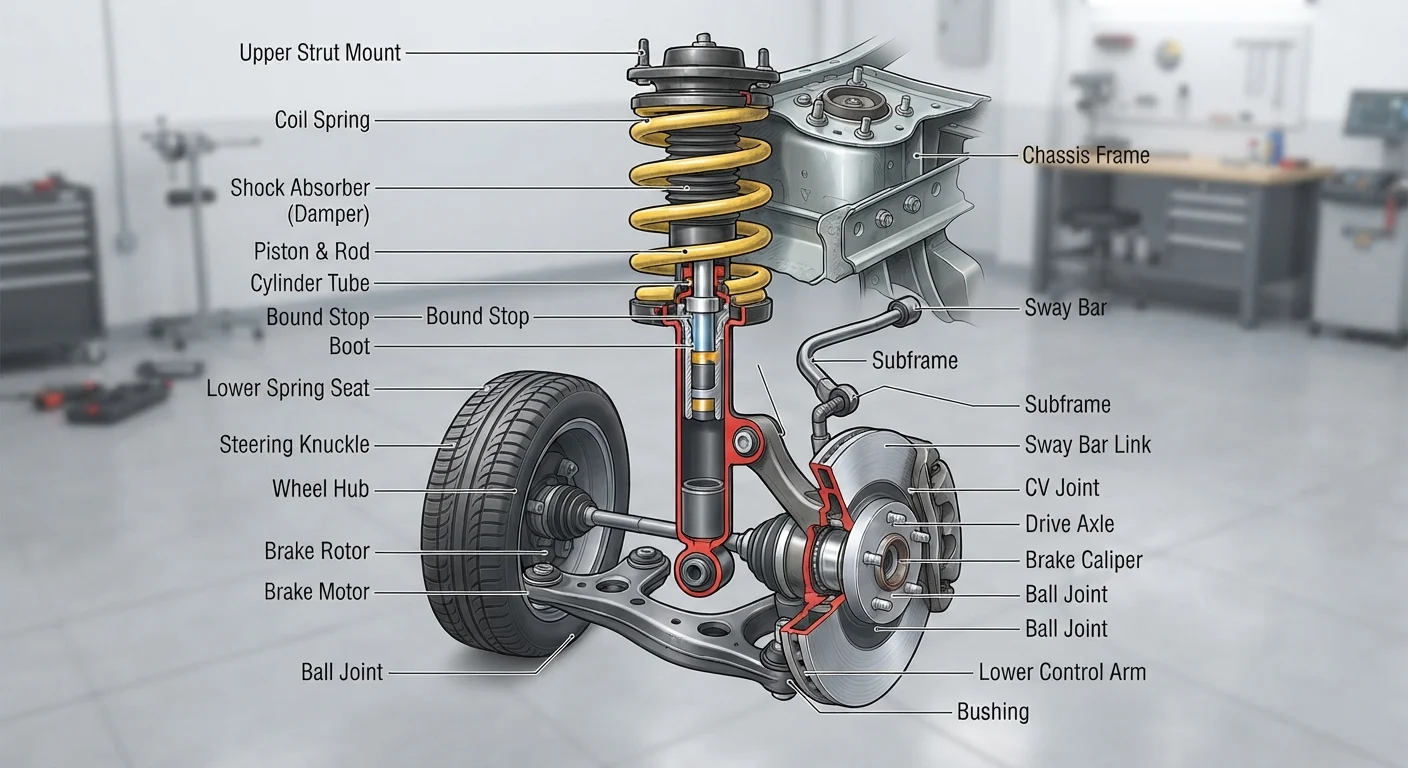
Every road surface has imperfections - cracks, potholes, expansion joints, and grade changes. Without a suspension system, every one of those inputs would transfer directly through the vehicle's chassis and into the cabin. The suspension system's job is to allow the wheels to move independently over road irregularities while keeping the vehicle body relatively stable and the tires in firm contact with the ground.
There are two competing demands at work here: ride comfort (isolating occupants from road impacts) and handling performance (keeping tires planted during acceleration, braking, and cornering). Suspension tuning is largely about finding the right balance between these two goals for a specific vehicle's purpose. A luxury sedan and a performance coupe share the same basic principles but use very different calibrations - and the same logic applies to mountain bike suspension choices as it does to four-wheeled vehicles.
Springs: Managing Energy Storage
When a wheel hits a bump, it must rise to follow the road surface. A spring allows that movement by compressing, absorbing the kinetic energy of the impact. Once the bump has passed, the spring releases that stored energy and extends back to its resting length, pushing the wheel back down toward the road.
The critical specification of any spring is its spring rate - the amount of force required to compress the spring by a given distance (typically expressed in pounds per inch or Newtons per millimeter). A high spring rate resists compression forcefully, producing a firm ride but excellent body control. A low spring rate compresses easily, resulting in a more compliant, comfortable ride at the cost of more body roll during cornering.
Spring rate
The stiffness of a spring, measured as the force needed to compress it by a set distance. Higher rates mean a firmer ride; lower rates allow more wheel travel.
Damper (shock absorber)
A hydraulic device that controls the speed at which a spring compresses and rebounds, preventing uncontrolled bouncing after road impacts.
Camber
The inward or outward tilt of a wheel when viewed from the front of the vehicle. Camber angle affects tire contact and cornering grip.
Toe
Whether the front edges of a pair of tires point toward or away from each other. Toe settings influence straight-line stability and steering response.
Rebound
The extension phase of suspension movement - when the spring pushes the wheel back downward after being compressed over a bump.
Coilover
A suspension unit that combines a coil spring and a damper into one integrated assembly, commonly used in performance and modern independent suspension setups.
Common spring types include coil springs (a helical metal coil used in most modern independent suspension systems), leaf springs (stacked steel strips, common in truck rear axles), and torsion bars (a rod that twists under load). Each type serves the same fundamental purpose but suits different packaging constraints and load requirements. For a deeper look at how these configurations play out in trucks, see how truck suspension systems affect ride quality.
Dampers: Controlling the Rebound
A spring left entirely on its own would bounce the vehicle repeatedly after any road impact - compressing and extending in an oscillating cycle that would make the vehicle nearly uncontrollable. Dampers (commonly called shock absorbers or, in coilover setups, struts) solve this problem by converting the spring's kinetic energy into heat through hydraulic resistance.
Inside a damper, a piston moves through oil-filled chambers. Small valves - called valving - control how quickly oil can pass through the piston. This resistance slows both compression (the wheel moving up) and rebound (the wheel returning downward). The result is a controlled, single-cycle motion rather than an uncontrolled bounce.
Match Your Dampers to Your Springs
If you're considering replacing worn dampers, use spring rate as a guide for the appropriate damper specification. A damper calibrated for a stock spring rate may feel harsh or unresponsive if paired with aftermarket springs of a significantly different rate. Consult a suspension specialist or the component manufacturer's guidelines to ensure a compatible match.
Damper condition degrades gradually over time. Worn dampers may not produce obvious noises but will allow more body movement, longer stopping distances, and reduced steering precision. A qualified mechanic can assess damper health during routine inspections.
Geometry: How Angles Define Behavior
Springs and dampers control vertical wheel movement, but suspension geometry determines the angles at which the tires contact the road - and how those angles change as the suspension compresses and extends. Three primary geometry settings define most vehicles' handling character:
- Camber: The inward or outward tilt of the wheel when viewed from the front. Slight negative camber (top of wheel tilted inward) improves cornering grip by keeping more tire surface in contact with the road during body roll.
- Caster: The fore-aft tilt of the steering axis when viewed from the side. Positive caster improves straight-line stability and steering return-to-center feel.
- Toe: Whether the fronts of the tires point inward (toe-in) or outward (toe-out) relative to each other. Toe settings affect straight-line stability and turn-in responsiveness.
These angles are set at the factory for a specific use case. When components wear or after suspension modifications, a professional alignment check re-establishes correct geometry. Incorrect alignment causes uneven tire wear and compromised handling - two issues that compound each other over time.
Alignment After Any Suspension Work
Any replacement of suspension components - including control arms, ball joints, or springs - can alter geometry settings, even if new parts appear identical to the originals. Always have a professional four-wheel alignment performed after suspension repairs or replacements. Driving on misaligned geometry accelerates tire wear and can compromise vehicle stability.
How the System Works Together
Understanding each component in isolation is useful, but suspension performance is defined by how all elements interact. A spring that is too stiff for a given damper will overwhelm the damper's ability to control rebound. Geometry that shifts dramatically through suspension travel will introduce handling quirks even when spring and damper rates are well-matched.
Engineers refer to the relationship between spring rate and damper resistance as damping ratio - a measure of how well the damper controls the spring's natural frequency of oscillation. A well-matched system feels settled and predictable across a range of road conditions. A mismatched system may feel harsh, wallowy, or unpredictable depending on which element is out of proportion.
For vehicle owners, this means that modifying one element without considering the others can produce unintended results. Before exploring any changes, it's worth understanding the full range of options - from anti-roll bars to strut braces - covered in our guide to handling modifications worth understanding. Building that foundational knowledge ensures any modification decisions are informed, purposeful, and matched to your vehicle's actual use.