What a Slide-Out Actually Does to Interior Space
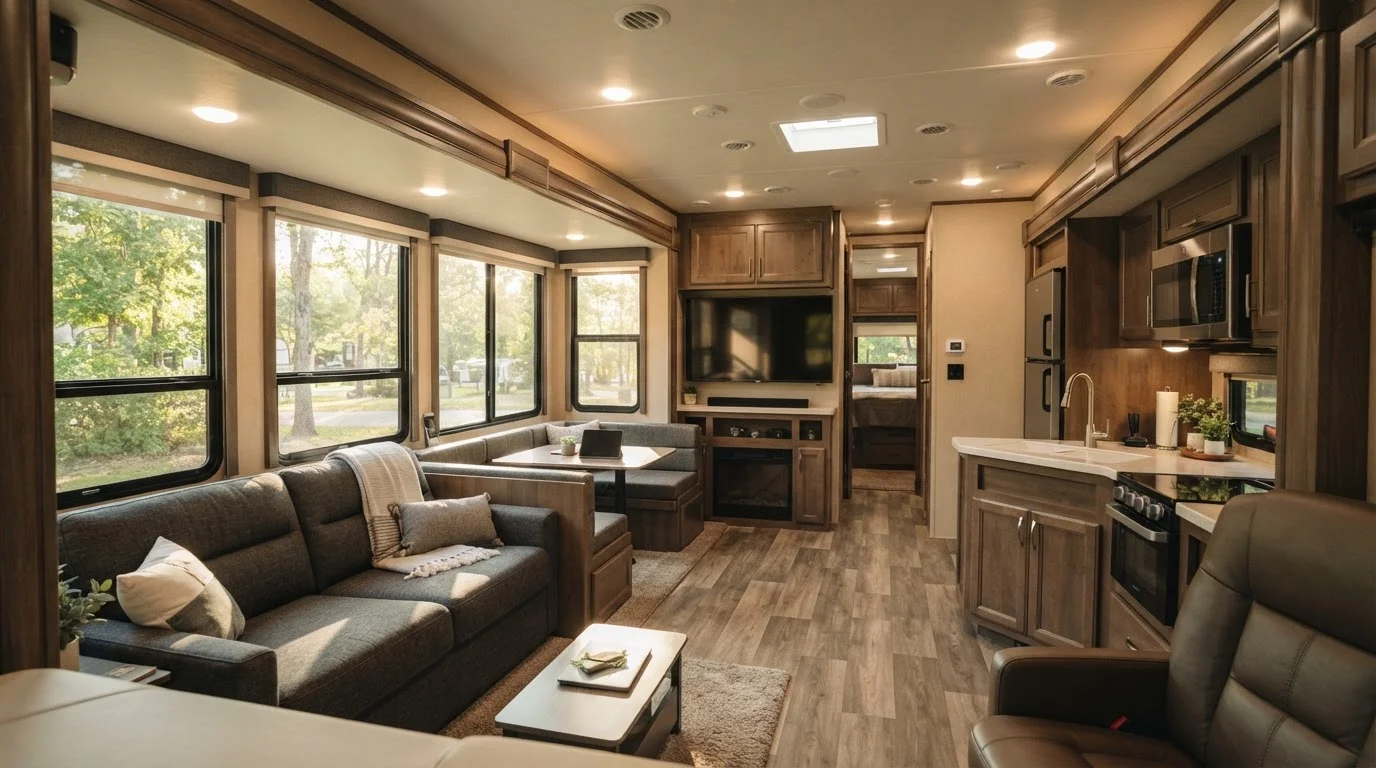
A slide-out - sometimes called a slideout or slide room - is a section of an RV's wall and floor that extends outward when parked, expanding the usable interior. Typically adding 2 to 3 feet of width across a section of the coach, a single slide-out can meaningfully change how a living room, dinette, or bedroom feels to occupy. In a 40-foot Class A, multiple slides can push total interior square footage well beyond what the exterior footprint implies. For more on how that scale works, see our guide to Class A motorhome trade-offs.
The practical effect depends heavily on placement. A living room slide that opens up the sofa and entertainment area creates a qualitatively different social space. A bedroom slide that lets a king bed sit perpendicular to the coach - rather than lengthwise - changes how accessible the mattress is and whether two people can move around it simultaneously. These aren't luxury upgrades in the abstract; they address specific friction points in RV living that compact floor plans struggle to solve.
Substantially expands usable interior floor space
A single slide-out can add 2-3 feet of width across a living or sleeping area, fundamentally changing how a room functions and how many people can occupy it comfortably.
Enables residential-scale furniture configurations
Slides allow manufacturers to place full-width sofas, dinettes, and king beds in orientations that simply aren't possible in fixed-wall floor plans, improving ergonomics and comfort.
Improves traffic flow through the coach when deployed
With slides extended, the main corridor widens considerably, making it easier to move through the coach without squeezing past furniture - a practical daily benefit on long stays.
Can support full-time living more comfortably
For those living in their RV year-round, the additional space created by slides reduces the psychological compression of small-space living, which matters significantly over months or years.
Creates distinct room zones within a single coach
Multiple slide-outs can define separate living, dining, and sleeping areas, giving an RV a more house-like spatial structure that single-zone layouts cannot replicate.
The Mechanical and Weight Reality
Every slide-out adds a motor, a track or rack system, seals, and wiring - all of which require periodic inspection and can fail. Slide mechanisms are among the more commonly reported maintenance issues in RV owner communities, and a slide that won't retract can strand you in a campsite or prevent travel. Some systems use electric motors; others use hydraulics. Hydraulic systems tend to be more powerful and better suited to large or heavy slides, but they introduce fluid-level management and seal integrity as additional maintenance variables.
Weight is a compounding concern. The slide structure itself - frame, floor decking, furniture, and appliances - adds significant mass. Depending on configuration, a fully furnished slide-out can add several hundred pounds to the coach's gross vehicle weight. This affects tow ratings for fifth wheels and travel trailers, and influences fuel consumption and handling in motorized units. It also reduces the payload available for water, gear, and passengers. The RV classes comparison guide covers how weight differences interact with drivability across coach types.
Adds mechanical complexity and failure points
Slide mechanisms - motors, tracks, seals - require periodic maintenance and are among the more commonly reported repair issues in RVs. A failed slide can prevent travel or trap an owner at a site.
Increases gross vehicle weight meaningfully
A furnished slide-out can add several hundred pounds to a coach, reducing available payload for water, gear, and passengers, and affecting tow ratings in towable units.
Restricts campsite options requiring lateral clearance
Slides need 3-4 feet of clearance on the extension side, ruling out tight, wooded, or older sites that weren't designed with slide-equipped coaches in mind.
Increases setup and breakdown time at every stop
Deploying and retracting multiple slides - combined with leveling requirements - adds meaningful time to camp setup and departure, a real friction point for frequent movers.
Seals degrade and can allow water intrusion
The rubber seals around slide-out perimeters are wear items that need regular inspection and replacement. Neglected seals are a common source of water damage, one of the costliest RV repairs.
Slides should not deploy on significantly uneven terrain
Extending a slide on an unlevel surface stresses the mechanism asymmetrically over time. This limits spontaneous parking and boondocking where perfectly level ground isn't guaranteed.
Campsite Compatibility and Setup Time
Slide-outs require lateral clearance - typically 3 to 4 feet on the affected side of the coach. In tight campgrounds, wooded sites, or areas with adjacent hookup posts and utility boxes, that clearance may not exist. Some sites at popular national parks and older campgrounds were designed before slides became nearly universal, and the pad width simply doesn't accommodate full extension. Traveling without a plan for this is a recipe for frustration.
Level ground matters too. Most manufacturers recommend deploying slides only when the RV is sufficiently level; extending on a significant slope can put asymmetric stress on the mechanism over time. Auto-leveling jacks help, but they don't eliminate the issue on severely uneven sites. Setup time also increases - a unit with three slides takes meaningfully longer to deploy and break camp than a comparable slide-free floor plan. For travelers who prioritize spontaneous overnight stops or boondocking, that friction accumulates quickly. The practical realities of everyday RV living often surface most clearly in routine setup and breakdown.
Retracting Before You Drive Is Non-Negotiable
All slide-outs must be fully retracted before the RV moves. Driving with a slide even partially extended can cause catastrophic structural damage to the mechanism, the coach wall, and anything in the slide's path. Most modern RVs include warning systems, but always perform a visual check as part of your pre-departure routine - especially in busy campgrounds where distractions are common.
Weighing Slides Against Your Actual Camping Style
The right question isn't whether slide-outs are good or bad - it's whether they match how you actually use an RV. Full-timers who park at developed RV resorts for weeks at a time get maximum value from slides: the space is deployed far more hours than it's stowed, and infrastructure for level hookup sites is reliable. Weekend campers who move frequently and prefer primitive or semi-developed sites may find the trade-offs outweigh the gains.
Floor plan literacy matters here. Learning to read a floor plan - how furniture is arranged, where the slide boundaries fall, what the traffic flow looks like both retracted and extended - is one of the most practical skills a prospective buyer can develop. Our complete RV interior layouts guide walks through how to evaluate configurations across every major coach category. Storage is a related consideration that slide-outs influence indirectly - extended floor space sometimes displaces under-floor storage access, a nuance covered in our article on thinking through RV storage before it becomes a problem.
2-3 ft
Typical width added per slide-out
Most standard RV slide-outs extend the interior width by approximately 2 to 3 feet, with larger rooms or full-wall slides extending further in some Class A configurations.
~200-600 lbs
Estimated weight added per furnished slide
Industry estimates vary by slide size and furnishings, but a fully equipped slide-out room - including floor, walls, and furniture - commonly adds this range to a coach's base weight.