Why RV Storage Demands a Different Mindset
Storage in a sticks-and-bricks home is largely passive - you acquire space, fill it, and forget it. In an RV, storage is an active, ongoing discipline. Every cubic foot carries weight consequences, and clutter compounds fast when your living room, kitchen, bedroom, and office are all within twenty feet of each other.
The gap between an RV that feels livable and one that feels chaotic usually isn't the floor plan - it's how intentionally the available space is used. Whether you're in a Class B van conversion or a 40-foot Class A motorcoach, the same principles apply. For a broader look at how floor plan choice shapes your storage baseline, see the complete RV interior layout guide.
The strategies below are grounded in real-world use across multiple RV configurations. Each one targets a specific space problem - not just a general suggestion to "declutter."
Audit Before You Organize
The single most impactful storage improvement has nothing to do with buying organizers - it's removing what doesn't earn its place. Before rearranging anything, pull every item out of a given area and sort it into three groups: used on nearly every trip, used occasionally, and rarely or never used.
Rarely used items should leave the RV entirely or move to a climate-controlled home storage unit if you maintain one. Occasional-use items belong in the hardest-to-access compartments - the deepest bay corners, high overhead shelves. Daily-use items need to be immediately reachable without moving anything else.
This audit also reveals duplicate items - a common issue when RVers stock a rig independently of their home pantry or toolbox.
Removing what doesn't earn its place does more than any organizer ever will.
Claim Vertical Space on Every Wall
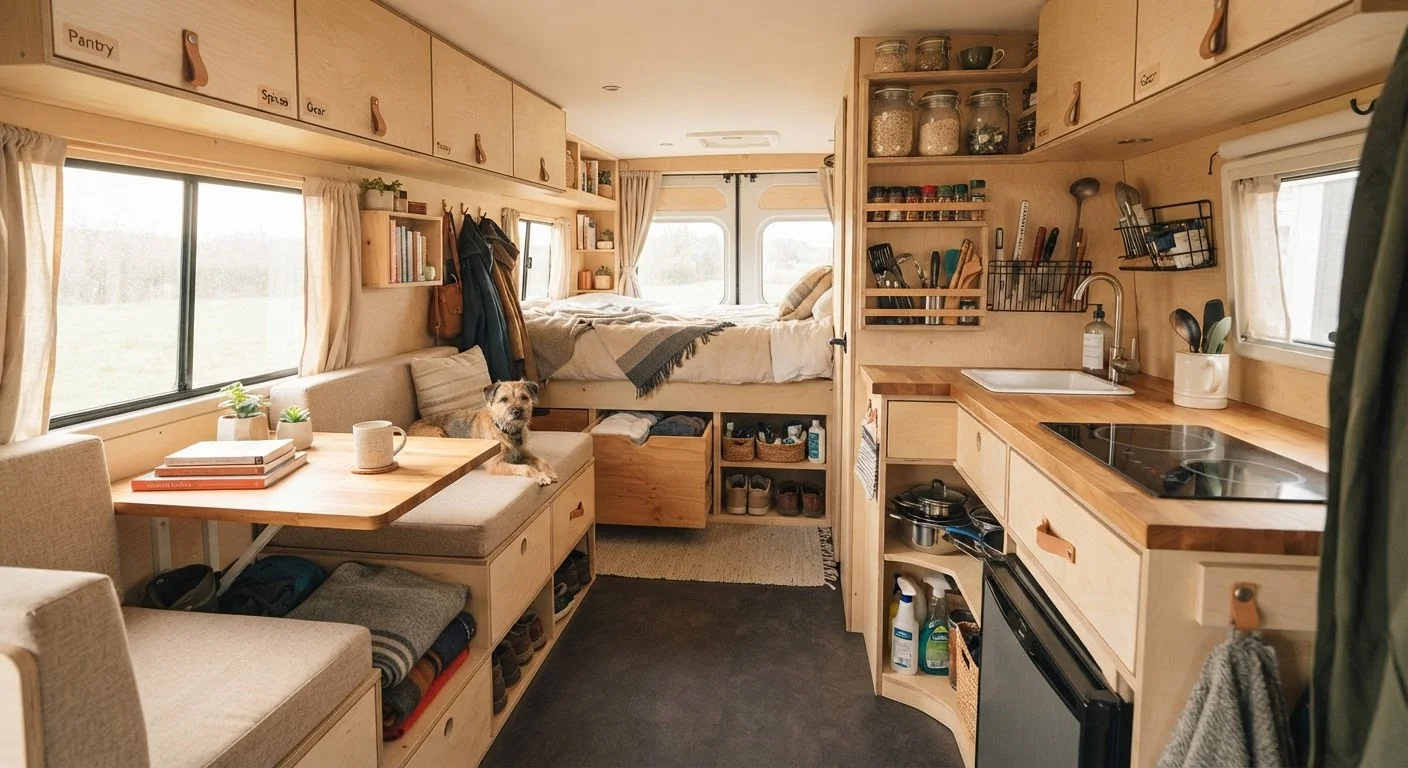
Most factory RV interiors use horizontal shelf space well but leave vertical wall runs underutilized. Tension rods mounted inside cabinet doors can hold spray bottles, cleaning supplies, or foil rolls. Adhesive-backed hooks rated for RV vibration (check the weight limit carefully) work on cabinet sides, the backs of bathroom doors, and slide-out walls.
Magnetic spice strips or knife bars - common in small apartment kitchens - translate well to RV galley walls, keeping cooking essentials accessible without consuming counter space. In the bedroom, vertical fabric organizers hung from overhead cabinet handles or wall hooks can replace a full dresser drawer for lighter clothing items.
For context on how different kitchen layouts affect the vertical wall space you have to work with, the RV kitchen layout comparison is a useful reference.
Vertical wall runs are the most consistently underused storage real estate in RV interiors.
Rethink the Pass-Through Bay
Pass-through storage bays - the long compartments that run beneath the main floor and open on both sides - are a significant asset in larger travel trailers and fifth wheels, but they're often treated as a dumping ground. Without organization, retrieving a specific item means unpacking half the bay.
Dedicated rolling bins or hard-sided totes sorted by category (electrical/power, outdoor gear, leveling equipment, tools) make the bay genuinely functional. Label each bin on both the lid and the side so you can identify contents without pulling everything out. A portable LED strip light adhered to the bay ceiling costs little and eliminates the flashlight dependency that slows down setup and breakdown at camp.
Heavy items - fresh water hoses, leveling blocks, wheel chocks - belong toward the center of the bay for weight distribution. Lighter, more frequently accessed items go near the door.
Sorting pass-through bay contents into labeled bins transforms setup and breakdown time at camp.
Optimize Under-Bed Storage Systematically
Under-bed compartments vary considerably by RV class and floor plan. In many travel trailers and Class C motorhomes, the bed lifts on a pneumatic or manual hinge to reveal a full-width storage well - one of the largest single storage areas in the rig. In others, access is through exterior doors only.
Either way, under-bed space benefits from the same tote-and-label approach used in the pass-through bay. Vacuum compression bags work well here for seasonal clothing, extra bedding, or items that compress without damage. Avoid storing anything sensitive to temperature extremes in this location, as under-bed compartments are often less insulated than the main living area.
If you're comparing RV classes and under-bed storage capacity is a priority, the RV classes comparison breaks down how storage varies across Class A, B, and C motorhomes and common towable types.
Vacuum compression bags in under-bed compartments can double the effective storage volume for soft goods.
Choose Collapsible and Multi-Use Gear
Fixed-volume items - rigid colanders, nested but still bulky pot sets, single-purpose gadgets - consume disproportionate cabinet real estate relative to how often they're used. Silicone collapsible versions of kitchen staples (colanders, measuring cups, mixing bowls, dish racks) fold to roughly one-quarter of their expanded size and stack flat in a single drawer.
The same principle applies beyond the kitchen. A folding step stool replaces a fixed one. A compact multipurpose tool replaces several single-use items. Nesting cookware with removable handles stores in a fraction of the space of traditional sets. Each swap is small, but across an entire rig the cumulative space recovery is substantial.
Multi-use furniture extends this logic to the living area: benches with interior storage, ottomans that open for blanket storage, and fold-down tables all reduce the number of dedicated pieces competing for floor space.
Replacing just five fixed-volume kitchen items with collapsible versions can free an entire cabinet shelf.
Design a Dedicated Spot for Daily-Use Items
The fastest way to create visual clutter in a small RV is to leave daily-use items without a permanent home. Keys, phones, sunglasses, medications, dog leashes, and outdoor footwear accumulate on counters and seats because no intentional landing zone exists for them.
A small entryway caddy, a mounted hook rail near the door, or a shallow tray on a fixed surface creates a home base for these items. The discipline isn't difficult to maintain when the spot is genuinely convenient - it only breaks down when the designated location is inconvenient or doesn't accommodate the actual items being used.
This approach is especially relevant for RVers who work remotely from their rig. A dedicated workspace with organized cable management and a consistent spot for work equipment prevents work gear from spreading across the living area. The remote work in an RV guide covers workspace planning in more depth.
A designated landing zone for daily-use items is the simplest way to prevent chronic counter clutter.
Putting It All Together
Effective RV storage isn't a one-time project - it's a habit of regular reassessment. What works when you're weekend camping may need adjustment during extended travel or full-time living. Revisit your setup after every significant trip and eliminate anything that hasn't been touched.
Reassess Storage Every Few Trips
Living patterns shift - a dish you packed for occasional use may become a staple, or gear you assumed was essential may go untouched for months. A fifteen-minute storage review after every two or three trips keeps the rig calibrated to how you actually live in it, not how you planned to. Small adjustments made consistently are easier than a full overhaul once clutter has accumulated.
If you're still in the layout selection phase, evaluating storage capacity before purchase is far easier than retrofitting later. Our guide on thinking through storage in an RV layout walks through how to read a floor plan for real-world storage potential. And if you share your rig with pets, factor in their gear when calculating usable space - the RV living with pets guide covers practical approaches for animals on the road.