The Reputation vs. the Reality
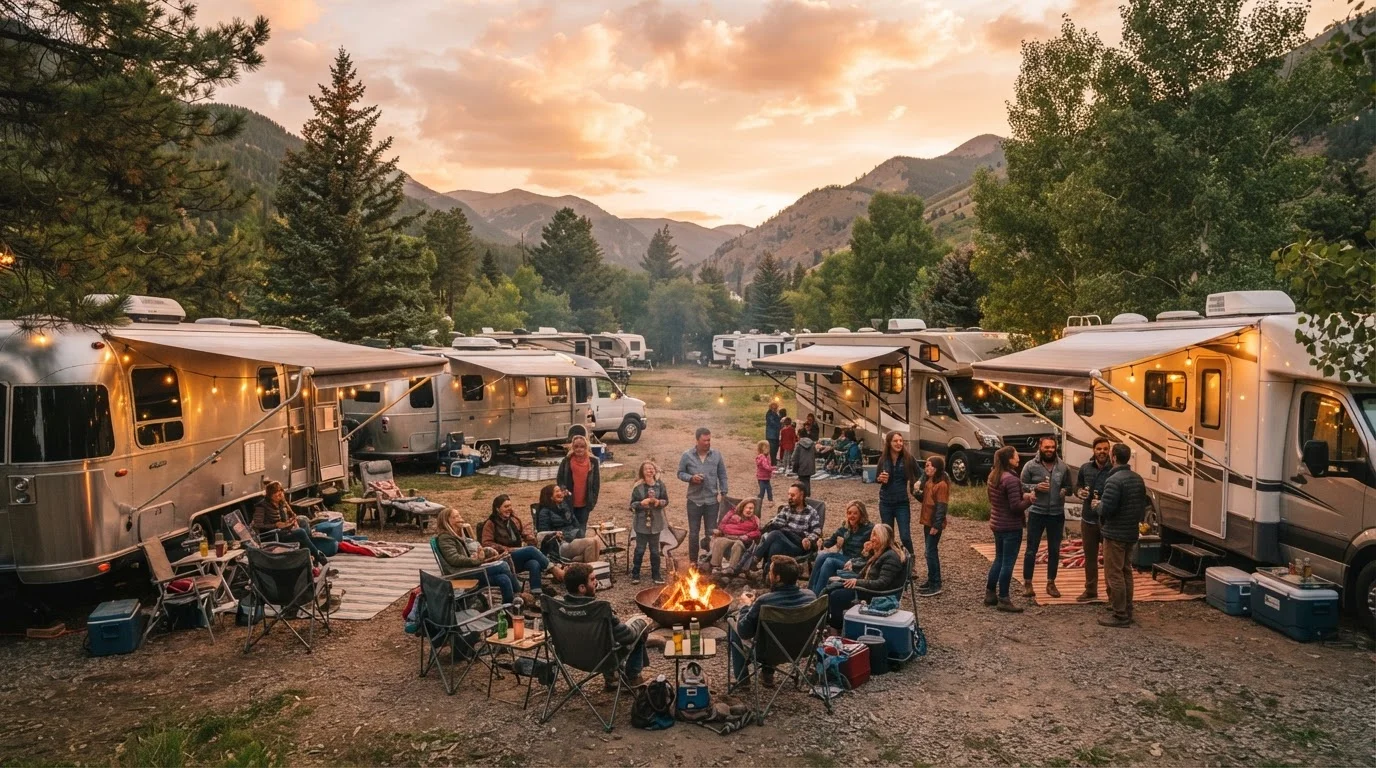
RV culture carries a well-worn reputation: pull into any campground, and you'll be greeted by friendly neighbors sharing fire rings, swapping stories, and offering insider tips on the next great destination. That image isn't entirely wrong-but it's selective. The actual social experience of RV life is far more varied, shaped by campground type, rig size, travel style, and the simple fact that not every traveler is looking for the same thing.
Understanding that gap between expectation and experience is genuinely useful before you commit to full-time or part-time life on the road. If you go in expecting a built-in social life, you may feel blindsided by the stretches of solitude. If you expect isolation, you may miss the very real community that's there to be found-just not always in the obvious places.
For a broader look at what day-to-day RV life actually involves, see our honest breakdown of full-time RV living.
Myth
Pull into any campground and you'll instantly have a circle of friends-RV communities are inherently social.
Fact
Social connection in RV life is available but not automatic. It depends heavily on campground type, your travel style, and the effort you invest.
Some campgrounds-particularly full-service resorts with organized activities-do foster spontaneous socializing. But many RVers stay at quieter sites, travel off-season, or simply prefer to keep to themselves. The community is there if you seek it out, but assuming it will find you is a setup for disappointment.
Myth
Full-timers are always part of a tight-knit nomadic tribe, traveling in coordinated groups.
Fact
Most full-time RVers travel independently, and group caravanning-while it exists-is a deliberate choice, not the default mode.
Caravanning requires significant coordination around timing, destinations, and pace. Many full-timers value the flexibility to change plans spontaneously, which is harder to do when traveling with others. Those who do travel in groups typically organize through online communities rather than meeting by chance at a campground.
Myth
RV neighbors always share campfire tips, food, and supplies-a generous culture of mutual aid.
Fact
Helpfulness is common in the RV community, but it isn't universal, and expecting generosity from strangers can create awkward dynamics.
Many experienced RVers are genuinely willing to offer advice or lend a hand in a mechanical pinch. But they're also on vacation or managing their own schedules, and the degree of neighborliness varies widely by individual. Approaching interactions with courtesy rather than expectation tends to produce far better outcomes.
Myth
Staying connected while traveling means relying on campground Wi-Fi, which is usually adequate.
Fact
Campground Wi-Fi is notoriously inconsistent and is rarely sufficient for remote work, video streaming, or reliable communication.
Shared campground networks often struggle under the load of dozens of simultaneous users. RVers who need dependable connectivity-especially those working remotely-typically rely on cellular data plans, signal boosters, or satellite internet solutions. See our guide on internet options for RVers by region for a practical breakdown. Our article on working remotely from an RV addresses the full connectivity picture for location-independent workers.
Myth
RV culture is uniform across the country-the same community norms apply everywhere.
Fact
RV culture varies significantly by region, campground type, and even rig class. Norms in one setting may not transfer to another.
A Class A motorhome resort in Florida caters to a very different demographic than a dispersed campsite in the Southwest. Age, travel purpose, rig type, and regional culture all shape the social environment. Approaching each new setting with fresh observation rather than fixed assumptions leads to more genuine connections and fewer misunderstandings.
Where Community Actually Forms
Campground neighbors are one source of social connection-but rarely the most reliable one. The RVers who build the strongest networks tend to do it through structured channels: organized rallies, brand-specific gatherings (common among owners of particular coach types), and digital communities that coordinate meetups in advance.
11M+
US households that own an RV
According to the RV Industry Association, RV ownership has grown substantially over the past decade, reflecting the expanding base of potential community members.
1M+
Estimated full-time RV residents in the US
Industry observers and RV advocacy groups estimate that over one million Americans live in RVs full-time, though precise figures are difficult to verify given the mobile nature of this population.
Online forums, Facebook groups, and dedicated RV apps have become primary social infrastructure for many travelers. These platforms allow RVers to arrange caravanning trips, share campsite reviews, and coordinate arrivals at the same location-transforming what might otherwise be anonymous campground stays into genuine reunions.
Rallies deserve specific mention. Regional and national RV rallies attract thousands of attendees and offer structured programming alongside organic socializing. They're among the fastest ways for newcomers to build a network, especially if you attend with a specific interest-amateur radio, quilting, woodworking-that intersects with organized group activities.
The contrast with more traditional vehicle communities is instructive. Car clubs operate on formal membership structures, while RV community tends to be more fluid and self-organized-which lowers the barrier to entry but also means it requires more personal initiative to find your people.
Etiquette, Boundaries, and the Unwritten Rules
One persistent misconception is that campground life operates on a universally understood code of neighborly conduct. In practice, norms shift considerably between campground types. A busy KOA on a holiday weekend operates very differently from a quiet state park or a remote Bureau of Land Management dispersed site.
Don't Assume Your Norms Are Universal
Arriving at a new campground and immediately playing music, running a generator, or letting pets roam off-leash can create friction with established campers. Policies and informal norms differ at every site. Take 15-20 minutes to observe the setting and review posted rules before settling in. When in doubt, err toward quieter and more contained behavior until you have a clearer read on the environment.
Noise hours, generator use policies, pet rules, and expectations around shared spaces all vary-and written campground rules only capture part of the picture. Observational awareness matters: watching how established campers behave in a given setting is often more informative than any posted sign.
If you're weighing the social trade-offs between campground stays and more remote camping, our article on boondocking vs. campground living covers the practical differences in depth. Solitude and community aren't mutually exclusive-but they do require intentional choices about where and how you park.
For beginners navigating these norms for the first time, our fundamentals guide for new RVers addresses campsite etiquette alongside the mechanical and logistical basics.