Why Pedal Choice Matters More Than It Looks
Pedals are where your body meets the bike. Along with the saddle and handlebars, they form one of three contact points that determine comfort, control, and how efficiently your effort translates into forward motion. Yet pedal selection is often an afterthought - most bikes ship with basic platform pedals, and many riders never revisit the decision.
Understanding the differences between pedal types, and the cleat systems designed to work with them, helps you match your setup to your actual riding. Whether you're commuting, riding gravel, or logging road miles, the pedal-and-shoe interface has a measurable effect on performance and day-to-day usability. This pairs directly with other drivetrain decisions - see how your drivetrain transfers power for broader context on the mechanical chain from legs to wheel.
The Four Main Pedal Systems Compared
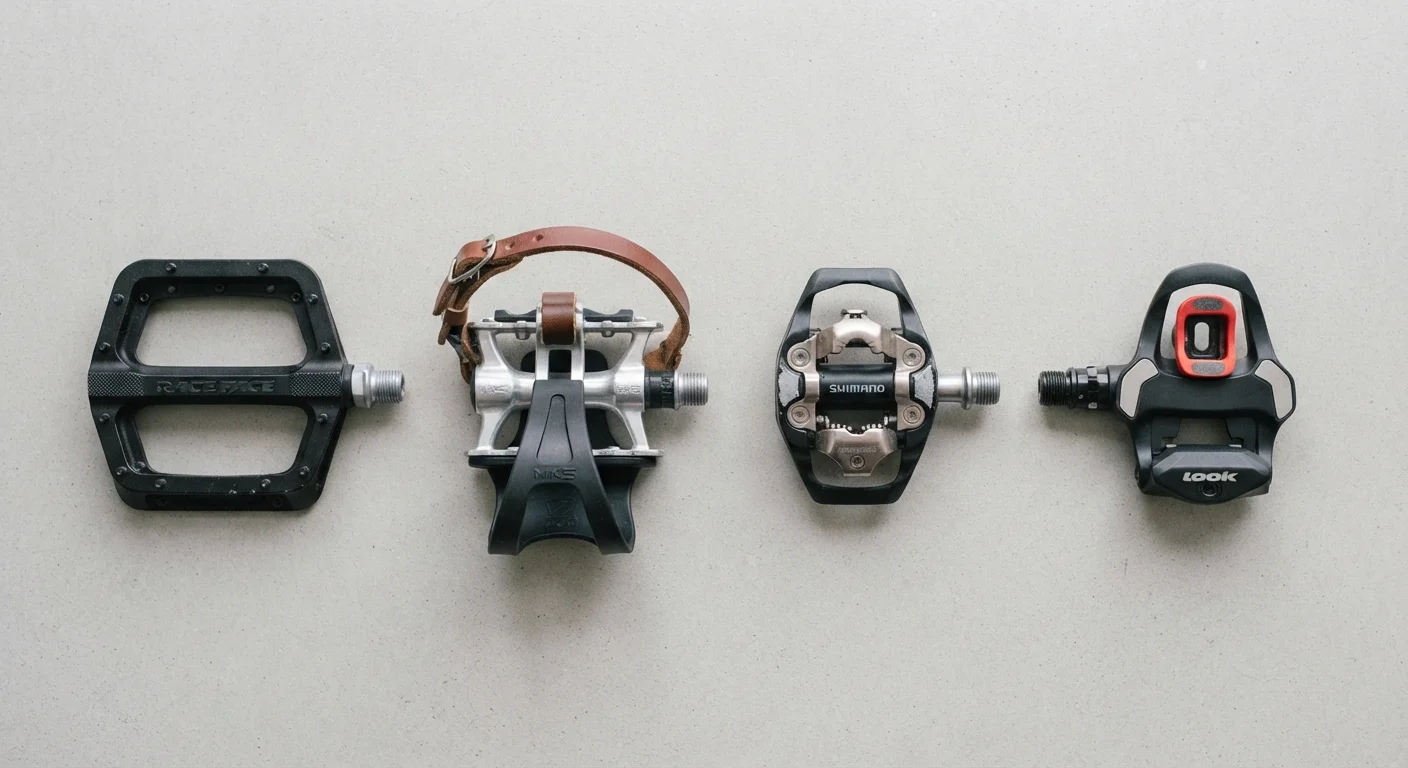
Each pedal type occupies a distinct position in the market, defined by shoe compatibility, retention method, and the rider profile it suits best.
| Flat Pedal | Toe Clip & Strap | SPD Two-Bolt | Three-Bolt Road | |
|---|---|---|---|---|
| Shoe requirement | Any shoe | Any shoe | SPD-compatible shoe | Road cleat shoe |
| Walkability | Excellent | Good | Good (recessed cleat) | Poor (protruding cleat) |
| Power transfer | Low | Moderate | Good | High |
| Entry/exit ease | No engagement | Moderate | Easy once practiced | Easy once practiced |
| Typical use | Casual, urban, MTB | Urban, touring | Gravel, commute, MTB | Road, racing |
| Float options | N/A | N/A | 0°, 2°, 6° (varies) | 0°, 4.5°, 9° (varies) |
Flat Pedals
Flat or platform pedals accept any shoe - sneakers, boots, sandals. They offer zero mechanical retention, meaning your foot can slide or come off the pedal freely. For casual riding, urban commuting, and riders who stop frequently, this freedom is a genuine advantage. Aggressive flat pedals designed for mountain biking use metal pins to grip shoe soles, providing surprising traction without any cleat system.
Toe Clips and Straps
Toe clips are cages that mount to the front of a flat pedal and partially enclose the foot. A strap cinches around the top of the shoe. This system pre-dates modern clipless pedals and was the standard for serious cycling through the 1980s. It works with ordinary shoes, though performance-oriented riders often used leather-soled cycling shoes with it. Entry and exit are less reliable than modern clipless systems, particularly at speed, but toe clips remain practical for urban riders who want light retention without buying dedicated footwear.
SPD Two-Bolt Clipless Pedals
Shimano Pedaling Dynamics (SPD) is the dominant two-bolt cleat standard and has been widely adopted beyond Shimano's own pedals - many competing systems use the same cleat interface. The metal cleat recesses into the shoe sole, making the shoe walkable. SPD pedals are frequently double-sided, meaning you can clip in from either face, which is practical for commuting and touring. The system suits gravel, cyclocross, and mixed-terrain riding well - an important consideration if you're choosing a bike for varied routes.
Three-Bolt Road Clipless Pedals
Road cleat systems - including the common Look Keo and Shimano SPD-SL standards - use a larger, triangular three-bolt cleat that mounts flush with the shoe sole. The larger cleat spreads pedaling load over more surface area, which many riders find improves power transfer and reduces hot spots on long rides. The trade-off is that the cleat protrudes from the shoe sole, making walking awkward and increasing wear on the cleat itself. These systems are designed for cyclists who move directly from bike to bike stand without significant walking.
New to Clipless? Start Double-Sided
If you're transitioning from flat pedals to clipless for the first time, a double-sided SPD pedal reduces the frustration of searching for the correct face when clipping in. Practice clipping and unclipping while stationary - ideally near a wall for balance - before riding in traffic or technical terrain.
Cleat Float and Knee Health
Float refers to how much rotational movement your foot is allowed while clipped in before the cleat releases. Most clipless systems offer cleats in multiple float levels - commonly 0°, 4-6°, and 9° - indicated by color coding that varies by manufacturer.
Fixed (zero-float) cleats lock the foot in one precise angle. This suits riders whose natural foot position aligns with the fixed angle, but it can stress knees if the alignment is off. Cleats with float allow small corrections throughout the pedal stroke, accommodating the natural variation in how feet move. For most riders, starting with a mid-float cleat and adjusting from there is a reasonable approach.
Don't Ignore Knee Pain from Cleats
Pain behind or around the kneecap is a common early signal of poor cleat alignment or inappropriate float. Riding through persistent knee discomfort risks turning a fit issue into an overuse injury. Stop and reassess cleat position, or seek guidance from a qualified bike fitter before continuing high-volume training.
Cleat position on the shoe - fore-aft, lateral, and rotational - also affects comfort. A misaligned cleat can cause knee pain, hot spots, or hip discomfort over longer rides. If you're new to clipless pedals, take time to position cleats carefully and build mileage gradually before assessing fit.
Matching Pedal Type to Riding Style
The practical question isn't which system is objectively best - it's which fits your actual routine. Consider how often you walk in your cycling shoes: if you're locking a bike and heading into a coffee shop, a stiff road shoe with a protruding cleat is a liability. SPD shoes with recessed cleats handle that transition far more gracefully.
Discipline matters too. Cyclocross and gravel riders often run SPD or compatible two-bolt systems because they may need to run sections of trail on foot. Road cyclists focused on efficiency tend to favor three-bolt systems for their larger cleat interface. Mountain bikers frequently use flat pedals or SPD-style systems depending on riding style and terrain. For riders exploring how different bike styles align with different systems, understanding how cyclocross, gravel, and adventure bikes differ is a useful starting point.
E-bike riders should also consider that pedal-assist systems interact with how and when you pedal - the sensor type matters as much as the pedal interface. Pedal-assist vs. throttle delivery is worth reviewing if you're fitting clipless pedals to an e-bike.
This article is for informational purposes only. Cleat positioning and bike fit can affect physical comfort and injury risk; if you experience persistent pain, consult a qualified bike fitter or sports medicine professional.