
Why Operating Environment Is the First Specification
Before horsepower ratings, seating capacity, or towing packages enter the conversation, a single question should anchor every boat purchase: where will this vessel primarily operate? The physical characteristics of your water - fetch length, wave height, tidal exposure, water salinity, and typical weather patterns - determine which hull geometries, materials, and propulsion systems are genuinely appropriate versus dangerously mismatched.
Inland bodies of water such as lakes, ponds, rivers, and reservoirs generally produce short, low-amplitude waves with limited fetch. Coastal and offshore environments generate longer swells, tidal currents, wind chop, and conditions that can shift dramatically within hours. A vessel designed for the former may become unstable or unsafe in the latter. Understanding this distinction before evaluating any specific model is foundational to making a sound decision. For a broader look at how environment shapes equipment choices, see how freshwater and saltwater boating compare.
Matching Hull Design to Water Conditions
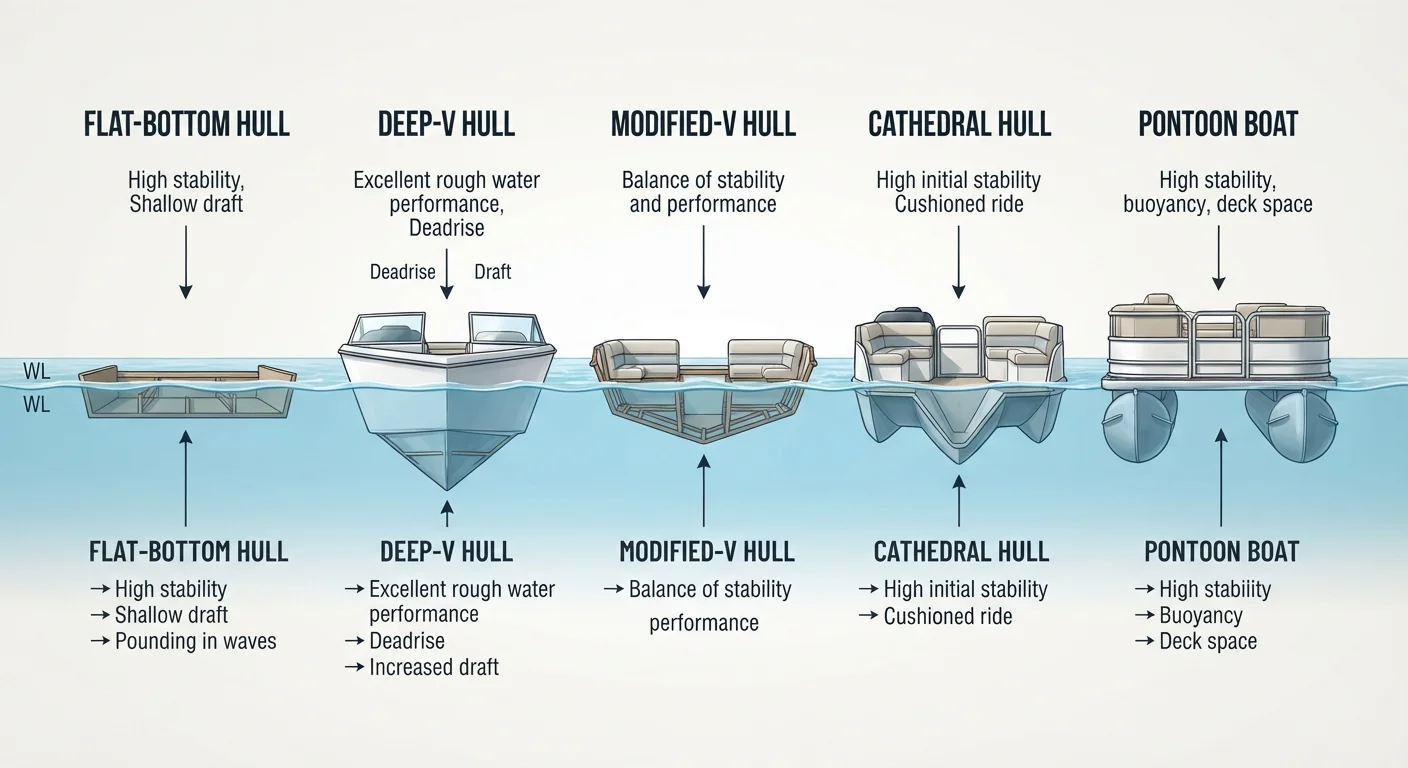
Hull geometry is the single most consequential variable in this decision. Each hull form performs a specific function tied directly to wave energy and water behavior.
Choose a flat-bottom or modified-V hull for sheltered inland waters with minimal wave action.
Flat-bottom hulls provide maximum stability and interior space on calm surfaces and reach plane quickly at lower horsepower. They are optimized for conditions where wave height is consistently low and fetch is limited, making them efficient and cost-effective for lakes and slow rivers.
Specify a deep-V hull with a deadrise angle of at least 18-20 degrees for coastal or offshore use.
Deep-V hulls slice through oncoming waves rather than slamming across them, reducing hull stress and passenger fatigue in open-water conditions. The steeper the deadrise angle, the more pronounced this wave-penetrating behavior becomes, which is essential when swells exceed two feet.
For mixed-use environments - large inland lakes, bays, or coastal estuaries - evaluate a modified-V or semi-V hull as a practical compromise.
Modified-V hulls blend some of the stability advantages of a flat bottom with improved rough-water handling. They suit buyers who primarily use calm water but occasionally encounter chop from boat traffic or afternoon winds on large bodies of water.
Assess freeboard height relative to the largest waves you are likely to encounter in your operating area.
Freeboard - the distance from the waterline to the top of the hull - determines how much wave energy can break over the side. Low-freeboard designs are acceptable on protected water but risk swamping in open coastal conditions where wave heights can exceed the hull's reserve buoyancy.
Match the vessel's USCG capacity plate and safety ratings to the maximum conditions you expect to operate in.
The U.S. Coast Guard requires capacity plates on most monohull boats under 20 feet, specifying maximum persons, weight, and horsepower. These ratings reflect design limits under specific conditions - they are not performance targets. Operating near maximums in rough offshore conditions compounds risk substantially.
Buyers who operate primarily on protected inland waters have wider latitude to prioritize cockpit space, shallow-water draft, and economy. Those venturing into coastal bays, inlets, or open ocean should treat hull performance in a seaway as a non-negotiable baseline - everything else is secondary. The complete guide to watercraft features covers hull classifications in greater depth alongside propulsion and safety systems.
Engine and Fuel Considerations by Environment
Operating environment also shapes propulsion requirements in practical ways. Inland boaters on smaller bodies of water typically deal with shorter run distances, lower sustained speeds, and easy return-to-dock logistics. Outboard motors dominate this segment because they offer straightforward maintenance access, shallow-water tilt capability, and broad horsepower options. For a detailed breakdown, outboard vs. inboard engine differences is a useful reference.
Offshore operation introduces longer distances from shore, sustained higher speeds to navigate swells efficiently, and significantly greater fuel demands. A deep-V hull running in 3- to 4-foot ocean chop burns substantially more fuel than the same engine powering a flat-bottom hull across a glassy lake. Fuel tank sizing and range planning become safety concerns, not just convenience factors. Fuel tank sizing and range planning deserves careful attention before any offshore trip.
Material and Corrosion Factors for Saltwater Use
Saltwater accelerates corrosion on virtually every metal component aboard a vessel - fasteners, fittings, engine parts, trailer hardware, and electronics housings. Boats marketed specifically for saltwater use typically incorporate marine-grade aluminum alloys, stainless steel hardware, anodized or powder-coated finishes, and sealed electrical connectors. Freshwater-oriented vessels may use less expensive materials that will degrade quickly in a saline environment.
This is not merely a maintenance issue; it affects long-term structural integrity and resale value. Buyers considering occasional crossover use between environments should review how specifications shift. How boat specs shift between freshwater and saltwater environments walks through the key material and component differences in detail.
Occasional Crossover Use Carries Real Risk
Many buyers plan to use an inland-configured boat for occasional coastal trips, assuming mild weather will make it manageable. Coastal conditions can change rapidly regardless of the forecast, and a hull not designed for open-water swells provides little margin for error. If there is any realistic chance of offshore or large-bay operation, specifying a vessel appropriate for that environment from the outset is the safer and more practical approach.
Avoiding a mismatch between vessel and environment is discussed thoroughly in why mismatched vessel choice frustrates owners - a useful read before finalizing any purchase decision.