Orientation: The Language of Boat Anatomy
Before inspecting any vessel, you need a shared vocabulary. Boating terminology is precise by necessity - on the water, miscommunication carries real consequences. Whether you're reviewing a boat specification sheet, shopping a listing, or speaking with a marine surveyor, fluency in the core terminology puts you on solid footing.
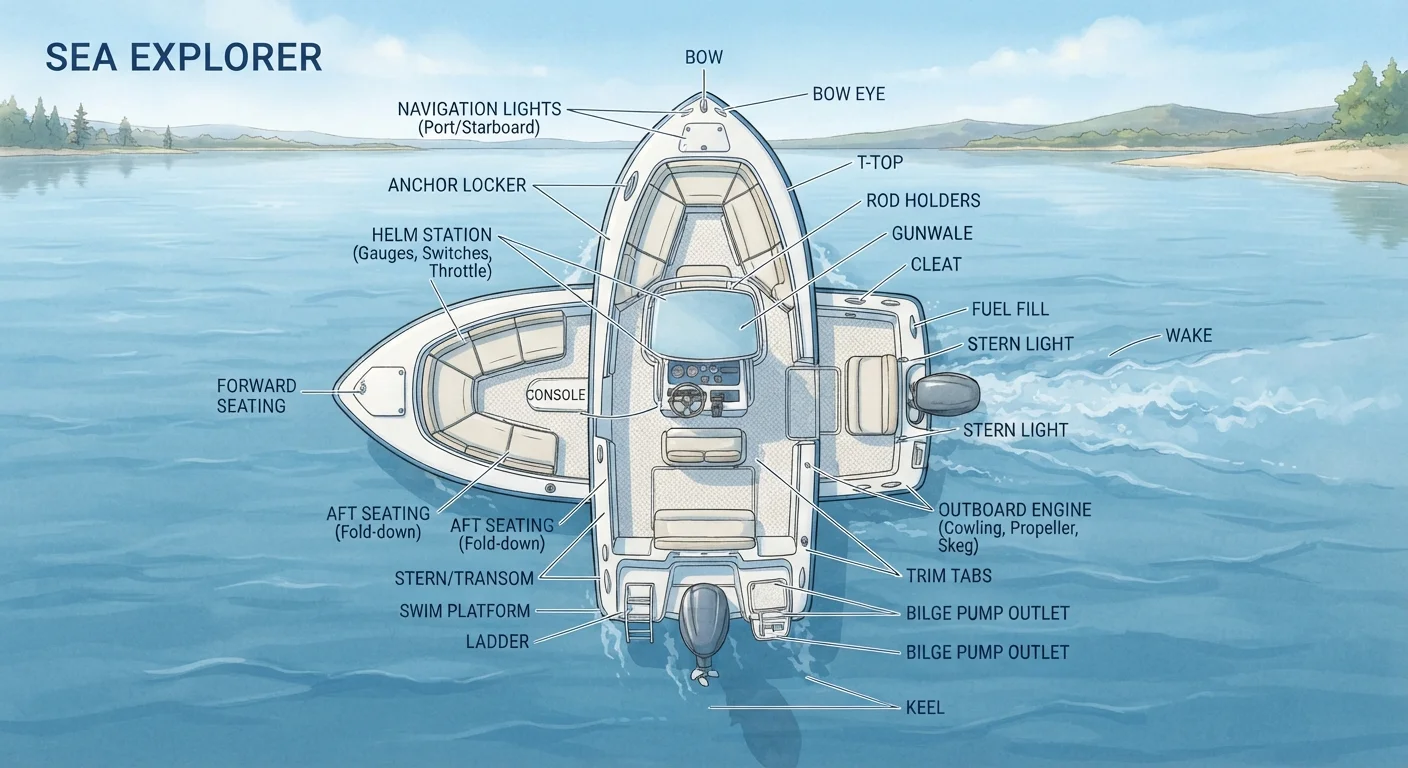
Every boat is divided into directional zones. Bow is the front of the vessel; stern is the rear. When facing forward (toward the bow), port is left and starboard is right - these designations remain fixed regardless of which way you're looking. Fore means toward the bow; aft means toward the stern. These four reference directions appear constantly in manuals, charts, and dockside conversation.
Bow
The forward-most section of the hull. When docking or anchoring, the bow is typically the reference point for approach angles.
Stern
The rearmost section of the boat. The transom, motor mount, and swim platform are typically located at the stern.
Freeboard
The vertical height of the hull side above the waterline. Higher freeboard generally means a drier ride in rough conditions and greater reserve buoyancy.
Bilge
The lowest interior compartment of the hull where water accumulates. A bilge pump removes this water to keep the vessel safe and dry.
Transom
The flat, vertical panel closing the stern of the hull. It is the standard mounting point for outboard motors and swim platforms.
Gunwale
Pronounced 'gunnel,' this is the upper edge of the hull's side. It often supports grab rails, rod holders, and cleats.
Keel
The structural spine running along the centerline of the hull bottom. It provides directional stability and, on sailboats, lateral resistance to prevent leeway.
Rode
The total anchor line system, typically a combination of chain and nylon rope connecting the anchor to the vessel's bow cleat.
Hull, Deck, and Structural Components
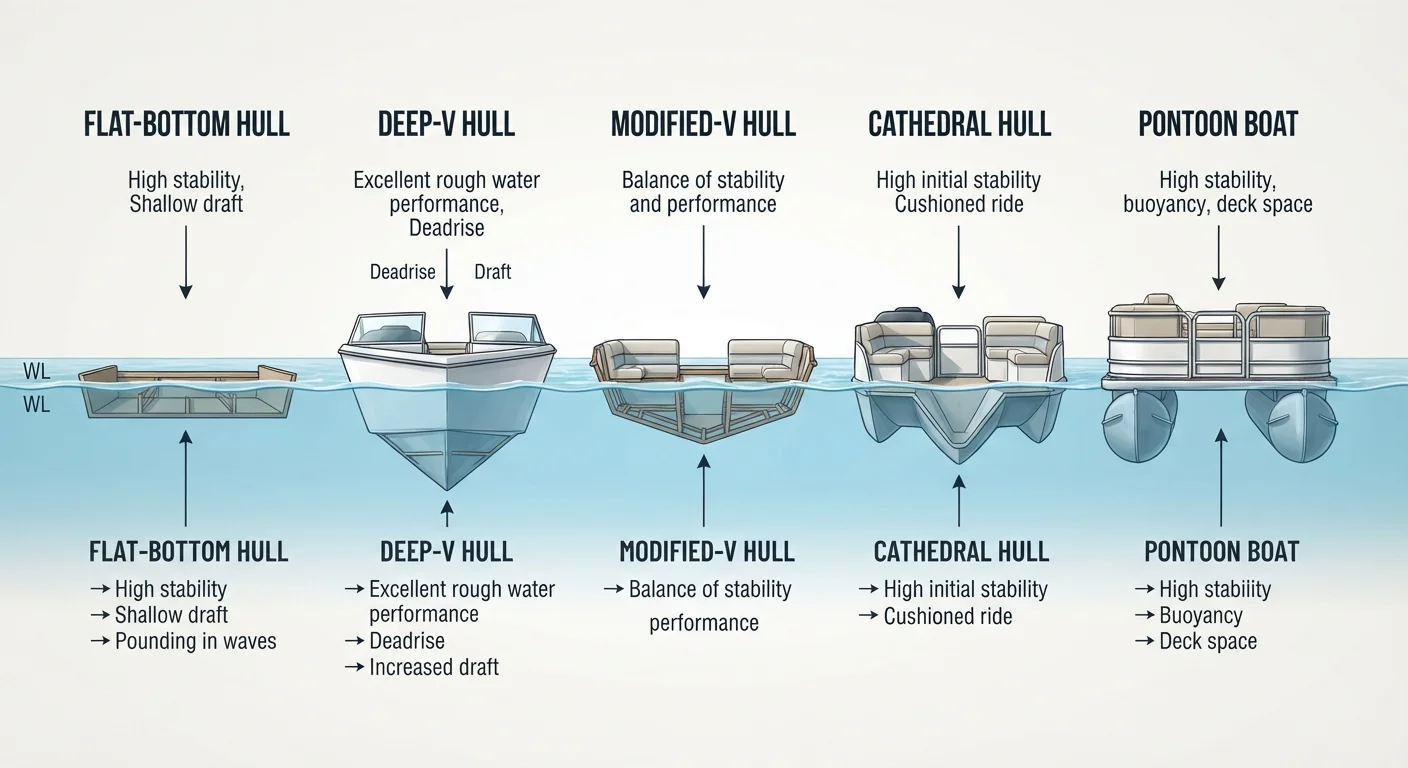
The hull is the watertight shell that keeps a boat afloat. Its shape - whether flat-bottomed, V-shaped, or multi-hull - determines how the vessel handles in different sea conditions. For a deeper look at how hull geometry affects performance, see our guide to how propulsion systems shape hull design.
Key structural terms include:
- Keel - the longitudinal spine running along the bottom centerline, providing directional stability.
- Transom - the flat vertical surface at the stern, often where outboard motors are mounted.
- Gunwale (pronounced "gunnel") - the upper edge of the hull's side, forming the rail you grip or lean against.
- Freeboard - the vertical distance between the waterline and the gunwale; more freeboard means drier passage in chop.
- Bilge - the lowest interior section of the hull, where water collects and is removed by a bilge pump.
The deck is the horizontal surface you walk on. On larger vessels, the deck may include a cockpit (the recessed working or seating area), a helm station (where steering controls are located), and a foredeck (the flat area forward of the cabin or console).
| Forward direction | Bow (front of vessel) |
| Rear direction | Stern |
| Left side (facing forward) | Port |
| Right side (facing forward) | Starboard |
| Hull bottom spine | Keel |
| Stern flat panel | Transom |
| Hull upper edge | Gunwale (gunnel) |
| Water collection point | Bilge |
Propulsion, Steering, and Running Gear
A boat's propulsion system converts engine power into forward thrust. The core components vary by configuration - outboard, inboard, and sterndrive systems each have distinct layouts - but several parts are universal.
- Propeller (prop) - the rotating blade assembly that generates thrust by moving water astern.
- Shaft - connects the engine to the propeller on inboard configurations.
- Rudder - a submerged blade that deflects water flow to steer the vessel; not present on all designs.
- Throttle and shift control - typically a single lever at the helm that manages engine speed and gear selection.
- Steering wheel or tiller - the helm input that turns the drive unit or rudder. Smaller boats often use a tiller - a simple arm attached directly to an outboard motor.
Understanding these components is foundational whether you're evaluating a small runabout or a larger cruiser. For a complete breakdown of how each propulsion type shapes the vessel built around it, the propulsion systems guide provides thorough coverage.
Rigging, Fittings, and Safety Features
Beyond the hull and engine, a boat carries a variety of hardware that serves navigation, docking, and safety functions.
- Cleat - a horn-shaped fitting used to secure dock lines or sheets.
- Anchor and rode - the anchor holds the vessel in place; the rode is the combination of line and chain connecting anchor to boat.
- Navigation lights - required by U.S. Coast Guard regulations for vessels operating at night or in reduced visibility. Red light marks port; green marks starboard; white marks the stern.
- Bimini top - a canvas frame-mounted sun shade mounted over the cockpit.
- Through-hull fitting - any fitting that passes through the hull below the waterline, requiring a seacock (a shutoff valve) to prevent flooding.
Sailboats add an entirely separate vocabulary of rigging. The mast, boom, stays, and sheets all appear in our overview of sailboat types and rigs. For an extended glossary covering dozens of additional spec terms, the Watercraft Features Glossary is a useful companion reference.
Terminology Varies by Vessel Type
While the directional terms (bow, stern, port, starboard) are universal, structural terminology can shift between powerboats, sailboats, and personal watercraft. A 'cockpit' on a sailboat is an open steering well aft; on a sportfishing boat it refers to the open fishing area. Always cross-reference terminology against the specific vessel type you're evaluating. The New Boater's Map to Boat Categories is a practical starting point for understanding how form and function vary by class.