Why Feature Literacy Matters Before You Shop
Walking into a boat show or browsing listings without a grasp of core watercraft features puts you at a genuine disadvantage. Salespeople speak in specification shorthand - deadrise angles, displacement ratings, NMEA 2000 networks - and every number affects how a vessel actually performs on the water you plan to use it on.
This guide walks through every major feature category systematically. Whether you are evaluating a center console, a pontoon, or a cruiser, the same analytical framework applies. For a broader orientation on vessel categories before diving into specifications, see our guide to boat categories. And if you want a vocabulary foundation first, The Anatomy of a Boat covers every structural component from bow to stern.
Hull Design and Construction
The hull is a vessel's defining structural element - it dictates seakeeping ability, fuel efficiency, maximum speed, and load capacity simultaneously.
18-24°
Typical deadrise angle for deep-V hulls
Deadrise is measured at the transom; higher angles indicate greater rough-water capability and are the industry benchmark for offshore hull classification.
16 ft
USCG vessel length threshold for additional safety requirements
The US Coast Guard uses 16 feet as a key cutoff for several equipment mandates, including throwable PFDs and visual distress signals on applicable waters.
NMEA 2000
Dominant marine electronics networking standard
NMEA 2000 is the industry-standard protocol enabling chartplotters, engines, and sensors to share data over a single backbone cable.
Common Hull Forms
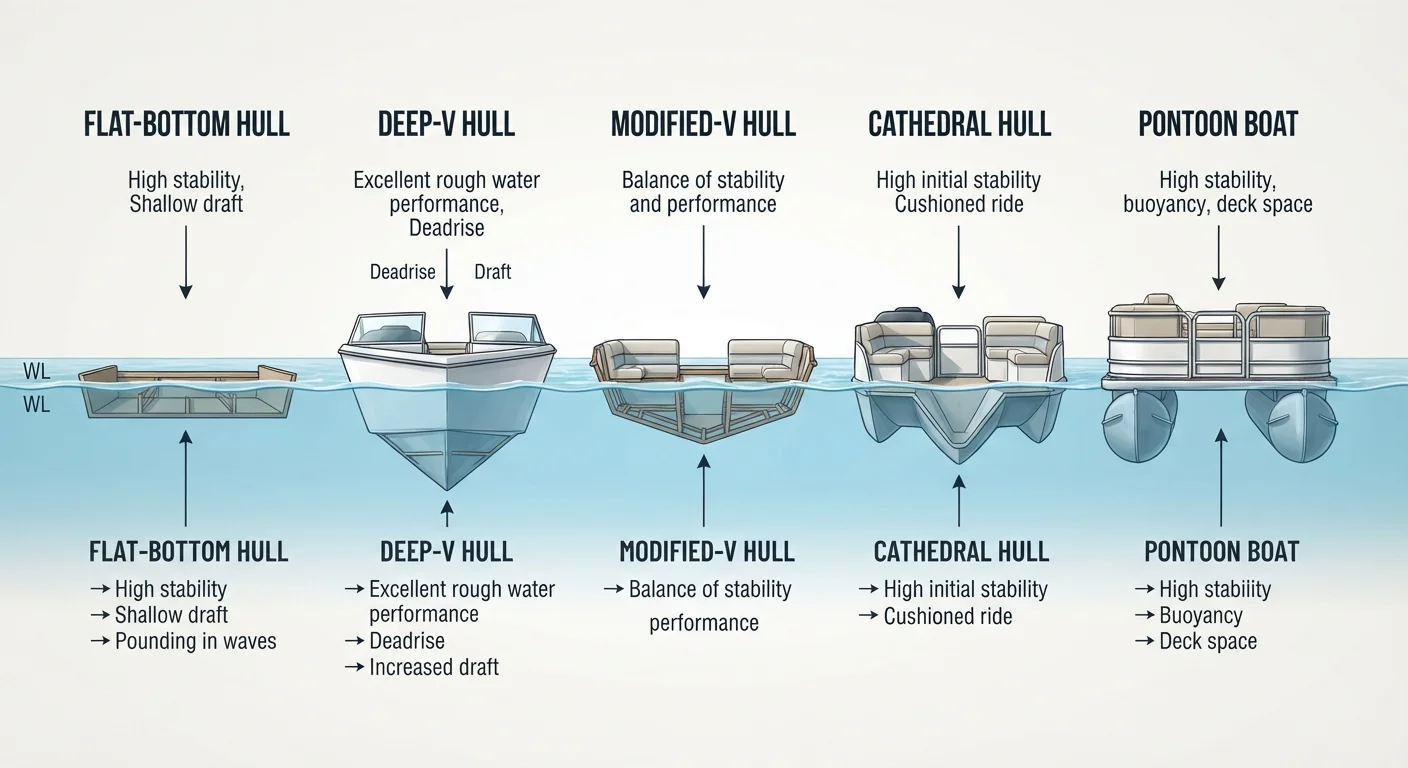
- Deep-V: A sharp deadrise angle (typically 18-24°) cleaves through chop cleanly. Preferred for offshore and rough-water use at the cost of some fuel economy at displacement speeds.
- Modified-V: Moderate deadrise delivers a compromise between the rough-water capability of a deep-V and the stability of a flat-bottomed hull - common in bay boats and multi-purpose runabouts.
- Flat-bottom / Jon: Maximum stability at rest and in calm water; highly efficient at low speeds. Suited for sheltered lakes, rivers, and marshes.
- Multi-hull (catamaran / pontoon): Wide beam creates exceptional initial stability. Pontoon boats use cylindrical tubes; performance cats use planing sponsons. Pontoon versus bowrider versus deck boat explores these distinctions in depth.
Construction Materials
Fiberglass remains the dominant material for production powerboats, offering a good strength-to-weight ratio and relatively straightforward repair. Aluminum hulls are lighter, resist corrosion in fresh water, and handle abrasion well - common in fishing, utility, and shallow-draft applications. High-end or performance vessels may use carbon fiber or composite laminates. Inspect gel coat condition, stringer integrity, and transom core for moisture intrusion when evaluating any used fiberglass vessel.
Propulsion Systems
Propulsion choice cascades into nearly every other specification - weight distribution, deck space, service accessibility, and operating range.
When comparing outboards, look at the full-throttle operating range (RPM band) in relation to your hull's recommended range - an over- or under-propped engine loses efficiency and strains components.
Propeller pitch directly controls where the engine operates in its power band; mismatches are one of the most common causes of underperformance on production boats fitted with generic factory props.
On any sterndrive vessel you evaluate used, budget for bellows inspection and potential replacement before purchase - deteriorated bellows can flood the bilge at speed.
Bellows are a known service interval item on sterndrive systems; neglected bellows are a leading cause of preventable sinkings on this propulsion type.
Outboard Motors
Outboards mount externally on the transom and tilt clear of the water when trailering or in shallows. They dominate the recreational market because they are relatively straightforward to service and replace without a haulout. Modern four-stroke outboards meet stringent EPA emissions standards while delivering strong fuel economy.
Sterndrive (Inboard/Outboard)
The engine sits inside the hull; a drive unit passes through the transom. This configuration frees stern space and lowers the center of gravity compared with a transom-mounted outboard, but the drive leg requires periodic bellows and gimbal bearing inspection - tasks typically suited to a qualified marine technician.
Inboard and Jet Drive
Inboard shaft-drive systems are standard on ski boats, large cruisers, and many sailboats, offering centralized weight and a clean hull profile. Jet drives draw water through an intake and expel it under pressure - no exposed propeller, making them safer for swimming and effective in very shallow water. Jet systems are common on personal watercraft and some shallow-draft river vessels.
Electronics and Navigation
Modern marine electronics have converged around networked systems. Most current-generation equipment communicates over an NMEA 2000 backbone, meaning a chartplotter, engine display, autopilot, and AIS transponder can share data across a single bus.
Core Electronics to Evaluate
- Chartplotter / Multifunction Display (MFD)
- Combines GPS navigation with mapping data. Screen size, chart library, and update policy matter more than brand. Confirm whether the unit supports NMEA 2000 integration.
- VHF Radio
- Required safety equipment on many vessel classes and the primary maritime distress communication channel. Digital Selective Calling (DSC) capability, which requires a registered MMSI number, enables one-button distress signaling.
- Depth Sounder / Fish Finder
- Transducer frequency affects resolution and depth range. High-frequency (200 kHz and above) excels in shallow water; lower frequencies penetrate deeper.
- AIS Transponder
- Broadcasts your vessel's position, speed, and identity to other AIS-equipped vessels and traffic management systems. Class B transponders are typical for recreational vessels.
MMSI Registration Is Separate from DSC Purchase
Buying a DSC-capable VHF radio is only half the step. Your vessel's Maritime Mobile Service Identity (MMSI) number must be registered with the FCC or through BoatUS/Sea Tow for the distress system to function correctly. Registration is free and takes only a few minutes online. Without a registered MMSI, a DSC distress call cannot be traced to your vessel.
Safety Systems and Regulatory Equipment
The US Coast Guard classifies vessels by length and sets minimum safety equipment requirements for each class. These are legal minimums - not recommendations - and they apply regardless of how short your trip is.
Capacity Plates Are Legal Limits, Not Targets
Every federally regulated recreational vessel under 20 feet carries a USCG-compliant capacity plate specifying maximum persons, weight, and engine horsepower. These are hard ceilings, not guidelines. Exceeding them voids insurance coverage, creates legal liability in an incident, and - most critically - degrades vessel stability in ways that may not be immediately obvious until conditions deteriorate.
Required and Recommended Equipment
- Personal Flotation Devices (PFDs): One USCG-approved wearable PFD per person on board, plus a throwable Type IV device on vessels 16 ft and longer.
- Visual distress signals: Flares (pyrotechnic or electronic) are required on coastal and Great Lakes waters for vessels 16 ft and over.
- Fire extinguisher: Required on vessels with enclosed engine compartments, fuel tanks, or enclosed living spaces. Ratings and quantity scale with vessel class.
- Navigation lights: Required for operating between sunset and sunrise and in restricted visibility. Configuration varies by vessel type and size.
- Sound-producing device: A whistle or horn audible at least half a nautical mile.
Beyond minimums, an EPIRB is strongly advisable for any offshore or extended passage use. For foundational safety orientation, the Boating Basics hub covers licensing, safety courses, and regulatory overviews.
“The single biggest mistake recreational boaters make is treating safety equipment as a checklist afterthought rather than an integral part of the vessel evaluation. The gear you carry determines your options when something goes wrong - and something always eventually goes wrong on the water.”
— Boats & Watercraft Editorial Team, Marine industry analysts and on-water correspondents
Seating, Layout, and Storage
Raw performance specifications rarely tell you what a day on the water actually feels like. Seating configuration and storage architecture are where comfort and practical usability live.
Seating Configurations
Bow seating (lounge or forward-facing) affects social arrangement and spray exposure at speed. Helm seating ergonomics - seat height relative to wheel, bolster support for standing operation - matter enormously on rough-water days. Rear bench or lounge seating determines how many guests you can accommodate comfortably versus the legal maximum capacity plate rating.
Wet and Dry Storage
Evaluate rod locker dimensions (length and lining material for fishing applications), live well volume and aeration quality, anchor locker size relative to your ground tackle, and whether underdeck storage is drained or sealed. On cruisers and cabin boats, galley storage and berth configuration require the same scrutiny you would give a small apartment.
Use our pre-purchase evaluation checklist to work through seating, storage, and layout questions systematically before committing to any hull type.
Sit in Every Seat Before You Commit
Dealers and boat show displays make it easy to evaluate the helm, but most buyers spend more time in passenger seating than at the wheel. Sit in every position on the boat - check sightlines, bolster comfort, and proximity to cleats or hardware that could create a hazard underway. A five-minute test on a dry deck reveals ergonomic issues no specification sheet will disclose.
Putting It All Together
No single feature category stands alone. A deep-V hull optimized for offshore performance demands a matched propulsion system, adequate fuel capacity, and the electronics suite to navigate safely beyond sight of land. A pontoon configured for lake recreation prioritizes stable seating and shallow-draft handling over speed. Fishing boat styles illustrate how different intended environments drive entirely different feature priorities even within the same broad category.
Build your evaluation by starting with the water you will actually use, then match hull form, propulsion, and electronics accordingly. Safety equipment is non-negotiable regardless of that context. Seating and storage are where the day-to-day experience is won or lost. Approached this way, feature comparison becomes a structured exercise rather than an overwhelming list of specifications.
This article is for informational and educational purposes only. Equipment requirements and regulations vary by state, waterway, and vessel class. Always verify current US Coast Guard and applicable state boating authority requirements before operating a vessel.