Why Spec Terminology Matters When Buying a Watercraft
Every boat listing, manufacturer datasheet, and dealer brochure is packed with technical shorthand. Terms like deadrise, freeboard, and transom aren't marketing language - they describe measurable, functional characteristics that directly affect how a vessel performs and whether it suits your needs. Misreading or ignoring these terms can lead to purchasing a boat that's too narrow for stable fishing, too shallow-drafted for a local cove, or underpowered for the loads you intend to carry.
This glossary collects the terms you're most likely to encounter across hull specs, propulsion listings, safety gear descriptions, and on-deck feature breakdowns. For a deeper look at how these measurements are read together on an official datasheet, see our guide to reading a boat specification sheet. If you're still orienting yourself to vessel categories, The New Boater's Map to Boat Categories is a useful starting point.
| Most commonly misread spec | Beam (often confused with overall length) |
| US federal labeling requirement | Maximum Capacity Plate required on most vessels under 20 ft (U.S. Coast Guard regulations) |
| Deadrise range (typical V-hull) | 12° to 24° depending on application |
| Freeboard relevance | Higher freeboard = better offshore wave protection |
| Draft importance | Critical for shallow water, flats, and river navigation |
| Bilge pump types | Automatic electric and manual hand pump |
Core Hull and Structural Terms
Understanding the hull is foundational to evaluating any watercraft. The terms below define the physical structure and geometry buyers will encounter most often.
Beam
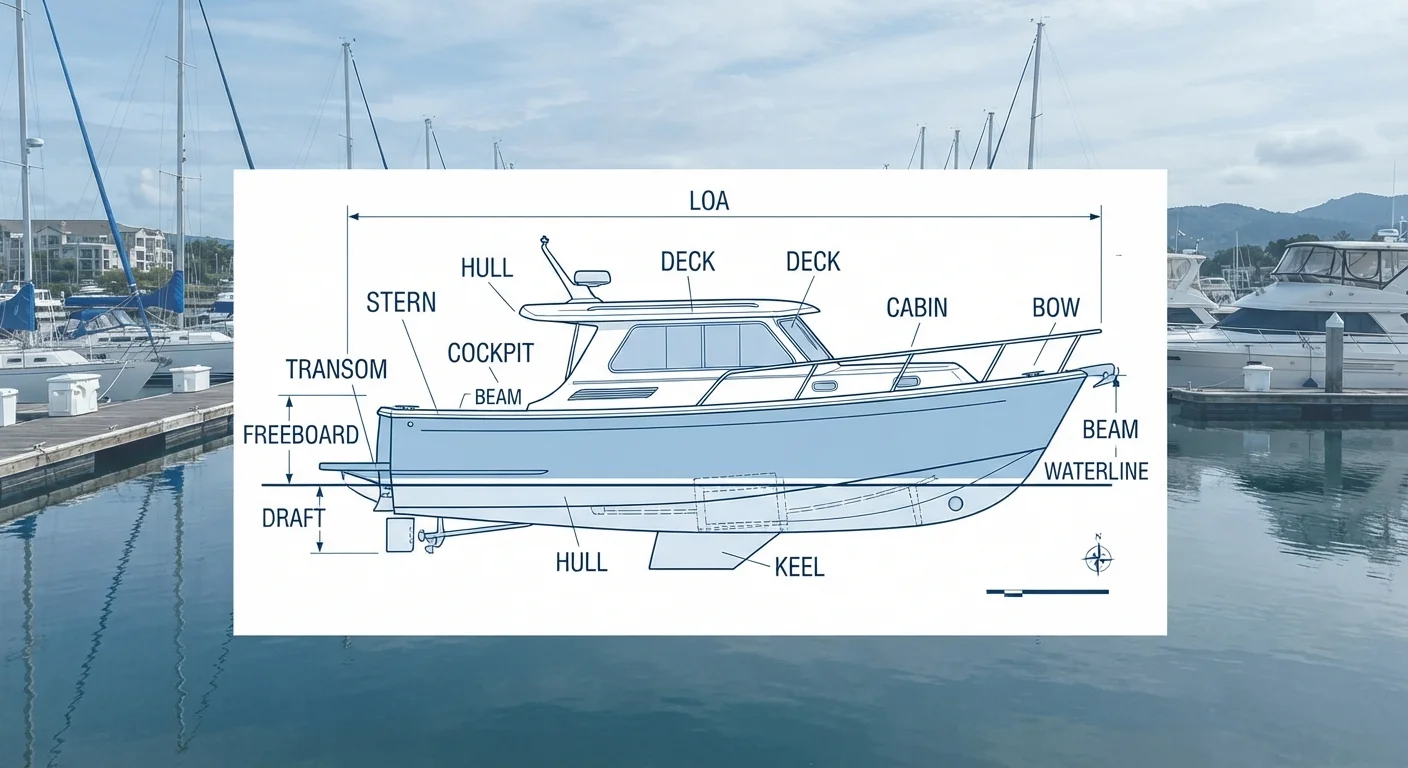
The widest measurement of a vessel, taken across the hull at its broadest point. A wider beam generally provides more stability and deck space, though it can limit access to some marinas and trailering widths.
Freeboard
The vertical distance from the waterline to the top of the hull side (gunwale). Higher freeboard offers more protection from waves and spray, which is especially relevant in offshore or rough-water conditions.
Draft
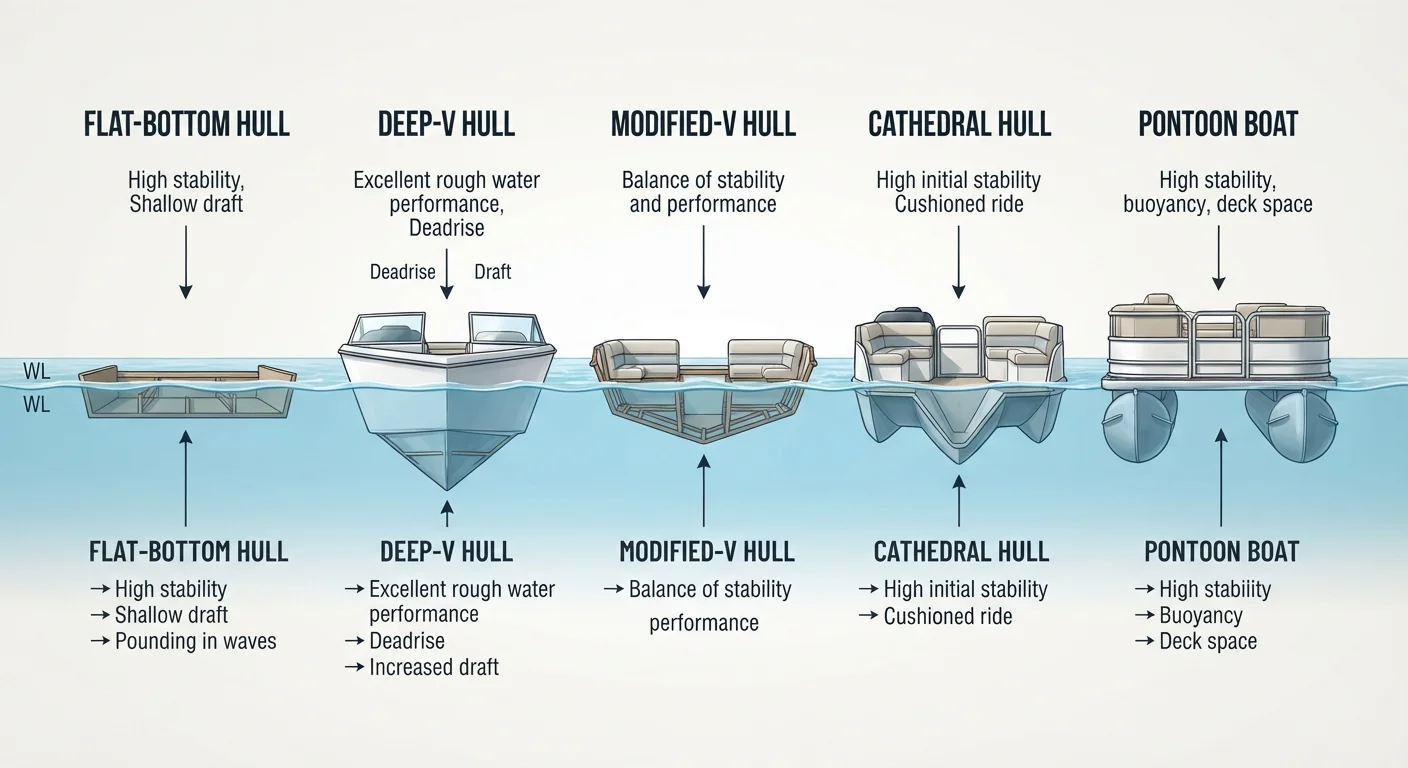
The depth of water a vessel needs to float without touching the bottom. Shallow-draft boats are better suited for coastal flats and rivers, while deeper-draft designs typically handle open-water swells more effectively.
Deadrise
The angle of the hull bottom measured from a horizontal plane. Higher deadrise (a sharper V-shape) cuts through chop more comfortably; lower deadrise offers more stability at rest and in calm conditions.
Transom
The flat or angled structural panel that forms the stern (rear) of the boat. The transom typically supports the outboard motor or sterndrive unit, and its construction affects both engine placement and structural integrity.
Displacement
The weight of water a vessel displaces when floating - effectively equal to the vessel's own weight. Displacement figures appear in specifications as a baseline for understanding how heavily a boat sits in the water.
Bilge Pump
An automated or manually operated pump installed at the lowest interior point of the hull to remove water that enters the bilge (the lowest interior compartment). A functioning bilge pump is a standard safety requirement on most recreational vessels.
Gunwale
Pronounced 'gunnel,' this is the upper edge or rail running along the top of the hull sides. It defines the boundary between the interior deck and the exterior hull, and often serves as a handhold or anchor point for fittings.
Chine
The intersection line where the hull's bottom meets its sides. Hard chines (sharp angles) tend to provide a drier, more predictable ride; soft chines (rounded transitions) are generally associated with a softer motion through waves.
Cavitation Plate
A horizontal fin mounted on an outboard or sterndrive unit just above the propeller. It prevents the propeller from sucking in surface air, which would reduce thrust and could damage the prop.
Maximum Capacity Plate
A federally required label (for most US recreational vessels under 20 feet) that states the maximum safe number of persons, total weight, and maximum horsepower the vessel is rated to carry.
Freeboard Height
Sometimes listed separately from basic freeboard, this measurement at specific points along the hull (bow, midship, stern) helps buyers assess how a particular design handles load and wave wash at different positions.
For a detailed look at how transom construction and swim platform design interact with hull geometry at the stern, see our article on transom design and swim platforms. And if you want a part-by-part orientation before diving into specs, The Anatomy of a Boat covers each component from bow to stern.
Propulsion, Safety, and On-Deck Feature Terms
Beyond the hull, listings describe propulsion systems, safety installations, and deck-level features using their own specialized vocabulary. These terms often determine a vessel's practical usability and regulatory compliance.
20 ft
Threshold for US federal capacity plate requirements
The U.S. Coast Guard requires maximum capacity plates on most monohull recreational vessels under 20 feet in length.
12°-24°
Typical deadrise range for V-hull recreational boats
Manufacturers vary deadrise angles based on intended use - fishing boats and offshore cruisers often fall toward opposite ends of this range.
3 categories
Key measurements defining hull fit
Beam, draft, and freeboard together determine whether a vessel suits a buyer's marina, trailer, and water conditions - none of the three should be evaluated in isolation.
Specifications Are Measured Under Standard Conditions
Manufacturer specs - including draft, displacement, and capacity - are measured under defined test conditions, typically with a standard engine and minimal or no load aboard. Real-world figures change with passengers, fuel, gear, and installed accessories. Always review the maximum capacity plate and consult the owner's manual for operational limits relevant to how you'll actually use the vessel.
For a comprehensive walkthrough of how all these feature categories interact - from electronics to seating to storage - the Watercraft Features End to End guide covers the full picture. Readers comparing vessel categories will also benefit from Eight Distinct Boat Types Worth Knowing, which contextualizes how these specs vary across hull classes.