Why Propulsion Defines the Whole Boat
It's easy to think of a boat's engine as a component you select after everything else is decided. In practice, the relationship works in reverse: the propulsion system is one of the earliest design constraints a naval architect works around. Where the engine sits determines where the transom must be reinforced, how deep the hull needs to run, what the cockpit floor can look like, and how much usable space remains for seating, storage, or a swim platform.
Understanding this relationship is essential for anyone comparing boats across categories - whether you're evaluating a center-console fishing boat, a wakeboard platform, or a family cruiser. For a broader look at how these choices interact with hull form, see the complete watercraft features guide.
~75%
U.S. recreational boats powered by outboard motors
According to the National Marine Manufacturers Association (NMMA), outboard-powered boats consistently represent the majority of new powerboat registrations in the United States.
3-5 years
Typical sterndrive bellows replacement interval
Marine industry service guidelines generally recommend inspecting sterndrive bellows annually and replacing them every three to five years, or sooner if cracking or wear is detected.
300+ hp
Common output range for modern four-stroke outboards
Advances in outboard technology have pushed single-engine ratings well above 300 horsepower, with some production models exceeding 600 hp, narrowing the performance gap with larger inboard applications.
Outboard Motors: External Power, Maximum Flexibility
Outboard motors are self-contained units - engine, gearcase, and propeller all hang from a bracket or mount directly to the transom. Steering is accomplished by rotating the entire motor, which makes outboard-equipped boats highly responsive and well-suited to a wide range of hull types, from flat-bottomed aluminum fishing boats to deep-V offshore hulls.
The external placement carries practical advantages. The motor tilts up clear of the water for storage or shallow-water use, reducing biofouling and corrosion exposure. When service is needed, most of the powerhead is accessible without crawling into an engine compartment. Modern four-stroke outboards have also brought significant improvements in fuel economy and emissions compared to earlier two-stroke designs.
The tradeoff is transom real estate. An outboard - or a bank of multiple outboards on larger vessels - occupies the full width of the stern, which constrains swim platform design and limits what the transom and swim platform can do functionally. Hull designers compensate with bracket-mounted systems that push the motor farther aft, reclaiming cockpit space.
Tilting Up Extends Outboard Longevity
When an outboard-equipped boat is stored or moored for extended periods, trimming the motor fully up and out of the water significantly reduces corrosion exposure and marine growth on the lower unit. This is particularly important in saltwater environments, where even brief periods of submersion accelerate wear on seals, anodes, and the gearcase housing.
Inboard Engines: Interior Placement, Dedicated Performance
Inboard engines sit entirely within the hull, connected to a fixed prop shaft that exits through the bottom of the boat. Steering is handled by a separate rudder. This arrangement keeps the propeller tucked safely beneath the hull - a meaningful safety advantage around swimmers - and allows the full transom to remain open for swim platforms, boarding ladders, or tow-sport rigging.
Two common inboard drivetrain configurations exist: direct-drive (where the engine faces forward and the shaft runs straight aft) and V-drive (where the engine faces aft and power routes back through a V-shaped gearbox). V-drive setups push engine weight toward the stern, generating the pronounced wake preferred by wakeboarders and wake surfers. Direct-drive installations typically produce a cleaner, flatter wake suited to slalom skiing.
Maintenance access is the primary challenge. Everything from oil changes to impeller replacement requires working within the engine compartment, often in confined spaces. Cooling systems and exhaust routing are more complex than outboard equivalents. For readers newer to these mechanical distinctions, understanding a boat's core components provides useful foundational context.
Sterndrive Systems: The Hybrid Configuration
Sterndrive - also called inboard/outboard or I/O - pairs an inboard engine with an external drive unit that passes through the transom. The drive leg pivots for steering, combining the responsive helm feel of an outboard with the interior-mounted engine of an inboard. Many runabouts, bowriders, and express cruisers are built around sterndrive systems specifically because they offer competitive performance and a clean cockpit aesthetic.
The drive unit itself handles both thrust and steering, and it can be trimmed in and out to optimize running angle and efficiency across speeds. This tunability makes sterndrives appealing for mixed-use boats that alternate between watersports, cruising, and day-trip use.
Sterndrive systems have a reputation for more involved maintenance schedules compared to outboards. The bellows - rubber boots that seal the drive unit where it passes through the transom - require regular inspection and replacement on a schedule manufacturers specify. Failure here can allow water intrusion into the hull. A practical comparison of outboard and inboard engines expands on these maintenance considerations in more detail.
How Propulsion Shapes Hull and Deck Decisions
Each propulsion type creates specific constraints and opportunities that designers work with - not around. Outboard boats typically feature wider, flatter sterns to accommodate motor brackets or multiple engine mounts. Inboard hulls often have a more pronounced keel line and deeper deadrise aft to protect the prop shaft. Sterndrive boats tend to sit lower at the stern, with the hull designed around the drive unit's trim range.
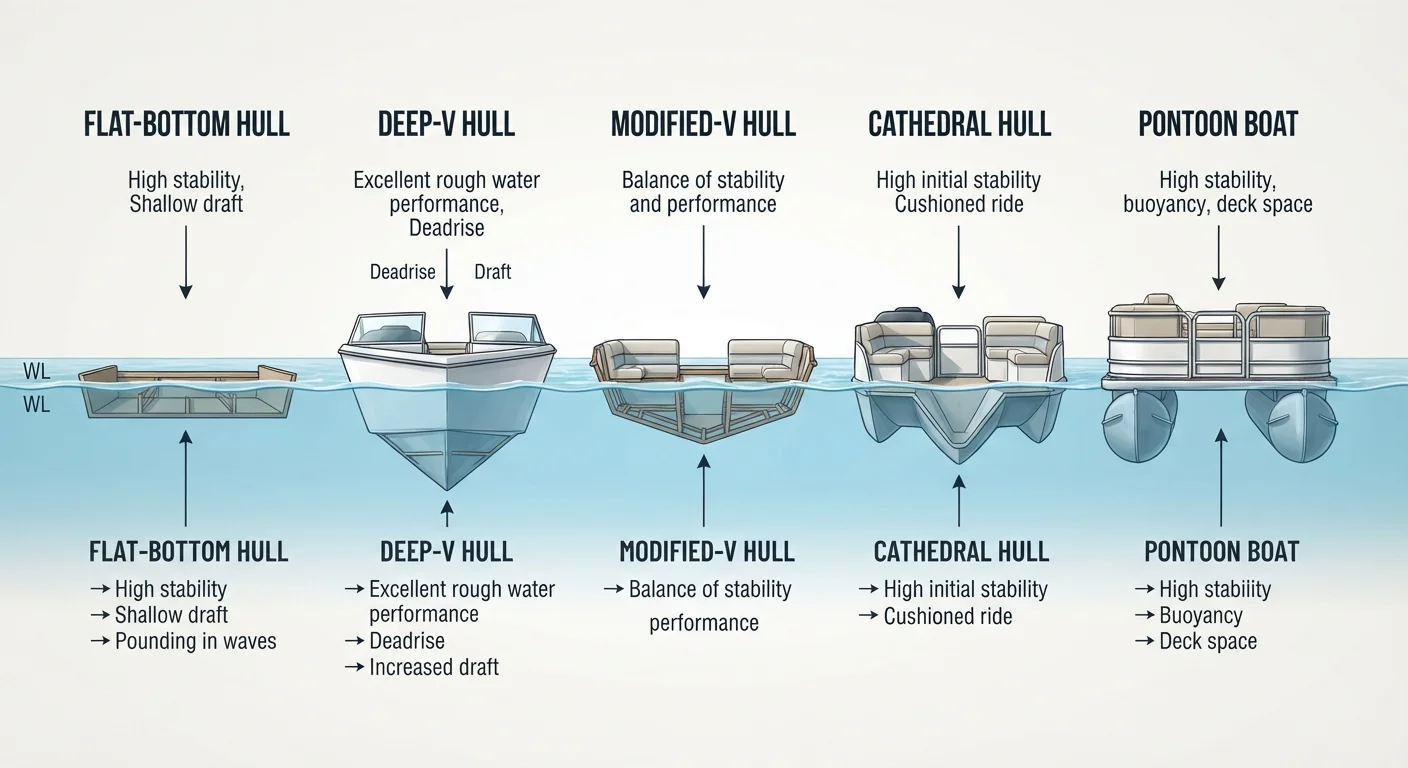
Deck layout follows the same logic. Outboard center-consoles maximize cockpit space by eliminating the interior engine box entirely. Inboard performance boats route engine hatches through the cockpit floor, sometimes limiting seating configurations. On sterndrive runabouts and bowriders, the engine compartment lives under an aft hatch, keeping the bow and midship seating unobstructed - a factor explored further in our coverage of recreational hull choices.
For anyone comparing specific models across these categories, a direct side-by-side comparison of all three propulsion systems offers a structured breakdown of performance, cost, and use-case fit.
Propulsion and Insurance Considerations
Marine insurance underwriters sometimes factor propulsion type into policy terms - particularly for high-horsepower outboard configurations or boats used for watersports with elevated liability exposure. When evaluating a boat purchase, it is worth consulting a licensed marine insurance professional to understand how propulsion system choice may affect coverage terms and premiums. This article does not constitute insurance advice.