Why the Features That Matter Most Get Missed
First-time boat shoppers tend to arrive at the dealership with a mental checklist built almost entirely from marketing materials: engine horsepower, hull length, seating capacity, and maybe a GPS chartplotter. Those numbers matter, but they rarely determine how satisfying a boat is to own and operate over time. The features that shape daily usability - storage architecture, bilge system accessibility, livewell performance, helm ergonomics - get almost no headline attention.
The pattern isn't unique to boating. As first-time performance vehicle buyers and new RV owners also discover, specification obsession tends to crowd out the questions that would have predicted real-world satisfaction. On the water, that gap between expectation and experience can arrive quickly - usually the first time you run out of rod storage on a full-day trip or discover your bilge pump switch is buried under a floor panel.
Understanding what to look for requires shifting from a performance mindset to a livability mindset. The mistakes below represent the most consistent gaps we observe among first-time buyers across all boat categories.
Prioritizing engine horsepower over functional storage layout.
Why it happens: Marketing materials and showroom conversations lean heavily on performance numbers, so first-timers naturally anchor to horsepower as the primary quality signal.
Ignoring bilge pump placement and accessibility during the walkthrough.
Why it happens: Bilge systems are tucked below decks and rarely discussed during a sales presentation, so buyers assume they are all equivalent.
Overlooking livewell capacity and circulation quality when buying a fishing-oriented boat.
Why it happens: Buyers focused on seating count or trolling motor compatibility often treat the livewell as a checkbox feature rather than a variable worth comparing.
Failing to account for the operating environment - freshwater vs. saltwater - when evaluating hardware.
Why it happens: Buyers shopping near inland lakes may not anticipate future coastal use, or vice versa. Dealers sometimes present a single spec sheet without flagging material differences.
Choosing a boat based on aspirational use rather than actual planned use.
Why it happens: New buyers often picture an idealized version of boating - offshore fishing, overnight cruising - but their near-term reality is day trips on a local lake.
Skipping a close inspection of helm ergonomics and instrument visibility.
Why it happens: Buyers sit at the helm briefly during a walkaround but rarely simulate actual operating posture or check sight lines at full seating depth.
How to Inspect What the Brochure Won't Show You
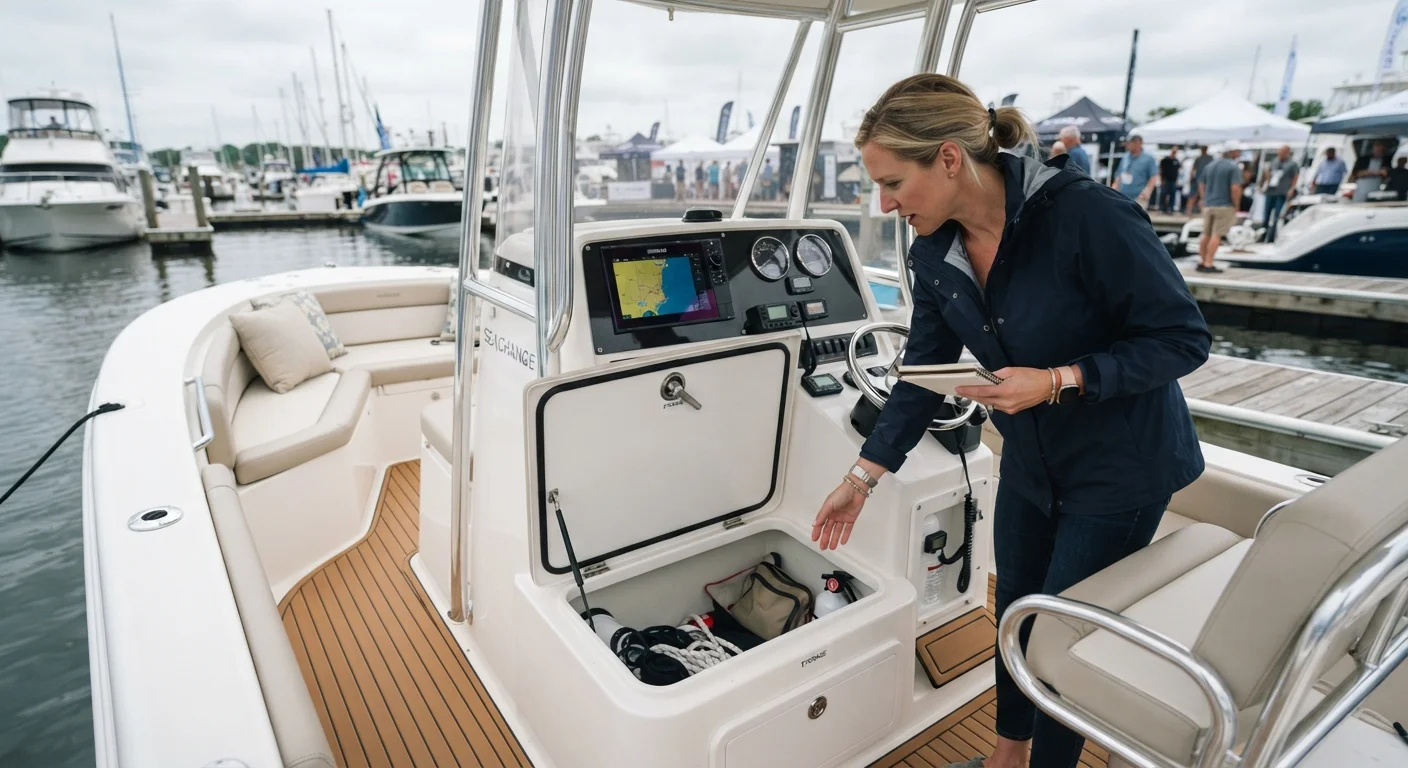
Addressing these oversights requires a more structured approach to the physical walkthrough. Before any sea trial, spend at least 20 minutes aboard the stationary vessel treating it as a working platform rather than a showpiece. Open every storage hatch. Measure headroom in cabin-equipped models - what cabin specs don't reveal about livability is a subject worth reviewing before you board. Sit at the helm in your normal operating posture and reach for every control.
Bilge Pump Access Is a Safety Issue
A bilge pump that cannot be reached, inspected, or manually overridden is more than an inconvenience - it is a safety liability. Before purchasing, physically locate the bilge pump, confirm the float switch operates freely, and verify the manual override is accessible from the helm. U.S. Coast Guard regulations require certain vessels to carry operable bilge pumps; consult current federal and state requirements for your vessel class.
Environmental fit is a separate but equally important dimension. Hardware rated for freshwater use can degrade rapidly in a tidal or offshore environment. If your use case will ever include saltwater exposure, this needs to be part of the evaluation - not an afterthought after the purchase agreement is signed. For a thorough walkthrough of every major feature category on modern watercraft, the complete watercraft features guide provides a useful framework to bring to any dealership visit.
Don't Assume Feature Parity Across Similar Models
Two boats with identical hull lengths and engine ratings can differ dramatically in storage volume, wiring access, and hardware quality. Trim levels and option packages vary widely by manufacturer and model year. Always inspect the specific hull you intend to purchase rather than relying on spec sheets or same-model comparisons found online.
Safety-adjacent features also deserve deliberate attention. Kill switches, navigation lights, and fire suppression systems are covered in depth in our overview of watercraft safety features. These are not optional considerations - they are fundamental to responsible ownership and, in many cases, federally mandated equipment.
The goal of any pre-purchase inspection is to answer one question as honestly as possible: does this vessel match how I will actually use it? Not how I hope to use it - how I will. Buyers who approach that question rigorously tend to report significantly higher satisfaction in their first two seasons of ownership.
~70%
First-time buyers who cite post-purchase regret
Industry surveys conducted by boating associations have consistently found that a majority of first-time boat buyers report at least one significant feature they wish they had evaluated more carefully before purchase.
3-5 gal
Typical small livewell volume range
Entry-level fishing boats often ship with livewells in the 3-5 gallon range, which many anglers find limiting for catch-and-release fishing on warm-water days.