Why Boat Categories Matter Before You Start Looking
Walking into a boat show - or scrolling through listings - without a framework for vessel types is genuinely disorienting. Boats are grouped by hull design, propulsion method, and primary use, and each combination produces a different ownership experience. Understanding categories upfront saves you from pursuing a vessel that is fundamentally mismatched to your waterway, your skill level, or your intended activities.
This guide covers every major category in plain language. For a deeper dive into specific terminology you will encounter on listings, the Watercraft Features Glossary is a useful companion. And before you leave the dock with anything, the Boating Basics hub covers the fundamentals every new operator should know.
Hull
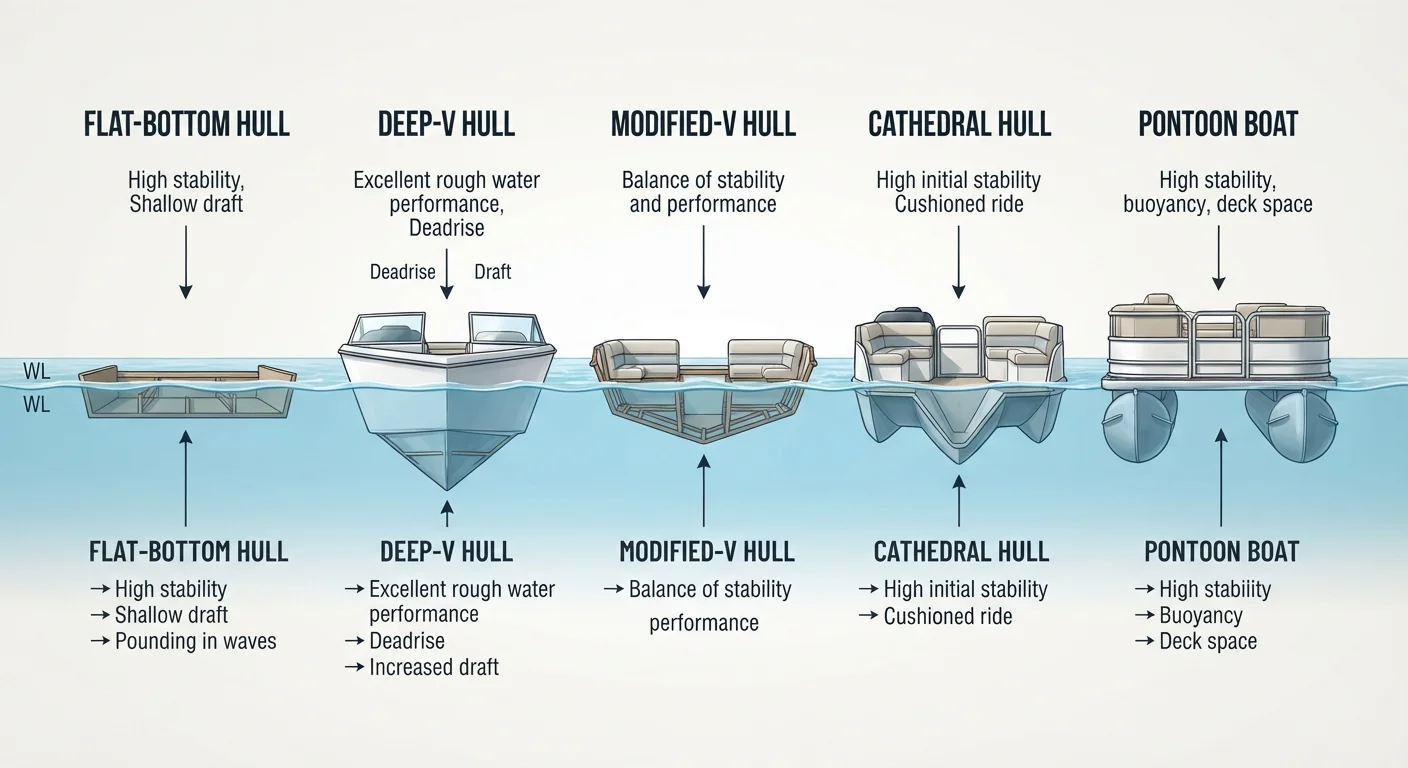
The main body of a boat, whose shape determines how it moves through and sits in water. Different hull forms suit different water conditions and uses.
Displacement hull
A hull that moves through water by pushing it aside rather than riding on top. These hulls are fuel-efficient at low speeds and common on trawlers and sailboats.
Planing hull
A hull designed to rise up and skim across the water surface at higher speeds. Most recreational powerboats use planing hulls.
Outboard motor
A self-contained engine and propeller unit mounted on the outside of the transom (rear) of a boat. Easy to service and common on smaller boats.
Inboard engine
An engine mounted inside the hull, connected to a propeller shaft that exits through the bottom. Common on larger cruisers and tow boats.
Tender
A small dinghy or inflatable boat used to travel between a larger anchored vessel and the shore.
Beam
The widest measurement of a boat measured side to side. A wider beam generally means more stability and interior space.
Draft
The depth of water a boat needs to float without touching bottom. Shallow-draft boats can access more waterways than deep-draft vessels.
Small Boats and Tenders: Where Most People Begin
The smallest vessels - dinghies, jon boats, canoes, kayaks, and inflatables - introduce new boaters to the water with minimal complexity. Jon boats are flat-bottomed aluminum workhorses suited to rivers, ponds, and calm lakes. Dinghies and tenders are compact rowboats or inflatables used to ferry people and gear between a larger vessel and shore.
These craft are low-cost, easy to trailer or cartop, and forgiving to operate. They are also where many lifelong boaters develop their instincts for reading water, wind, and currents. For context on how the environment shapes your choices, see Freshwater vs. Saltwater Boating.
Powerboats: From Day Cruisers to Performance Hulls
Powerboats represent the broadest category in recreational boating. They are defined by engine-driven propulsion - outboards, inboards, or sterndrives - and subdivided by hull and purpose.
- Center console boats have an open deck with the helm mounted centrally, prioritizing fishing access and versatility.
- Bowriders feature forward seating ahead of the windshield, making them popular for day cruising and watersports.
- Deck boats offer a wide, flat-floor layout optimized for passenger capacity on lakes and calm bays.
- Cuddy cabin boats add a small enclosed forward berth for overnight capability without full cruiser bulk.
- High-performance V-hulls are engineered for speed, with deep-V hull designs that cut through chop but demand more operator skill.
For a side-by-side look at eight distinct powerboat and multi-use categories, Eight Distinct Boat Types Worth Knowing provides useful context.
Match the hull to your water first
Before evaluating engine size or amenities, identify the typical conditions where you will boat - calm lakes, coastal bays, offshore ocean, or rivers. Hull design is the single most important factor in how a boat handles its intended environment. A deep-V offshore hull on a landlocked lake is overkill; a flat-bottom jon boat in ocean chop is genuinely unsafe.
Sailboats and Multi-Hulls
Sailing vessels harness wind as primary propulsion, supplemented by auxiliary engines for maneuvering and motoring in calm conditions. Within this family, the main distinctions are hull count and rig type.
- Sloops - one mast, one mainsail, one headsail - are the most common and easiest to single-hand.
- Ketches and yawls carry a second, smaller mast aft of the main, distributing sail area across more manageable panels.
- Catamarans use two parallel hulls for exceptional beam stability and interior volume, popular for cruising and charter.
- Trimarans add a third central hull and two outriggers, prioritizing speed over comfort space.
Sailing introduces a steeper initial learning curve than powerboating, including understanding points of sail, tacking, and jibing. Formal education is strongly advisable. The Case for a Boater Education Course explains what structured training actually covers and why it matters even where not legally required.
Cruisers, Trawlers, and Liveaboards
Larger powerboats designed for extended time on the water fall into this group. They share enclosed cabins, overnight berths, and more self-sufficient systems than day boats.
- Express cruisers prioritize speed and sporty styling with moderate cabin accommodations.
- Flybridge cruisers add an elevated helm station above the main cabin, improving visibility and entertaining space.
- Trawlers use full-displacement or semi-displacement hulls optimized for fuel efficiency at slower speeds - typically 7-10 knots - making them well-suited for long passages and coastal exploration.
- Liveaboard vessels are any boat configured and used as a primary residence, often trawlers or wide-body cruisers with expanded tankage and shore-power systems.
Ownership of vessels in this category involves more complex systems - generators, watermakers, holding tanks, and advanced electronics. The Marine Electronics guide covers navigation and communication gear you will encounter as you move up in vessel size.
Liveaboard rules vary by marina and state
Not all marinas permit liveaboards, and some municipalities regulate the practice through zoning or sewage discharge rules. If long-term vessel habitation is your goal, research local regulations and marina policies before committing to a liveaboard-oriented purchase. The U.S. Coast Guard and your state's boating authority are the primary regulatory references.
Specialty and Activity-Specific Watercraft
Several categories exist primarily to serve a specific on-water activity rather than general cruising or transportation.
- Bass boats are low-profile, high-speed aluminum or fiberglass platforms engineered around tournament freshwater fishing - featuring live wells, trolling motors, and rod storage.
- Pontoon boats mount a flat deck on two or three aluminum tubes (pontoons), delivering wide stability and high passenger capacity on lakes and rivers.
- Personal watercraft (PWCs) - commonly called jet skis, a brand name - are sit-down or stand-up craft using jet propulsion, classified by the U.S. Coast Guard as Class A motorboats.
- Wakeboard and ski boats are inboard-powered towboat designs generating a specific wake shape for cable skiing or wakeboarding.
- Rigid inflatable boats (RIBs) combine a hard fiberglass or aluminum hull with inflatable tube sponsons, balancing seakeeping ability with lightweight portability - widely used by coast guards and dive operators.
Once you understand which category matches your intended use, exploring the full range of vessel features becomes much more productive. The Watercraft Features End to End guide walks through hull types, propulsion, safety systems, and storage across every major vessel class.
PWC operation requires the same safety diligence as any motorboat
Personal watercraft are frequently involved in recreational boating accidents in the U.S., partly because their accessibility leads operators to underestimate the risks. Most states require a boater safety certificate for PWC operation by riders under a certain age, and some extend that requirement to all ages. Always wear an approved life jacket and familiarize yourself with local operating rules before heading out.