Why Hull Style Matters More Than You Might Think
Shopping for a recreational powerboat often starts with aesthetics - the clean lines of a bowrider, the wide-open deck of a pontoon, or the purposeful beam of a deck boat. But hull geometry is about physics as much as appearance. It shapes how the boat rides in chop, how it responds to throttle input, how much usable space it provides, and what it costs to run. Understanding the structural differences between these three popular platforms gives you a far more useful filter than brochure photography alone.
For a broader orientation on how hull shape influences handling dynamics, see our guide to hull types and handling. And if you're also weighing fishing-specific platforms, fishing boats decoded covers that territory separately.
Pontoon Boats: Stability and Social Space
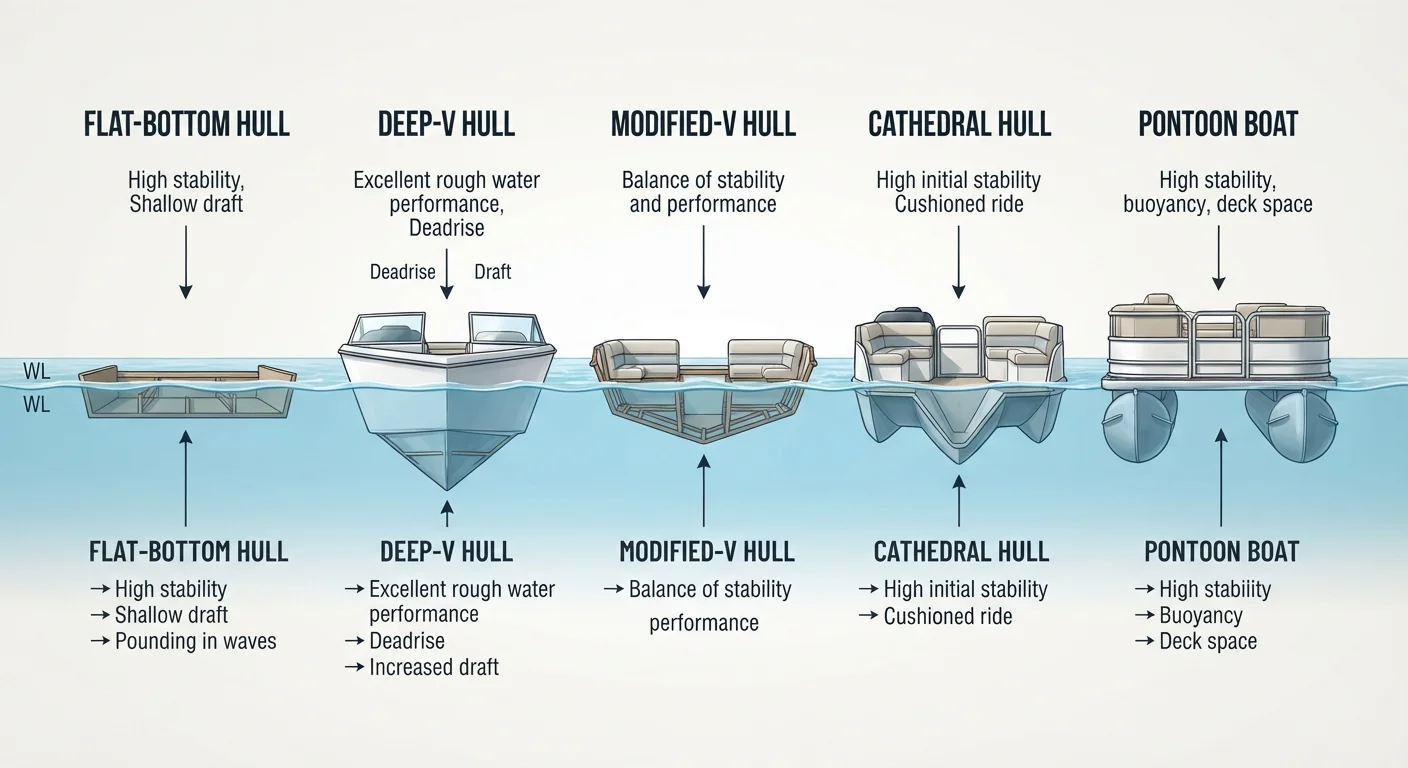
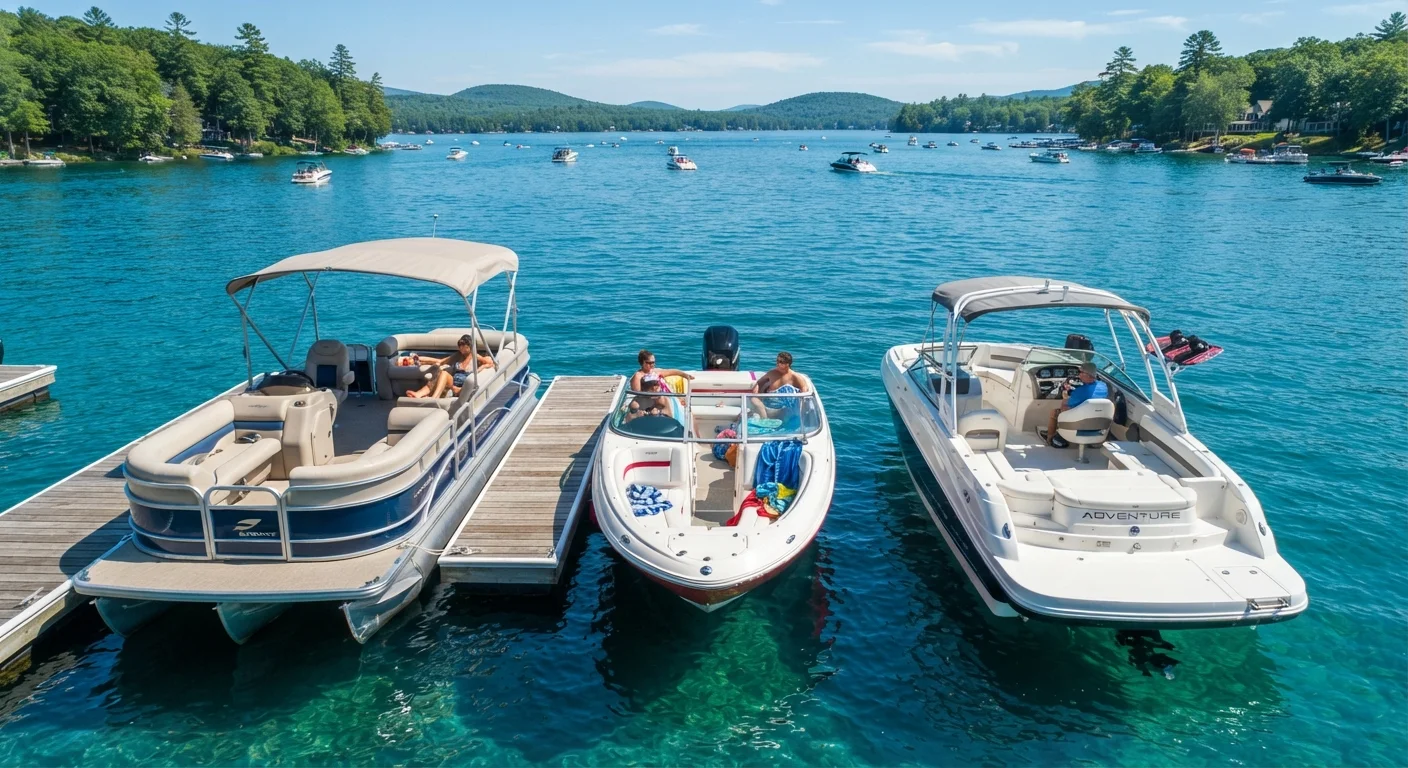
A pontoon boat rides on two (or three, in tritoon configurations) aluminum tubes - called toons - rather than a conventional displacement hull. This twin-tube platform creates exceptional initial stability and a flat, wide deck that maximizes usable passenger area. Most pontoons in the 20-26 foot range can comfortably accommodate eight to fourteen people, with seating arranged around the perimeter and a central walkway.
That stability comes with trade-offs. Pontoons are most at home on lakes, rivers, and protected bays. In open-water chop or higher sea states, the flat deck ride can become uncomfortable, and handling can feel ponderous compared to a V-hull. Acceleration and top speed are generally modest - many standard pontoons are optimized for cruising rather than watersports performance, though performance-oriented tritoon builds with high-horsepower outboards can change that calculus substantially.
Consider Your Home Water First
Before evaluating seating capacity or engine options, map out where you'll actually boat most often. A protected inland lake favors pontoon handling characteristics; open bays or coastal inlets reward the chop-handling of a V-hull bowrider or deck boat. No single hull type performs equally well across all water conditions.
Tritoon pontoons (three tubes) offer measurably better rough-water handling and support higher horsepower ratings than traditional twin-tube designs - worth evaluating if your home lake sees afternoon wind chop regularly.
Bowriders: The Performance-Oriented All-Rounder
The bowrider is arguably the most recognized recreational powerboat silhouette in the US. It uses a deep-V or modified-V fiberglass hull, with an open bow seating area ahead of the windshield - the feature that defines the category. Hull lengths typically run 17-26 feet, powered by stern drives or outboards depending on the builder and vintage.
A deep-V hull cuts through chop more cleanly than a flat-bottomed or pontoon design, delivering a drier, more controlled ride in rougher conditions. This also translates to sharper cornering and quicker acceleration - characteristics that suit watersport towing. Seating capacity is lower than a comparably sized pontoon (typically six to eight people), and the forward bow seating, while fun at low speed, can be wet and choppy underway in any real wind.
For those exploring the watersports end of the spectrum, it's worth noting how bowriders compare to more purpose-built tow platforms: wakeboard boats vs ski boats explains the specialization that separates dedicated tow vessels from general-purpose hulls.
| Pontoon | Bowrider | Deck Boat | |
|---|---|---|---|
| Hull type | Twin or triple aluminum tubes | Deep-V or modified-V fiberglass | Wide-beam V-hull fiberglass |
| Typical passenger capacity | 8-14+ | 6-8 | 8-12 |
| Rough-water handling | Limited - best in calm water | Strong - cuts chop well | Moderate - better than pontoon |
| Watersport towing | Limited with standard builds | Well-suited | Capable with right engine |
| Fuel economy | Moderate | Good to moderate | Moderate - beam adds drag |
| Deck/social space | Excellent | Moderate | Good |
| Model availability | Very wide | Very wide | Narrower selection |
Deck Boats: The Hybrid Platform
A deck boat takes the V-hull foundation of a bowrider and broadens the beam significantly - particularly at the bow - to create more usable deck and seating area without committing to the pontoon's tube-based platform. The result is a boat that can typically seat ten or more people while still delivering the rougher-water handling characteristics of a conventional fiberglass hull.
Deck boats occupy a genuine but sometimes overlooked niche. They tend to run well in moderate chop, tow reasonably well, and offer more interior space than a bowrider of equivalent length. The wider beam does affect fuel economy and can create more resistance in beam seas. Selection is also narrower - fewer builders offer dedicated deck boat lines compared to pontoons or bowriders, so buyers may have fewer configuration choices.
For a full breakdown of the feature categories - seating layouts, storage systems, propulsion options, and electronics - that apply across all three of these platforms, watercraft features end to end provides comprehensive context. And if you're situating these recreational hulls within a broader survey of vessel types, eight distinct boat types worth knowing is a useful starting reference.
~40%
Share of new powerboat registrations
Pontoon boats have consistently represented a significant share of annual new powerboat unit sales in the US, reflecting strong consumer demand for family-friendly platforms, according to NMMA industry data.
17-26 ft
Typical bowrider length range
The majority of recreational bowrider models on the market fall within this length bracket, with stern-drive and outboard configurations both common across that range.