Why Boat Category Matters Before Anything Else
Many first-time fishing boat buyers focus on engine horsepower or electronics packages - but the hull category is the decision that actually governs where you can safely go and how effectively you can fish when you get there. A bass boat in a coastal bay chop and a center console in a shallow-grass flat are both fish-catching tools in the wrong environment.
Understanding what each category was designed to do gives you a framework for every other decision that follows. For a broader view of how fishing boats fit within the full spectrum of watercraft, The New Boater's Map to Boat Categories covers all major vessel types in plain language.
~13M
Registered recreational boats in the US
According to the National Marine Manufacturers Association (NMMA), approximately 13 million recreational boats are registered in the United States, the majority used for fishing.
~50%
Freshwater fishing as primary use case
Industry surveys consistently show freshwater fishing accounts for roughly half of all recreational boating activity in the US, driving strong demand for bass boats, jon boats, and aluminum utility hulls.
18-24 ft
Most common center console length range
Marine industry sales data indicates the 18-to-24-foot segment represents the most popular size class for center console fishing boats in the US market.
Center Console: The Offshore Workhorse
A center console places the helm station on a single console in the middle of the deck, leaving walk-around space on all sides. This layout is the defining feature - it gives anglers unobstructed access to the entire gunwale, which is critical when fighting a fish or working multiple rods.
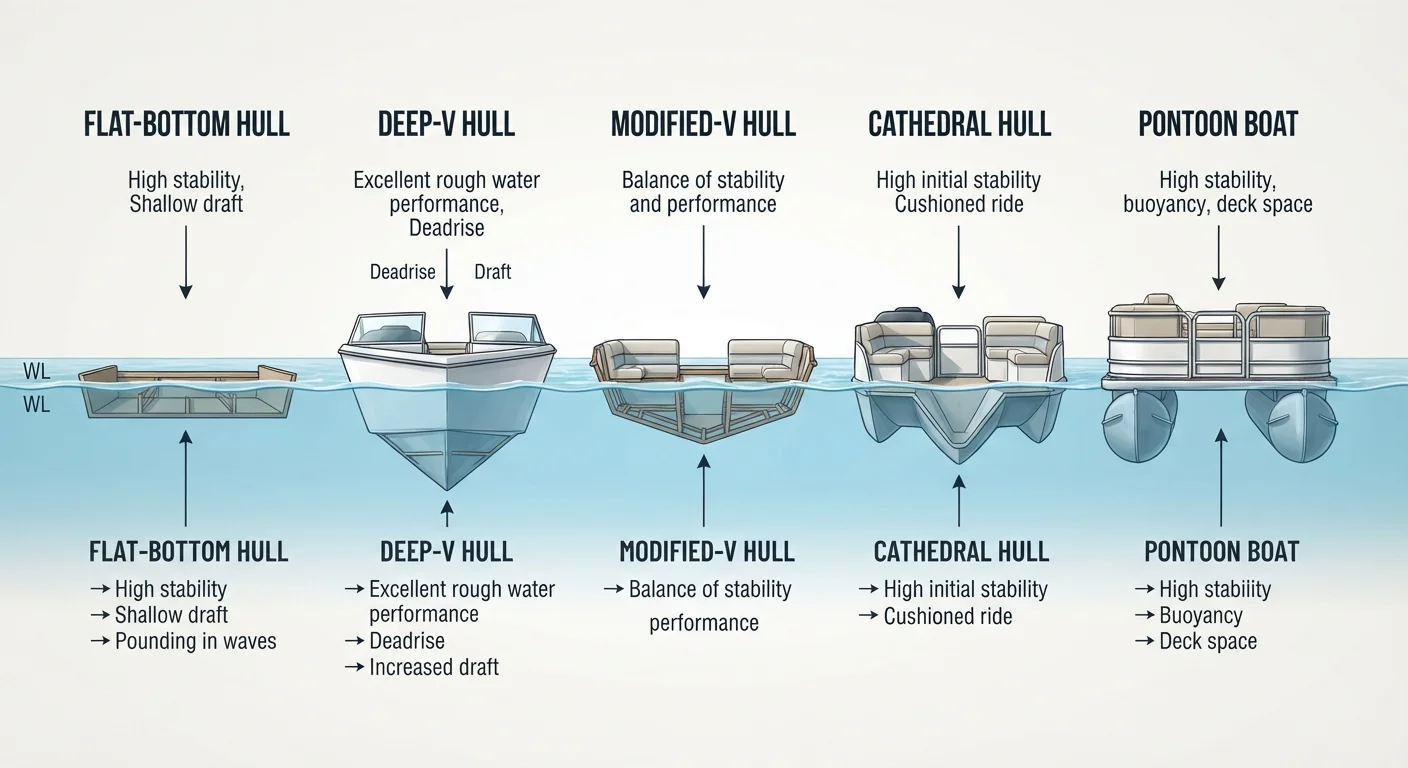
Center consoles range from 17-foot inshore skiffs to 40-plus-foot offshore platforms capable of blue-water runs. Larger examples typically run twin or triple outboard configurations with high-capacity fuel systems. Their deeper-V hulls and higher freeboard manage ocean swells far better than flat-bottomed alternatives.
Key rigging priorities on center consoles include live wells, rod holders, outrigger mounts, and T-top shade structures. For a full overview of electronics and navigation systems that typically accompany these boats, see Marine Electronics Every Serious Boater Should Understand.
Match Hull Size to Your Typical Run Distance
A center console rated for offshore use should be sized with your typical passage distance in mind, not just your target species. Smaller hulls can be rigged for offshore but may not handle the sea state you'll encounter on longer runs. As a general guideline, many experienced offshore anglers prefer a minimum of 24 feet for regular blue-water trips.
Bass Boats and Bay Boats: Freshwater vs. Coastal Specialists
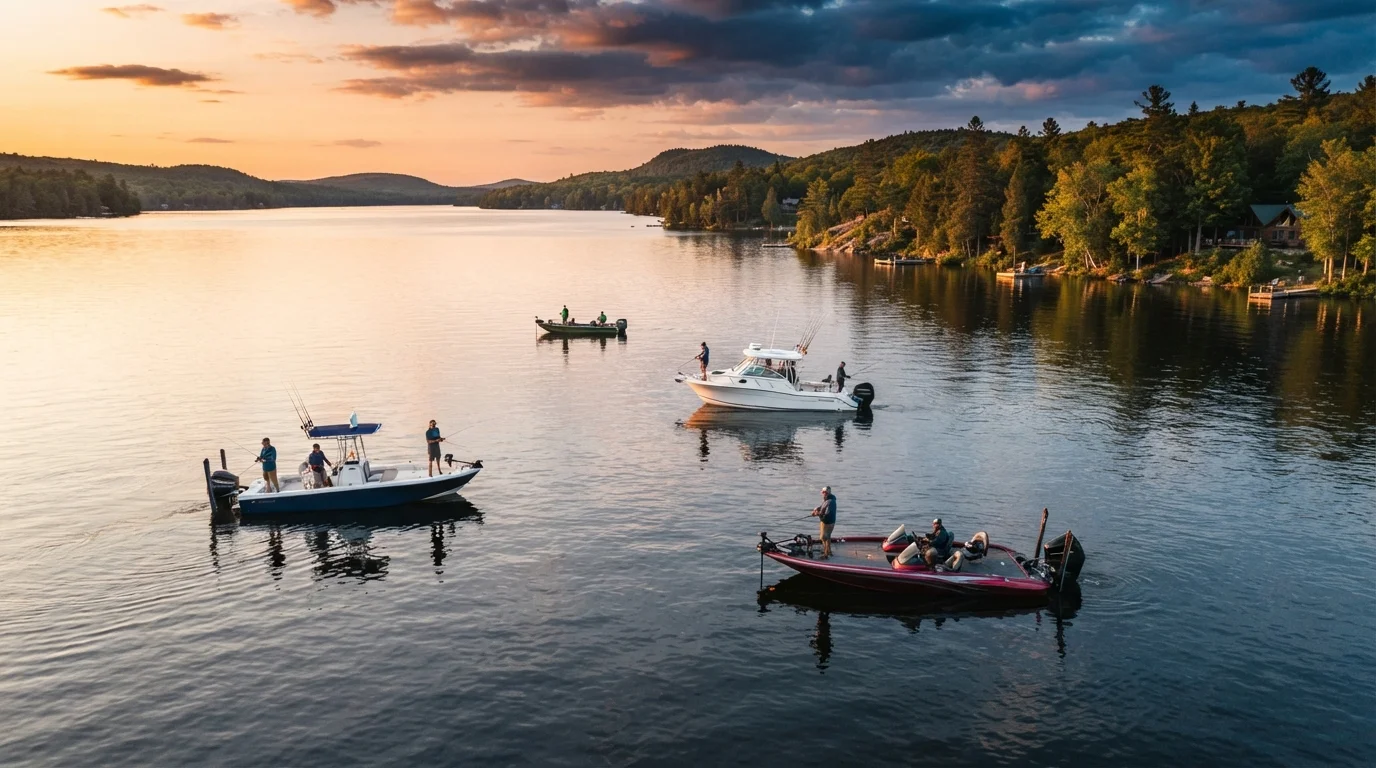
Bass boats are the tournament anglers' tool - low-profile, blindingly fast, and built for shallow freshwater lakes and reservoirs. A typical bass boat features a flat or shallow-V aluminum or fiberglass hull, a raised casting deck fore and aft, an elevated pedestal seat, and a powerful outboard designed to cover water quickly between fishing spots. Electric trolling motors mounted at the bow provide near-silent, precise positioning while working structure.
Their low freeboard is an intentional trade-off: it keeps the center of gravity low for stability while standing and casting, but it also limits their utility to protected, calm bodies of water.
Bay boats occupy a distinct niche between inshore skiffs and center consoles. Designed for shallow coastal environments - grass flats, oyster bars, tidal creeks - they offer a shallow draft that allows access where deeper-V hulls cannot go, combined with enough hull height to handle a moderate coastal chop. Most bay boats in the 18-24 foot range include a poling platform above the outboard for sight fishing.
Walkarounds, Cabin Boats, and Multi-Species Platforms
A walkaround adds a small cuddy cabin to a fishing-forward layout, providing sleeping berths, a head compartment, and weather protection for anglers who run longer passages or stay out overnight. The walk-around deck path that runs alongside the cabin gives the category its name - you can move from stern to bow without climbing over the console or the cabin top.
This makes walkarounds a strong choice for offshore trips where afternoon thunderstorms or overnight anchoring is part of the plan, without fully sacrificing the fishing deck real estate that an express cruiser or cabin cruiser would eliminate. They represent a genuine compromise platform rather than an optimised specialist - and that trade-off should be understood before committing.
Flats boats and skiffs sit at the shallow-water extreme: minimal freeboard, ultra-shallow draft, and purpose-built layouts for permit, redfish, and bonefish in inches of water. At the other end, sportfishing convertibles and large offshore platforms prioritise cockpit space for fighting big game species with full cabin amenities below.
Anglers weighing fishing-specific hulls against recreational alternatives will find useful context in Pontoon, Bowrider, or Deck Boat: Choosing the Right Recreational Hull, which examines how non-fishing hulls compare in layout and capability.
“The hull is the decision. Everything else - the engine, the electronics, the rigging - you can change. But the hull determines what water you can access and how safely you can operate in it.”
— Boats & Watercraft Editorial Team, Marine industry analysis and boat category guidance
Jon Boats and Utility Aluminum Boats: The Practical Foundation
Jon boats - flat-bottomed, aluminum-hulled utility vessels - remain the most accessible entry point into fishing by boat. Simple in construction, light enough to trailer easily, and tolerant of low-power outboards or electric motors, they are effective on ponds, rivers, and calm lakes where conditions are predictable.
Their flat bottom limits performance in any meaningful chop and provides less secondary stability when anglers move around the boat. However, for still or slow-moving freshwater environments, no other category offers the same combination of value, simplicity, and shallow-water reach.
Understanding how a boat's components function together - from hull material and deck rigging to transom configuration - is foundational before evaluating any category. The Anatomy of a Boat provides a useful reference for readers building that vocabulary. For a broader look at features across all watercraft types, Watercraft Features End to End covers propulsion, electronics, storage, and safety systems in depth.
Hull Material Affects More Than Weight
Aluminum hulls dominate the freshwater utility and jon boat segment because of their low cost, light weight, and resistance to corrosion in freshwater. Fiberglass is preferred for offshore and saltwater applications where hull stiffness, sea-keeping ability, and the capacity to carry heavier equipment and fuel loads matter more than trailering convenience.