
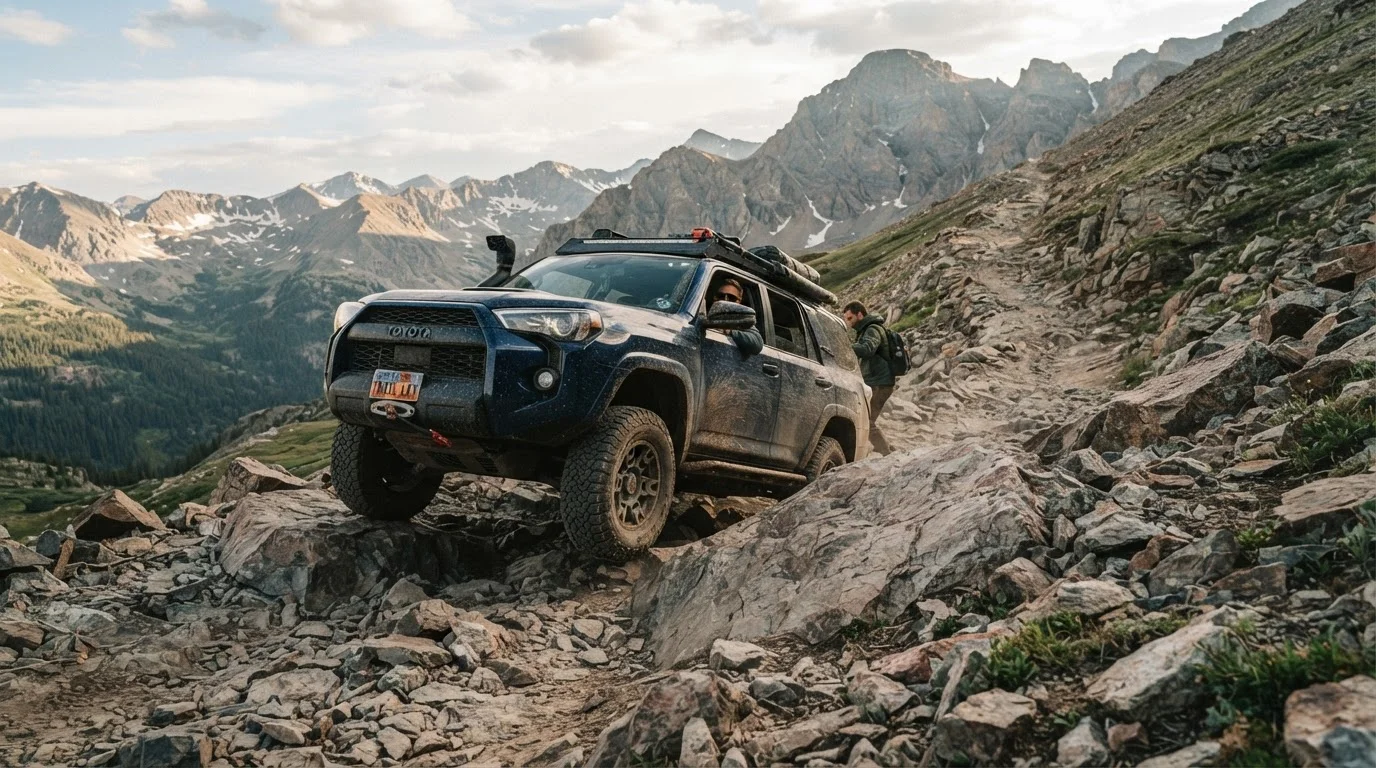
Why Off-Road Specs Deserve a Closer Look
Most SUV buyers encounter terms like "approach angle" and "water fording depth" in brochures but never stop to verify what those numbers actually mean in practice. For casual overlanders and serious trail drivers alike, these figures determine whether a vehicle clears an obstacle or gets hung up - and no amount of all-terrain tires compensates for a compromised geometry.
This reference guide breaks down the core off-road specifications you'll find on window stickers and manufacturer datasheets, explains what each one measures, and flags the thresholds that separate capable trail rigs from pavement-focused crossovers. For a broader foundation on reading factory data, see how to interpret an SUV's window sticker.
| Minimum useful ground clearance (trails) | ~8.5 inches (General industry benchmark for moderate off-road use) |
| Approach angle - capable off-roaders | 30°+ (Common threshold cited by off-road vehicle assessors) |
| Departure angle impact from a standard hitch | 2-5° reduction (Varies by hitch design and receiver position) |
| RTI score - strong articulation benchmark | 500+ (Ramp Travel Index; higher = greater suspension flex) |
| Typical crossover ground clearance range | 6-8 inches (Manufacturer spec sheets, various crossover segments) |
| Factory water fording depth - capable SUVs | 19-33 inches (Range across body-on-frame SUV classes) |
The Six Specs That Define Off-Road Geometry
These six measurements work as a system. Optimizing one while ignoring the others gives an incomplete picture of what a vehicle can actually handle.
Ground clearance
The vertical distance between the lowest fixed underbody point and level ground. It determines how large an obstacle the vehicle can pass over without contact.
Approach angle
The maximum angle of an incline a vehicle can climb without the front bumper or overhang striking the slope. Shorter front overhangs produce better approach angles.
Departure angle
The steepest downward slope a vehicle can descend without the rear bumper or overhang making contact. Tow hitches commonly reduce this figure.
Breakover angle
The sharpest ridge or crest a vehicle can straddle without the undercarriage bottoming out. It is influenced by wheelbase length and ground clearance.
Ramp Travel Index (RTI)
A standardized score measuring suspension articulation by driving one axle up a 20-degree ramp and recording how high the opposite wheel lifts before leaving the ground. Higher scores indicate greater flex.
Water fording depth
The maximum water depth a vehicle can safely cross as specified by the manufacturer, typically assuming a steady, controlled crossing on a flat, firm riverbed.
Ground Clearance
Measured from the lowest underbody point - often the differential or skid plate - to flat ground. Higher numbers let a vehicle clear rocks, ruts, and compacted snow without dragging the frame. Body-on-frame SUVs typically offer 8-11 inches; purpose-built off-roaders can exceed that with factory lift packages. Crossovers often land at 6-8 inches, which is adequate for gravel fire roads but marginal on technical trails.
Approach, Departure, and Breakover Angles
Approach angle is the steepest incline a vehicle can climb without the front bumper contacting the ground. Departure angle is the same concept applied to the rear. Breakover angle describes the sharpness of a crest the vehicle can straddle without the rocker panels or undercarriage bottoming out - calculated from the wheelbase and ground clearance. Short overhangs and high clearance improve all three. Factory tow hitches commonly reduce departure angle by several degrees, a detail that matters on downhill ledges.
Articulation and Wheel Travel
Articulation refers to how far a suspension can flex - one wheel drooping while the opposite compresses - while keeping all four tires in contact with uneven terrain. More articulation means better traction on broken surfaces. It's often expressed as a Ramp Travel Index (RTI), a standardized test where a vehicle climbs a 20-degree ramp; higher RTI scores reflect superior flex. Independent rear suspensions generally articulate less than solid rear axles, a key trade-off to weigh when comparing trail-focused SUVs against everyday crossovers.
Water Fording Depth
The maximum depth a vehicle can cross without water entering the intake or damaging electrical components. Factory figures assume a controlled crossing speed and a level water surface - real creek crossings are rarely either. Treat published fording depth as a maximum ceiling under ideal conditions, not a target.
For a complementary look at how these specs translate to truck platforms, explore recreational truck capability factors.
Putting the Numbers in Context
Specs only tell part of the story. A vehicle with a strong approach angle but minimal articulation will still struggle on uneven terrain where tires need independent contact with the ground. Likewise, high ground clearance paired with a long wheelbase can produce a surprisingly poor breakover angle - making shorter-wheelbase variants worth comparing directly.
30°+
Approach angle for serious trail SUVs
Purpose-built off-road trims frequently post approach angles above 30 degrees, compared to sub-20 degrees on most crossovers.
~3 inches
Typical ground clearance gap between crossovers and body-on-frame SUVs
Body-on-frame platforms average 2-4 inches more clearance than unibody crossovers in the same size class.
500+
RTI score separating capable from marginal off-roaders
Vehicles scoring above 500 on the Ramp Travel Index generally maintain all-four-tire contact on broken terrain more consistently.
Suspension tuning, locking differentials, and low-range transfer cases amplify - or limit - what these baseline numbers can achieve. An electronically controlled limited-slip differential on a crossover can meaningfully outperform an open-axle body-on-frame truck on loose gravel, even if the truck's geometric specs look superior on paper.
When you're ready to take your SUV further, turning an everyday SUV into an overland rig covers the practical limits of roof loads, recovery gear, and extended use. And if you're new to how SUVs handle differently from sedans before you ever reach a dirt road, SUV handling fundamentals for new drivers is a useful starting point.
For comprehensive coverage of every SUV concept - from platform architecture to lifestyle fit - visit the complete SUV guide.
Specifications cited in this article reflect general industry ranges. Always verify figures against the manufacturer's current published data for the specific model year and trim you are evaluating, as configurations vary.