Why Truck Choice Matters for Recreation
Trucks marketed as "adventure-ready" or "trail-capable" span an enormous range of actual capability. A base two-wheel-drive work truck and a purpose-built off-road variant may share a nameplate but perform very differently once pavement ends. Recreational use also places demands that pure work use does not - overnight gear, water sports equipment, bike racks, rooftop tents, and towed trailers all impose different requirements on the same vehicle.
Understanding which specs translate to real-world outdoor performance is the foundation of a smart truck decision. If you're new to the segment, our first-time truck buyer guide covers the fundamentals before you dive deeper into recreational applications.
13M+
Registered recreational boats in the U.S.
According to the National Marine Manufacturers Association, millions of American households own towable watercraft - a primary driver of truck towing demand.
~1,500 lbs
Typical mid-size truck payload ceiling
Mid-size truck payload ratings commonly fall between 1,000 and 1,600 lbs, meaning recreational gear and passengers can consume capacity quickly.
8-10 in
Ground clearance range, off-road truck trims
Off-road oriented trim levels on popular full-size trucks commonly offer 8-10 inches of ground clearance compared to 6-7 inches on base configurations.
Towing: Matching Capacity to What You Pull
Towing capacity is one of the most cited truck specifications, and also one of the most misunderstood. Manufacturers publish maximum tow ratings under optimal, often idealized, conditions - full-size crew cab with a specific engine and axle ratio. Your actual configuration may rate lower. Always consult the tow guide specific to your truck's cab, bed, engine, and drivetrain combination.
Recreational towing breaks into distinct use cases with very different weight demands:
- Bass or jon boats: Often 1,500-3,500 lbs - within reach of most mid-size trucks.
- Personal watercraft on dual trailers: Can reach 4,000-5,000 lbs combined.
- Travel trailers: Range widely from 3,500 lbs to over 12,000 lbs - larger units require full-size trucks with appropriate ratings.
- Fifth-wheel trailers: Typically 12,000-20,000+ lbs, requiring high-capacity full-size trucks with a bed-mounted hitch.
If you're considering larger towable RVs, see our comparison of fifth wheels vs. travel trailers for how hitch type and required truck specs differ significantly between the two formats.
Never Exceed Your Truck's Rated Limits
Towing beyond a truck's rated capacity strains the transmission, brakes, and frame - and can compromise control on grades or in emergency maneuvers. Payload overloads affect handling, tire wear, and braking distance. These ratings are engineering limits, not conservative estimates. Always account for tongue weight as part of your total payload calculation.
Off-Road Capability: What the Specs Actually Mean
Ground clearance, approach angle, departure angle, and breakover angle collectively determine where a truck can go. Ground clearance - the distance between the lowest point of the undercarriage and the ground - affects rock and obstacle clearance. Approach angle measures how steep an incline the truck can climb without the front bumper contacting terrain first. These numbers vary widely even within the same model line depending on trim level and whether the truck runs factory lift and skid plates.
Four-wheel drive (4WD) systems also differ meaningfully. Part-time 4WD, common on work-focused trucks, engages manually and is not intended for use on dry pavement. Full-time or automatic 4WD systems found on more recreation-oriented trims manage distribution continuously. Locking rear differentials and electronic traction management add further capability on uneven terrain.
For a detailed breakdown of how these figures translate to trail performance, our article on ground clearance and approach angles decodes the spec sheet comprehensively.
When evaluating a truck's off-road trim, look past the badge and check whether factory skid plates, a locking rear differential, and crawl control are actually included - or optional add-ons at extra cost.
Marketing trim names vary widely by manufacturer; the hardware that actually protects the drivetrain and improves low-speed traction control is not always standard even on labeled off-road packages.
Before your first tow, weigh your loaded trailer at a public scale and compare that figure against your specific truck's published tow guide - not the maximum tow rating headline on the window sticker.
The window sticker maximum is typically a best-case figure for a specific configuration; your actual cab, bed, and engine combination may carry a lower rating that directly affects safety and legal compliance.
Payload, Bed Size, and Gear Hauling
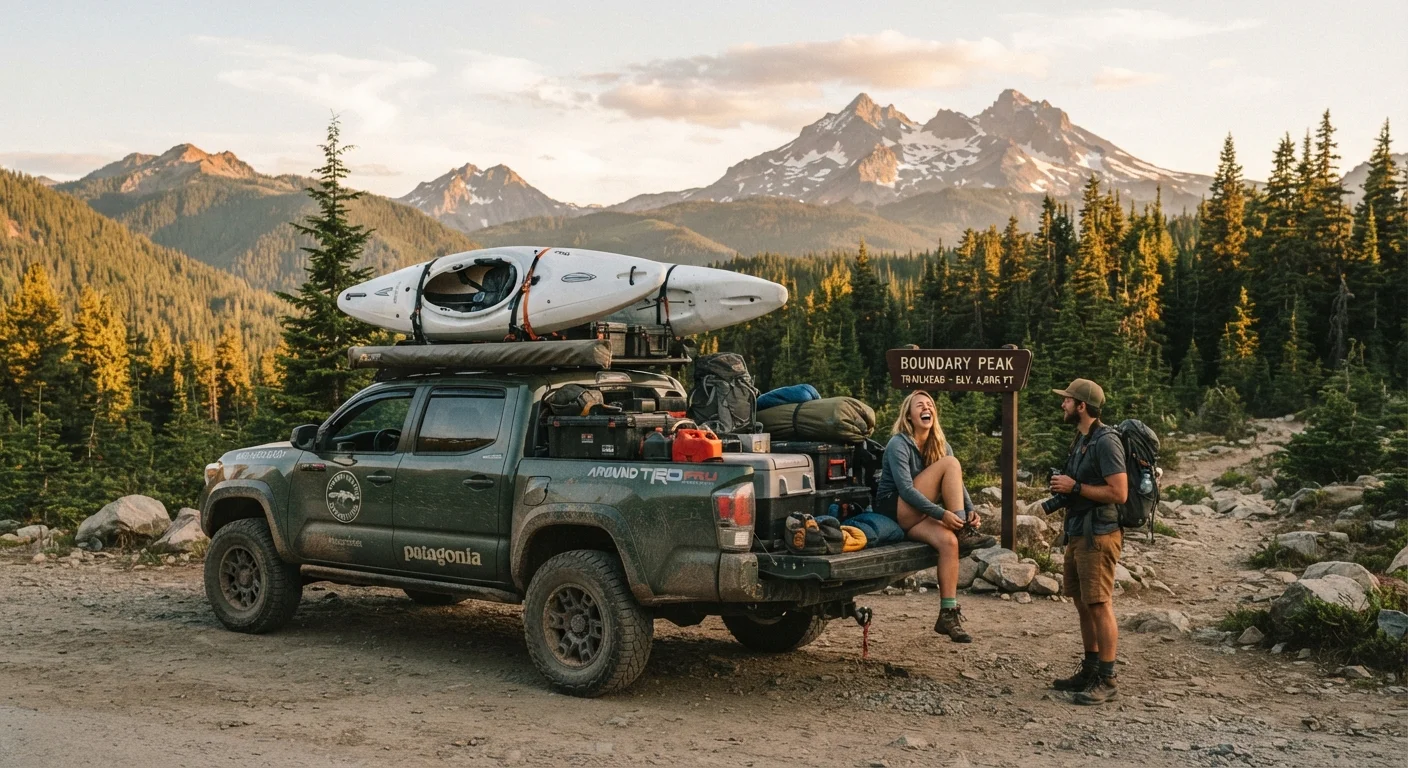
Payload capacity - the maximum weight a truck can carry in its bed and cab combined - is separate from towing capacity and frequently overlooked. It includes passengers, cargo, and any tongue weight transferred from a trailer hitch. Recreational users loading a bed with camping supplies, water containers, recovery gear, and a bed-mounted tent can easily approach payload limits on lighter-duty trucks.
Bed length directly affects what gear you can transport. Short beds (roughly 5.5 feet) accommodate most recreational loads but limit long items like lumber, kayaks lying flat, or full-size ATVs. Standard beds (6.5 feet) hit the practical sweet spot. Long beds (8 feet) maximize cargo space but reduce maneuverability in tight campsites and trail parking areas. Note that crew cab configurations typically pair with shorter beds - a trade-off worth understanding before you configure. Our cab configuration guide explains how cab style and bed length interact.
Cab Configuration and Crew Comfort
Outdoor adventures rarely happen solo. Families or groups camping together need genuine rear-seat space, which points toward crew cab configurations. Extended cabs offer a middle ground - usable rear space for gear storage or occasional passengers - while regular cabs maximize bed length and simplicity at the cost of passenger capacity.
Interior comfort on long drives to remote areas matters more than many buyers anticipate. Suspension tuning that improves off-road articulation can also produce a harsher highway ride. Trucks targeting the outdoor lifestyle segment often tune suspension for a balance between trail capability and long-haul comfort, a distinction worth test-driving on a sustained freeway run, not just a parking lot.
Test Drive on the Right Road
When test-driving a truck for recreational use, request a route that includes at least one highway stretch and, if possible, an unpaved surface. A short city loop won't reveal how the suspension handles load or how the cab feels over several hours of driving to a trailhead. Bring a passenger to simulate real-world occupancy.
Mid-Size vs. Full-Size: Choosing Your Platform
Mid-size trucks have narrowed the capability gap with full-size trucks in recent years while retaining meaningful advantages in maneuverability, fuel efficiency, and easier parking at crowded trailheads or boat ramps. Their shorter wheelbase handles tighter forest roads more confidently. However, towing and payload ceilings remain lower - typically 5,000-7,700 lbs towing and 1,000-1,500 lbs payload for competitive mid-size options.
Full-size trucks offer substantially higher ceilings - towing ratings of 10,000-14,000 lbs are common in half-ton configurations, with heavy-duty three-quarter and one-ton variants reaching well beyond that. If your recreational use includes large trailers, fifth wheels, or horse trailers, a full-size platform is likely necessary rather than optional.
Our dedicated comparison of full-size and mid-size trucks walks through the capability, cost, and daily-use trade-offs in detail. For those questioning whether a truck is the right vehicle at all, the SUV segment covers body-on-frame and crossover options that some adventurers find more versatile.
Vans as an Alternative for Lifestyle Use
For adventure use centered on sleeping in the vehicle, extended overlanding trips, or carrying large volumes of gear, full-size vans present a genuinely competitive alternative. A properly outfitted cargo or conversion van offers weather-protected sleeping, standing room, and organized interior storage that no truck bed - even with a camper shell - can match on equivalent floorspace.
Vans sacrifice towing capacity relative to heavy-duty trucks and offer no bed access for bulky exterior loads like ATVs. But for the "van life" style of travel - point-to-point road trips, surf and ski trips, and extended stays in dispersed camping - their enclosed utility is difficult to match. See our breakdown of cargo vans vs. pickup trucks for a utility-focused comparison of the two formats. Those pursuing a broader mobile lifestyle may also find our RV living guides and RV class matching guide useful for thinking through the full spectrum of vehicle-based travel options.
This article provides general educational information about truck and van capabilities for recreational use. Actual towing capacity, payload, and off-road performance vary by specific vehicle configuration. Always consult the manufacturer's towing guide for your exact truck build and have a qualified professional inspect any vehicle before off-road or heavy towing use.