The Depreciation Curve: Where Value Goes First
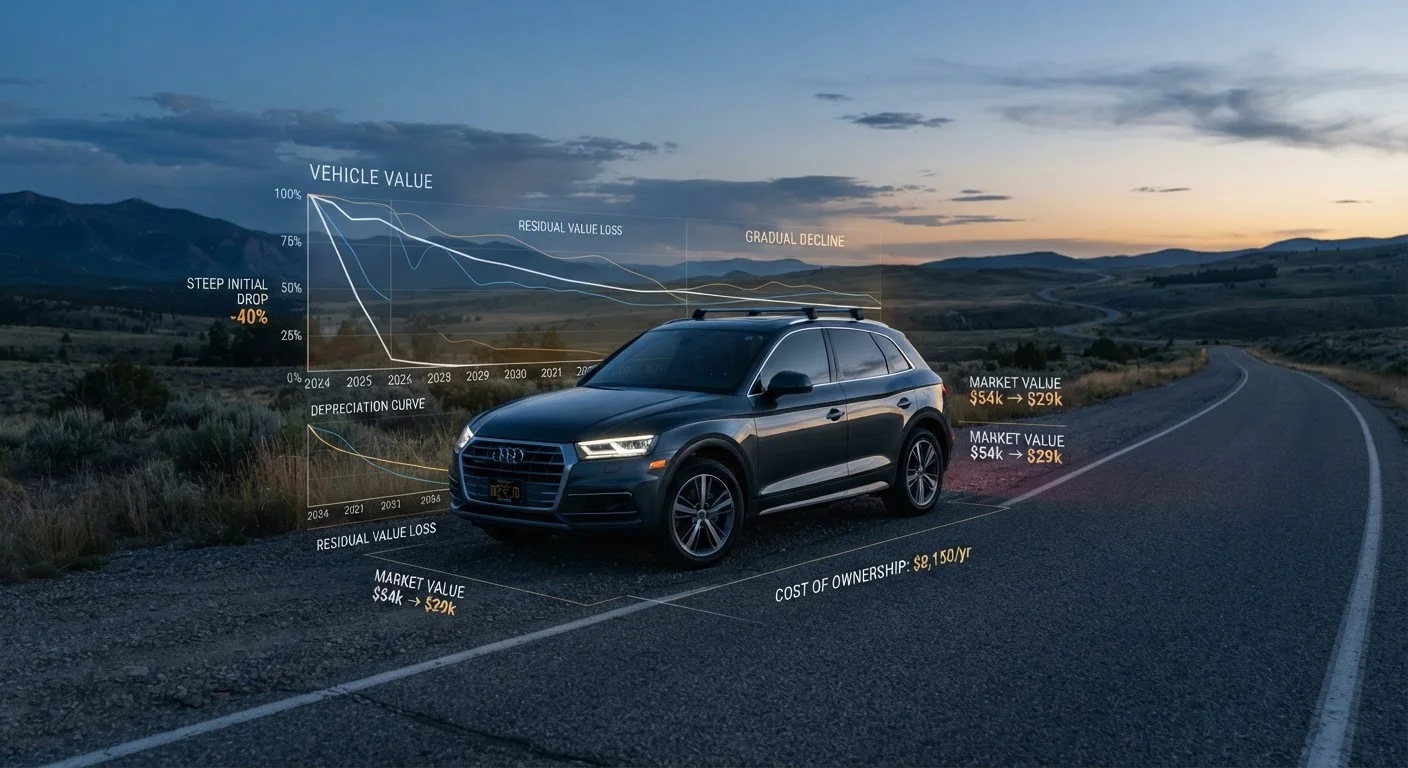
Depreciation is the single largest cost most SUV owners never see itemized on a bill. A new mainstream crossover can shed roughly 20% of its value within the first year and up to 50% by year five, depending on the segment and market demand. Luxury SUVs often experience this curve more sharply in absolute dollar terms - a vehicle that stickered at $75,000 may be worth $35,000-$40,000 after three years, even with low mileage and flawless condition.
Several variables shape how steep this curve gets. Supply and demand dynamics matter enormously - a crossover body style that's consistently backordered depreciates more slowly than a segment experiencing buyer saturation. Drivetrain type also plays a role: all-wheel-drive configurations tend to preserve residual value better than front-wheel-drive equivalents, particularly in northern climates. Trim level is another nuance - mid-tier trims often retain value more effectively than stripped base models or heavily optioned range-topping variants, because they represent the widest pool of used-car buyers.
~20%
Average first-year depreciation for mainstream SUVs
Industry analysts estimate most non-luxury SUVs lose roughly 15-25% of their original value in the first twelve months of ownership.
~50%
Typical five-year depreciation for mid-size SUVs
By the five-year mark, a large share of mid-size SUVs retain only around half their original purchase price, varying by brand and demand.
$1,200-$2,000+
Replacement tire set cost for large-rim SUVs
SUVs equipped with 20-inch or larger wheels frequently require premium all-season tires that carry significantly higher per-set costs than standard sedan fitments.
Understanding how platform architecture influences long-term durability - and therefore residual value - is covered in depth in our guide on modern SUV platforms and drivetrains.
Ownership Costs Beyond the Monthly Payment
Purchase price is only the opening figure. The true cost of SUV ownership is built from layers: fuel, insurance, maintenance, tires, and financing interest. Each layer compounds differently depending on the vehicle's segment and powertrain.
Fuel costs scale with engine displacement and driving patterns. A three-row SUV with a turbocharged V6 will burn meaningfully more fuel than a compact crossover with a four-cylinder hybrid system, particularly in stop-and-go conditions. Insurance premiums tend to track repair costs - larger, more complex vehicles with advanced driver assistance systems (ADAS) carry higher repair bills after even minor collisions, which insurers price accordingly.
Tire costs are frequently underestimated. Many mid-size and full-size SUVs run 20-inch or 22-inch wheels on upper trims, and replacement tire sets can run $1,200-$2,000 or more for quality all-season rubber. Differential servicing, transfer case fluid changes, and brake pad replacements on heavier vehicles also add up in ways buyers may not anticipate. Our related article on unexpected SUV ownership costs breaks these down systematically.
Track Your True Per-Mile Cost
Divide total annual ownership costs - insurance, fuel, maintenance, depreciation estimate - by miles driven to calculate a realistic per-mile figure. This metric makes it easier to compare ownership scenarios objectively and identify where costs are climbing unexpectedly. Many owners find maintenance and tire costs exceed their fuel bill by year four or five.
Diesel SUVs: Efficiency Trade-Offs and Servicing Reality
Diesel-powered SUVs promise improved torque and highway fuel economy, and they often deliver on that promise. However, the total cost picture is more nuanced. Diesel engines require more frequent oil changes using higher-specification lubricants, diesel exhaust fluid (DEF) top-ups, and periodic diesel particulate filter (DPF) regeneration cycles. If a diesel SUV is used primarily for short urban trips - a common real-world usage pattern - the DPF may not reach the temperatures needed for passive regeneration, potentially leading to expensive forced regeneration or filter replacement.
Specialist servicing costs for diesel SUVs can be meaningfully higher than equivalent gasoline variants, and fewer independent mechanics are equipped to handle the emissions systems confidently. Buyers who drive high annual highway mileage - typically above 15,000 miles per year - are more likely to see diesel's efficiency advantage translate into genuine savings. Those with predominantly urban or short-trip driving patterns often find the math tilts toward gasoline or hybrid alternatives.
Diesel Regulations Vary by State
Emissions standards for diesel vehicles differ across U.S. states, and some regions have adopted stricter requirements that affect which diesel models can be registered or operated. Before purchasing a diesel SUV, verify that it complies with your state's current emissions regulations - particularly if you're in a state that follows California Air Resources Board (CARB) standards rather than federal EPA standards.
Planning for Resale: Maximizing Long-Term Value
Resale value is not purely luck - it responds predictably to documented maintenance history, mileage management, condition preservation, and timing. Vehicles with a complete, dealer-stamped or verifiable service record consistently command stronger used-car prices because they reduce buyer uncertainty about mechanical history.
Color choice also has a measurable effect. Neutral colors - white, silver, gray, and black - maintain broader appeal in the used market, while niche colors can narrow the buyer pool at resale. Interior condition carries disproportionate weight: a vehicle with immaculate upholstery and undamaged trim will often sell more quickly and at a premium versus a mechanically identical example with a worn cabin.
For buyers evaluating the complete SUV picture - from body style choice to segment fit - our complete guide to SUVs provides a thorough end-to-end resource. And if you're weighing an SUV against a sedan purely on financial grounds, our Sedan vs. SUV comparison offers useful context beyond the hype.
Ultimately, an SUV's lifecycle value is best understood as a system - depreciation, running costs, and resale intersect to produce the real ownership experience. Buyers who account for each element upfront are better positioned to match the right vehicle to their financial expectations.