Why the Headline Number Rarely Reflects Reality
Walk into any dealership and the towing capacity badge on an SUV seems straightforward: 7,500 lbs, 5,000 lbs, 3,500 lbs. But that number is almost always a maximum rating achieved under a very specific combination of conditions - conditions that rarely match how a real buyer will configure and load the vehicle.
Manufacturers test towing capacity with the lightest possible configuration: typically a base powertrain, no optional equipment, a single driver, and no cargo. Every passenger, every pound of luggage, every aftermarket accessory eats into that ceiling. The figure printed on the window sticker is a theoretical upper bound, not a practical everyday target.
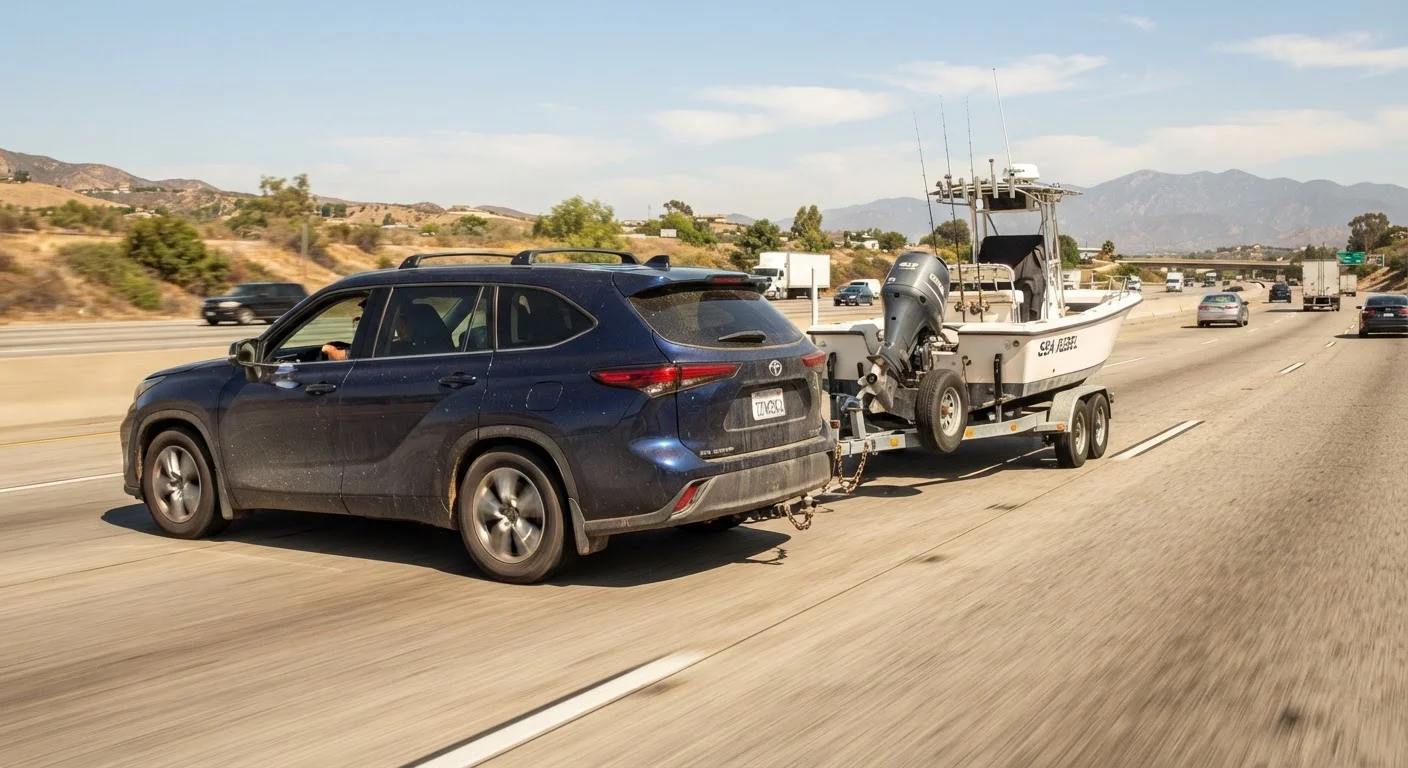
This matters enormously for SUV buyers because crossovers and body-on-frame SUVs are frequently purchased with towing in mind - whether for a small fishing boat, a pop-up camper, or a utility trailer. Understanding what the label omits is the first step toward avoiding an expensive or unsafe mismatch. See also our companion piece on what truck window stickers don't reveal for how the same pattern plays out in the pickup segment.
Treating the advertised maximum tow rating as the vehicle's everyday working limit.
Why it happens: Manufacturers market the highest achievable figure, and buyers naturally interpret that number as a reliable guideline rather than an idealized ceiling.
Ignoring the factory tow package requirement listed in the owner's manual.
Why it happens: Many buyers assume any trim can achieve the published tow rating, not realizing the figure is only valid with a factory-installed tow package that includes upgraded cooling, wiring, and trailer-sway control calibration.
Overlooking tongue weight capacity when selecting a hitch and trailer combination.
Why it happens: Shoppers focus on the maximum trailer weight figure and assume the hitch and rear suspension can handle any load within that limit.
Failing to account for how passengers and cargo reduce available tow capacity.
Why it happens: Tow capacity and payload capacity are perceived as separate, independent figures rather than the interconnected limits they actually are.
Assuming all SUVs with the same tow rating have equivalent cooling and drivetrain durability for sustained towing.
Why it happens: The tow rating number appears equivalent across vehicles, so buyers treat it as a uniform performance benchmark rather than a limit that different drivetrains reach in very different ways.
The Numbers Manufacturers Don't Feature Prominently
Beyond maximum tow rating, three figures determine whether an SUV can safely handle a given trailer in real-world conditions.
10-15%
Recommended tongue weight as share of trailer weight
This industry-standard guideline helps prevent rear-end sag, trailer sway, and hitch overload regardless of the vehicle's maximum tow rating.
~1,000 lbs
Typical mid-size SUV payload capacity
Many popular mid-size SUVs carry payload ratings in the 900-1,200 lb range, meaning a loaded family can consume the majority before a trailer is coupled.
Payload Capacity
Payload is the total weight of everything inside the vehicle - passengers, gear, and any tongue weight pressing down through the hitch. Many mid-size SUVs carry payload ratings under 1,200 lbs. A family of four with luggage can consume 700-800 lbs before a trailer is even attached. Whatever tongue weight remains in the payload budget is the practical ceiling for trailer coupling load. For a deep dive into how payload and towing interact, our guide on payload vs. towing capacity explains the relationship clearly.
Tongue Weight Rating
Tongue weight - the downward force the trailer exerts on the hitch ball - should typically fall between 10% and 15% of total trailer weight. SUVs carry a separate tongue weight rating that can be far more restrictive than the overall tow rating implies. Exceed it and you risk rear suspension overload, steering instability, and hitch damage.
Cooling System Capacity
Sustained towing generates significant heat in the transmission, engine coolant, and differential fluid. Spec sheets rarely list transmission oil cooler size or radiator capacity. Vehicles without factory tow packages often lack the upgraded cooling components needed for extended grades or hot-weather towing - a gap that shows up not on the label, but in premature component wear. This same principle of reading beyond the rating applies when assessing any towed equipment; see our article on what boat capacity ratings really mean for a parallel example.
Always Verify the Configuration-Specific Rating
Towing capacity varies by engine, drivetrain, and trim level within the same model line - sometimes by more than 2,000 lbs. Before relying on any figure, confirm the rating for your exact configuration using the manufacturer's towing guide or the vehicle's owner's manual, not the marketing brochure or window sticker headline.
Planning to tow an RV? The class of towable unit dramatically changes what any SUV can realistically handle. Our breakdown of RV classes and the tow vehicles they require outlines exactly what each category demands.