How Each System Works
Understanding the mechanical distinction between four-wheel drive (4WD) and all-wheel drive (AWD) is essential before comparing them in a truck context. The terms describe different hardware architectures with different intended use cases.
4WD systems use a transfer case to lock the front and rear driveshafts together, sending equal torque to both axles. Trucks typically offer selectable modes: 2H for normal pavement driving, 4H for slippery or loose surfaces at normal speeds, and 4L for slow-speed, high-torque situations like rock crawling or deep mud. Engaging 4WD on dry pavement causes driveline binding because the front and rear axles cannot rotate at different speeds - a critical limitation to understand.
AWD uses a center differential or electronically controlled coupling to distribute torque between axles continuously and automatically. There's no driver input required, and no selectable low range in most truck AWD configurations. The system reads wheel-speed sensors and adjusts torque split in milliseconds, making it transparent in everyday use.
For a broader comparison of how these systems translate to SUV platforms, see how AWD and 4WD differ in SUVs.
| Criterion | 4WD | AWD | |
|---|---|---|---|
| Engagement | Manual, driver-selected | Automatic, continuous | |
| Low-range gearing | Yes (4L mode) | Typically not available | |
| Dry-pavement use | 2H only; 4WD causes binding | Safe on all surfaces | |
| Off-road capability | High - with 4L crawl ratio | Moderate - no low range | |
| Daily driving ease | Requires mode management | No driver input needed | |
| Typical fuel economy impact | Lower in 2H; higher in 4WD | Consistent, moderate penalty | |
| Best application | Off-road, heavy towing, work sites | Mixed-use, all-weather commuting |
Off-Road and Towing Capability
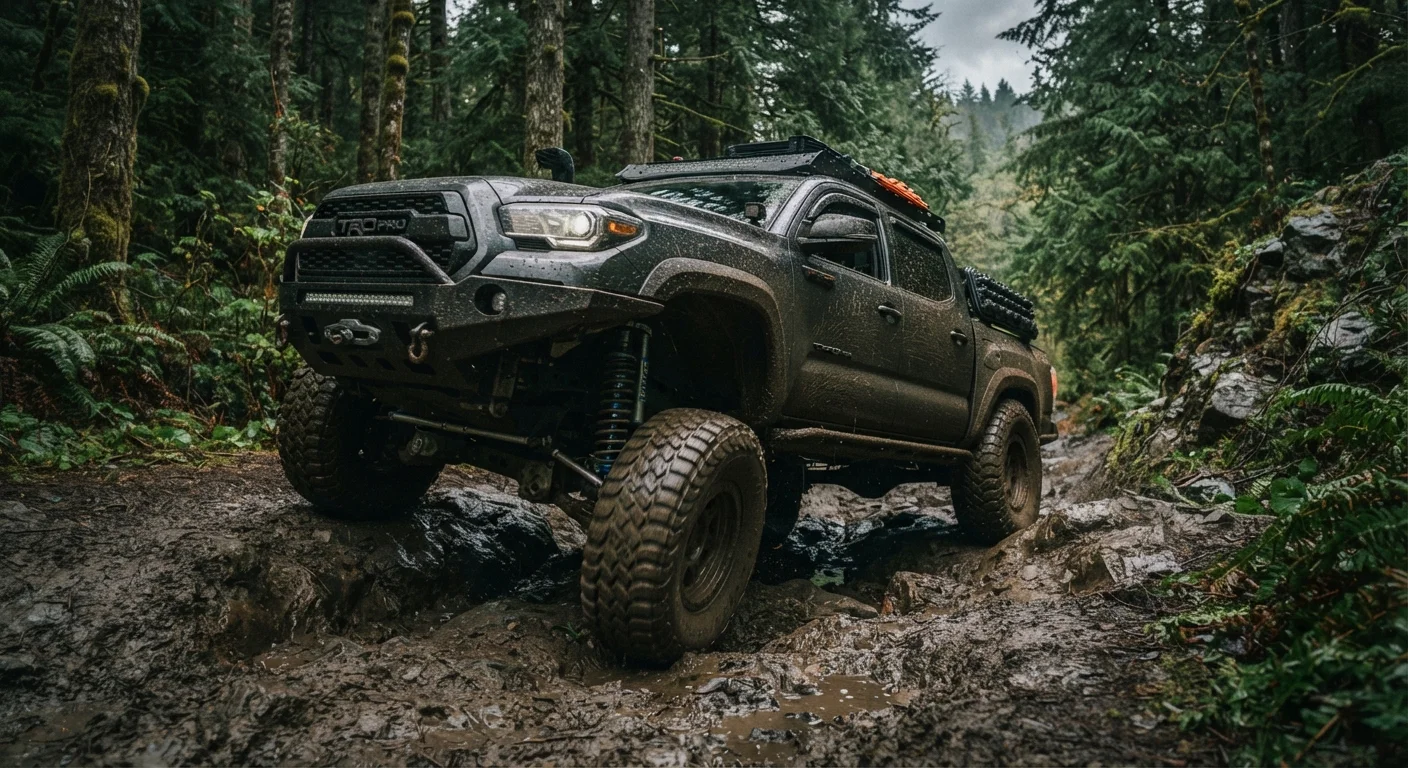
When the terrain gets serious, the presence of a low-range transfer case is often the deciding factor. 4WD's 4L mode multiplies torque mechanically, allowing a truck to crawl over rocks, through deep ruts, or up steep inclines at very low speeds without slipping the clutch or overheating the drivetrain. AWD systems, even sophisticated ones, cannot replicate this mechanical advantage.
For towing, 4WD provides the ability to switch into 4H when pulling a trailer up a slick boat ramp or navigating a muddy campsite. AWD handles these scenarios adequately in many cases, but drivers sacrifice the manual control that comes with selectable engagement. Trucks used for frequent heavy towing across unpredictable terrain benefit from having that control layer available.
Recreational truck use places distinct demands on a drivetrain - overlanding, trail recovery, and boat launching each stress traction systems differently, and 4WD's lower gear ratio provides a meaningful safety margin in those scenarios.
Know Your Terrain Before You Buy
If most of your off-pavement driving involves established forest roads or occasional gravel, AWD may be entirely sufficient. Reserve the added complexity of a 4WD system for buyers who regularly encounter deep mud, loose rock, or steep grades where low-range gearing provides genuine capability. Thinking honestly about your actual use - not aspirational scenarios - leads to the most practical drivetrain decision.
Daily Driving, Fuel Economy, and Practicality
AWD has a clear advantage in everyday usability. Because it operates automatically, there's no risk of forgetting to disengage 4WD on dry pavement, and no driveline binding. For truck owners whose off-pavement time is limited to wet highways, snowy parking lots, or occasionally unpaved roads, AWD handles the job without any additional attention.
From a fuel economy standpoint, both systems carry a penalty over two-wheel drive due to added rotating mass and drivetrain drag. Part-time 4WD systems that default to rear-wheel drive in 2H mode can be more efficient than AWD systems that maintain full-time torque distribution, though the difference varies significantly by vehicle and driving conditions.
~2-5%
Typical AWD fuel economy penalty vs. 2WD
Industry estimates suggest AWD adds roughly 2-5% to fuel consumption compared to equivalent two-wheel-drive configurations, varying by vehicle weight and system design.
2.5:1-4:1
Common 4L low-range gear reduction ratios
Transfer cases in body-on-frame trucks typically offer low-range ratios between 2.5:1 and 4:1, multiplying engine torque for low-speed traction demands.
Truck buyers who split time between urban commuting and weekend work or recreation should also consider how drivetrain choice interacts with suspension. Suspension system design affects how well either drivetrain can put power to the ground across different surfaces.
Finally, drivetrain selection doesn't exist in isolation from truck class. Full-size and mid-size trucks often differ in the sophistication and availability of their 4WD and AWD configurations, which can influence which class makes sense for a given use case.