Why Cushion Material Matters More Than You Think
Most OEM vehicle seats are engineered to suit a wide population average - not your specific anatomy, driving posture, or typical trip length. For drivers who spend meaningful time behind the wheel, the gap between a generic seat and a properly matched cushion can translate directly into fatigue, lower back tension, or pressure-point discomfort over time.
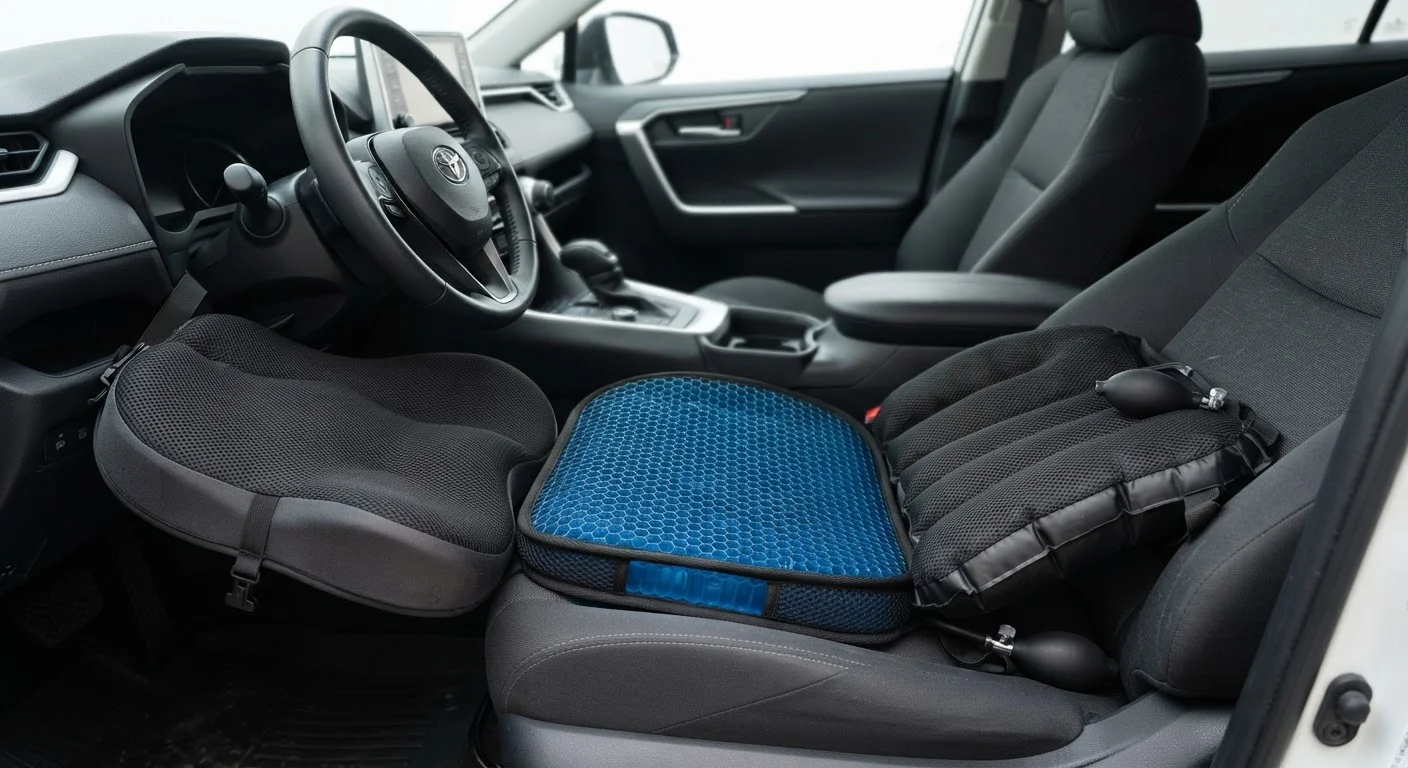
The three dominant cushion categories - foam, gel, and inflatable - each address that gap differently. Understanding their underlying mechanics helps you match the right option to your actual use case rather than defaulting to whatever looks most padded. For broader ergonomic context, the guide to driving ergonomics covers how seat positioning and lumbar support interact with cushion choice.
| Foam | Gel | Inflatable | |
|---|---|---|---|
| Pressure distribution | Good - broad contact area | Very good - flows under load | Adjustable - user-controlled |
| Heat management | Moderate - retains heat | Mixed - cools briefly, then retains | Good - air dissipates heat |
| Adjustability | None - fixed firmness | None - fixed firmness | High - pump to preference |
| Durability | Moderate - compresses over time | Good - resists compression set | Variable - valve/seam risk |
| Weight | Light | Moderate to heavy | Light when deflated |
| Best trip length | Short to medium | Medium | Medium to long |
| Complexity | None - use as-is | None - use as-is | Low - requires inflation |
Foam Cushions: Reliable Support with Tradeoffs
High-density foam is the most common cushion material and for good reason - it offers predictable, consistent support without mechanical complexity. Foam compresses under load and rebounds, distributing weight across a broader surface area than an unsupported seat pan. Memory foam variants add a time-delayed conforming quality that some drivers find reduces hotspots at the sit bones.
The primary limitation is heat retention. Closed-cell foam traps body heat, which becomes noticeable on drives exceeding 30-45 minutes in warm climates. Open-cell and ventilated foam designs partially address this, though they typically sacrifice some load-bearing rigidity in the process. Foam also has a finite compression lifespan - most consumer-grade foam cushions show measurable compression set after 12-24 months of daily use.
Drivers weighing foam against more specialized designs should also review the comparison of memory foam and coccyx cushions, which examines how foam density and cutout geometry interact differently depending on posture.
Test Foam Density Before Committing
A quick way to assess foam quality in-store: press your palm firmly into the cushion and hold for five seconds. High-density foam should rebound fully within two to three seconds. Slow or incomplete rebound suggests lower-density foam that will compress out faster under daily driving loads. This test doesn't work through thick packaging, so look for floor models or open-box units where possible.
Gel Cushions: Pressure Distribution and the Heat Question
Gel cushions - typically a polymer gel layer bonded over a foam base - excel at pressure distribution. The gel flows slightly under load, equalizing contact pressure across irregular surfaces more effectively than foam alone. This is particularly relevant for drivers who experience discomfort at the coccyx or ischial tuberosities (sit bones) during medium-length drives.
The heat management narrative around gel is more nuanced than marketing often suggests. Gel does absorb heat initially, producing a brief cooling sensation on contact. However, once the gel reaches body temperature - usually within 15-20 minutes of sustained contact - that thermal advantage largely disappears. In high-ambient-temperature environments, gel can actually retain heat longer than ventilated foam alternatives.
Durability is generally strong; quality gel-foam composites hold their shape well and resist the compression set that affects pure foam. Weight is a minor consideration - gel layers add meaningful mass compared to foam-only designs, which matters for drivers who frequently move cushions between vehicles.
Inflatable Cushions: Adjustability as the Core Feature
Inflatable cushions operate on a fundamentally different principle: rather than relying on material properties for support, they let the driver dial in firmness directly. A hand pump or built-in valve allows incremental adjustments, making these cushions uniquely suited to drivers whose support needs vary - due to fatigue, load-bearing changes, or evolving back conditions.
The adjustability advantage is most pronounced for commercial drivers, long-haul operators, and anyone recovering from a back injury who needs to shift pressure distribution throughout a trip. Van and large-vehicle operators in particular may benefit, as seat geometry in high-roofline vehicles creates different pelvic tilt dynamics - a topic covered in depth in the comfort accessories guide for vans and tall vehicles.
Durability is the main concern with inflatable designs. Valve mechanisms and seams represent potential failure points that foam and gel constructions simply don't have. Quality varies widely, and puncture or slow leaks - though uncommon in well-constructed models - do represent a risk not present in the other categories. Heat management is generally neutral; air-filled chambers don't retain body heat the way solid materials do, though the outer fabric covering plays a significant role.
Don't Over-Inflate for Maximum Firmness
With inflatable cushions, more air doesn't always mean better support. Over-inflation creates a rigid, unforgiving surface that can increase pressure on bony contact points rather than relieving it. Start at approximately 60-70% inflation and adjust upward gradually over several drives until you find the level that distributes weight without creating new pressure hotspots.
Choosing Based on Your Driving Profile
The most useful framework for selecting among these three types is to map cushion characteristics against three variables: trip duration, sensitivity profile, and vehicle type.
- Short commutes (under 30 min): Foam handles this range well. Heat buildup is minimal and support is consistent.
- Medium trips (30 min-2 hours): Gel's pressure-distribution advantage becomes relevant. Heat accumulation is manageable at this duration.
- Extended or all-day driving: Inflatable designs allow mid-trip adjustments that neither foam nor gel can match. This matters for commercial drivers and road-trippers alike.
Drivers with tailbone sensitivity should also evaluate cutout geometry regardless of material - a gel cushion with a coccyx relief channel will outperform a flat foam cushion for this specific concern. And if you're building out a fuller comfort setup, pairing your seat cushion with a headrest or neck pillow addresses the upper-body fatigue that seat cushions alone don't resolve.
65%
Drivers reporting lower back discomfort
According to occupational health research, roughly 65% of professional drivers report experiencing lower back pain related to prolonged seated driving.
~20 min
Gel heat-neutralization window
Thermal testing suggests most gel cushions reach ambient body temperature equilibrium within 15-20 minutes of sustained contact, after which cooling benefits diminish.