Why Helmet Certifications Matter - and Where They Differ
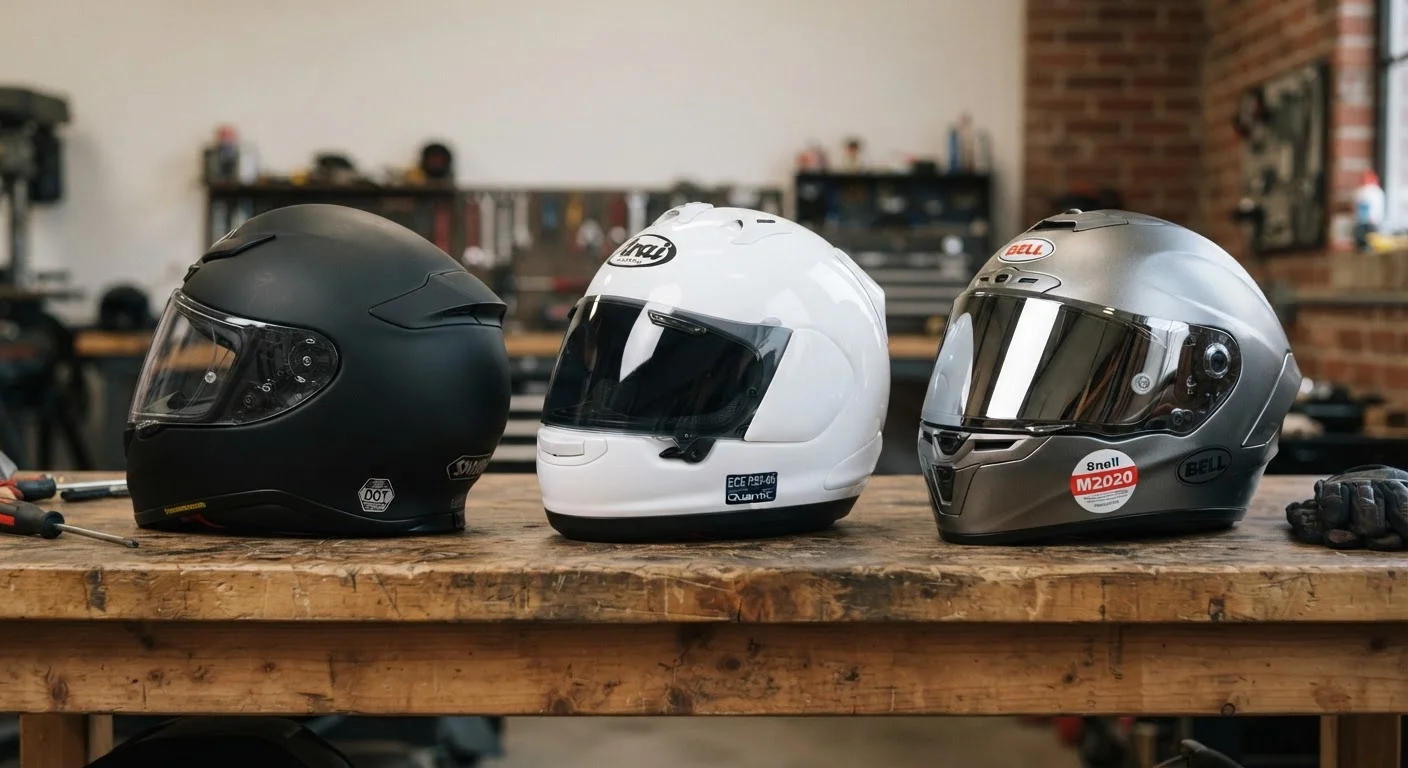
Not all certification labels represent the same level of scrutiny. The three standards most commonly found on helmets sold in the US - DOT, ECE 22, and Snell - each define their own test protocols, impact energy thresholds, and enforcement mechanisms. Understanding those differences helps riders make an informed decision rather than assuming any sticker signals equivalent protection.
For a broader look at how safety rating systems work across vehicle types, see how NHTSA and IIHS scores are structured. The same principle applies here: the methodology behind a rating shapes what it actually tells you.
| DOT (FMVSS 218) | ECE 22.06 | Snell M2020 | |
|---|---|---|---|
| Testing authority | Manufacturer self-certifies | Independent accredited lab | Snell-accredited lab |
| Pre-market lab verification | No | Yes | Yes |
| Rotational impact testing | No | Yes (22.06) | No |
| Impact energy threshold | Moderate (13.4 ft-lb) | Moderate-high | High (multiple levels) |
| Post-market surveillance | NHTSA reactive testing | Regulatory body oversight | Random purchase retesting |
| Legal requirement (US streets) | Yes (where mandated) | Accepted, not required | Not required |
| Common use context | Street, general use | Street, international use | Motorsport, track days |
DOT: The US Legal Baseline
The Department of Transportation (DOT) standard, codified under Federal Motor Vehicle Safety Standard No. 218 (FMVSS 218), is the minimum legal requirement for motorcycle helmets sold and used on public roads in the United States. Every state that mandates helmets recognizes DOT as the compliance threshold.
The critical nuance: DOT operates on a self-certification model. Manufacturers test their own products and apply the DOT sticker - no independent laboratory verifies a helmet before it goes to market. The National Highway Traffic Safety Administration (NHTSA) conducts post-market surveillance, pulling helmets from retail and testing them, but this is reactive rather than preventive. As a result, counterfeit and non-compliant DOT stickers do appear in the market.
Counterfeit DOT Stickers Are a Real Risk
Because DOT is self-certified, non-compliant helmets with fraudulent DOT stickers do circulate - particularly through unverified online marketplaces. NHTSA publishes a list of helmets that have failed post-market testing. If a helmet's price seems implausibly low or the liner feels thin and hard, treat that as a red flag and verify the model against known compliance records before relying on it.
DOT tests evaluate impact attenuation (energy absorption), penetration resistance, and retention system strength. Impact tests use a 13.4 ft-lb energy drop - a relatively moderate threshold compared to the other two standards.
ECE 22.06: Third-Party Testing Before Market Entry
The Economic Commission for Europe Regulation 22 - currently at revision 22.06 - is the dominant standard across Europe and recognized in more than 50 countries. Unlike DOT, ECE requires independent, accredited laboratory testing before a helmet can be certified and sold. Manufacturers cannot self-apply the label.
Revision 22.06 (adopted in 2020 and phased in through 2023-2024) introduced several meaningful updates over the previous 22.05: rotational impact testing using an angled impact protocol that measures forces linked to brain injury, expanded coverage zones on the helmet shell, and stricter chin-bar requirements for full-face helmets. The rotational component reflects evolving understanding of how oblique impacts contribute to concussion and diffuse axonal injury - a dimension that DOT does not currently address. See our safety equipment glossary for plain-language definitions of these injury mechanics terms.
ECE 22.06-certified helmets are legal for road use in most US states (since they meet or exceed DOT thresholds), though they are not required by US law. Riders seeking internationally aligned, independently verified certification often consider ECE 22.06 a meaningful step above DOT alone.
Snell: Voluntary, Rigorous, and Track-Oriented
The Snell Memorial Foundation is a non-profit organization that publishes its own helmet standards - most commonly M2020 for motorcycles. Snell certification is entirely voluntary; manufacturers submit helmets and pay for testing. If a helmet passes, it earns the Snell label; if it fails, the result is not publicized.
Snell's impact energy thresholds are higher than DOT's - the M2020 standard uses multiple impact energies and a harder, flatter anvil in some configurations, designed to reflect the types of impacts encountered in motorsport. Tests are conducted at accredited facilities under Snell's oversight, and certified helmets are subject to random purchase-and-retest surveillance.
Dual Certification Is Achievable - and Useful
Many helmets carry both ECE 22.06 and Snell M2020 certification, providing verification across two independent methodologies. If you ride on both public roads and at track events, a dual-certified helmet simplifies compliance across venues. Check the certification labels physically present inside or on the helmet, not just marketing copy.
One ongoing technical debate: some researchers have argued that Snell's historically harder foam liner (required to pass high-energy impacts) may transmit more force during moderate, real-world crashes compared to softer liners optimized for lower-speed impacts. The foundation has addressed this in newer standards, but it's a useful reminder that no standard captures every crash scenario. For a deeper dive into how helmet design choices affect protection, see what the evidence says about helmet effectiveness.
Choosing the Right Standard for Your Riding Context
For street riders in the US, a DOT label is the legal floor. Riders who want independently verified testing should look for ECE 22.06 or Snell M2020. Track-day participants should confirm which standard their venue requires - many WERA, NASA, and club events specify Snell or, increasingly, ECE 22.06.
Helmet standards are one part of the broader safety equipment picture. Understanding what each piece of safety gear does helps riders build a complete system rather than focusing on any single item. And regardless of certification tier, fit remains non-negotiable - a helmet that moves on your head during an impact cannot perform as tested. See full-face vs open-face helmet trade-offs for guidance on how coverage style interacts with protection level.
This article is for informational and educational purposes only. Helmet certification requirements vary by jurisdiction; consult your local laws and a qualified safety professional before making decisions about protective equipment.