
Why Factory Calibrations Leave Room on the Table
Manufacturers don't tune their engines for maximum output at the point of sale. Instead, ECU calibrations are engineered to satisfy a wide range of conditions: varying fuel octane grades across global markets, emissions certification requirements, temperature extremes, altitude ranges, and long service intervals. The result is a calibration that prioritizes reliability, regulatory compliance, and consistent behavior - not peak performance.
For turbocharged vehicles in particular, this means boost pressure and fueling are deliberately kept conservative. Understanding what each modification actually changes helps put this in perspective: the hardware may be capable of more, but the software acts as a governor. A remap adjusts that governor while keeping the engine within - or sometimes slightly beyond - its mechanical tolerances.
Remapping Is Software, Not a Hardware Upgrade
It's easy to conflate what a remap changes with what a physical modification does. A remap cannot overcome a hardware bottleneck - a restrictive stock turbo, undersized injectors, or an intercooler running heat-soak will limit results regardless of the calibration. Think of remapping as optimizing the instructions given to existing hardware, not replacing that hardware.
What a Remap Actually Changes
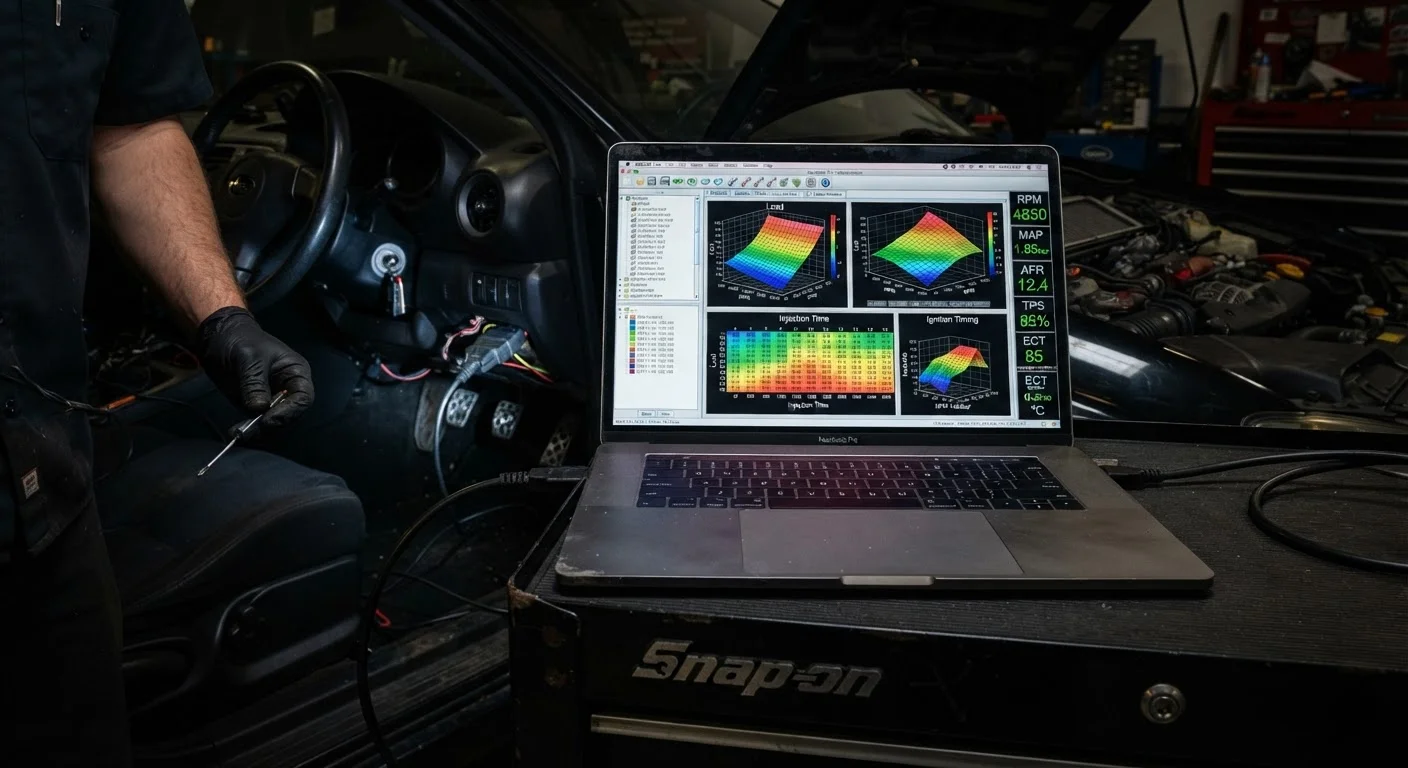
A tuner accesses the ECU either through the OBD-II port or, in some cases, directly via the ECU's circuit board (a process called bench flashing). Once connected, they read the existing calibration data and modify specific parameters:
- Ignition timing: Advancing timing increases combustion efficiency but risks knock on low-octane fuel.
- Fuel delivery: Adjusting injector duration and pressure affects air-fuel ratio across the rev range.
- Boost pressure: On turbocharged engines, raising target boost is one of the most impactful adjustments available.
- Torque limiters and rev limits: Manufacturers often impose software caps that a remap can raise, assuming mechanical components can tolerate the change.
- Throttle mapping: Altering throttle response curves changes how quickly the engine reacts to pedal input, independent of actual power output.
For a deeper look at how these variables interact inside a high-output engine, see the anatomy of a high-performance engine.
10-25%
Typical torque gain range on turbocharged engines
Commonly cited range across tuning industry data; actual results depend on engine design, starting calibration, and supporting modifications.
3-7%
Typical power improvement on naturally aspirated engines
Without forced induction, software changes have limited headroom; gains come primarily from optimized fueling and ignition timing.
OBD-II
Standard port used to access ECU calibration data
All US-market vehicles manufactured after 1996 are required to include a standardized OBD-II diagnostic port, which tuners use for reflashing.
Realistic Expectations by Engine Type
Not all engines respond equally to remapping. Turbocharged and supercharged engines have the most headroom because boost pressure is a powerful lever - and factory calibrations on forced-induction motors are often notably restrained. Naturally aspirated engines, which depend on atmospheric pressure and displacement for airflow, have far less to gain from software changes alone.
Diesel engines - particularly modern common-rail turbodiesels - are well-known for responding strongly to remapping. Torque gains are often substantial because diesel ECUs manage fueling across a wide range, and factory maps tend to be conservative to protect the drivetrain and meet emissions targets.
Petrol (gasoline) engines benefit most when the remap is paired with supporting hardware: a freer-flowing exhaust, upgraded intercooler, or higher-octane fuel. Without those changes, a remap on a stock petrol engine is working against physical constraints. A grounded approach to first performance modifications covers how to sequence upgrades logically before committing to a tune.
Prioritize a Custom Tune Over Generic Maps
Off-the-shelf remap files are written for a representative example of your engine, not your specific vehicle. A custom tune built on a dynamometer accounts for your actual air-fuel readings, knock threshold, and any supporting modifications already fitted. While it costs more upfront, a custom calibration carries meaningfully lower risk and more accurate results.
Risks, Emissions Compliance, and Longevity
A poorly executed remap - or one that pushes parameters beyond what the engine's cooling, fueling, or mechanical components can sustain - can accelerate wear, cause knock, or damage components over time. The quality of the tuner and their calibration methodology matters enormously. Generic off-the-shelf maps carry more risk than a custom dyno-verified tune built specifically for your vehicle's condition and supporting modifications.
Emissions compliance is a separate and serious consideration. Federal law under the Clean Air Act restricts tampering with emissions-related control systems, and many states - including California - have additional CARB regulations that apply. Remaps that alter EGR, DPF, or catalytic converter behavior to bypass emissions systems can create legal exposure, especially if the vehicle is subject to periodic emissions testing.
Common engine tuning myths are worth reviewing before forming expectations - particularly claims about dramatic power gains on stock, naturally aspirated engines. Additionally, understanding your vehicle's diagnostic baseline before a remap helps you identify whether any existing issues need addressing first.