
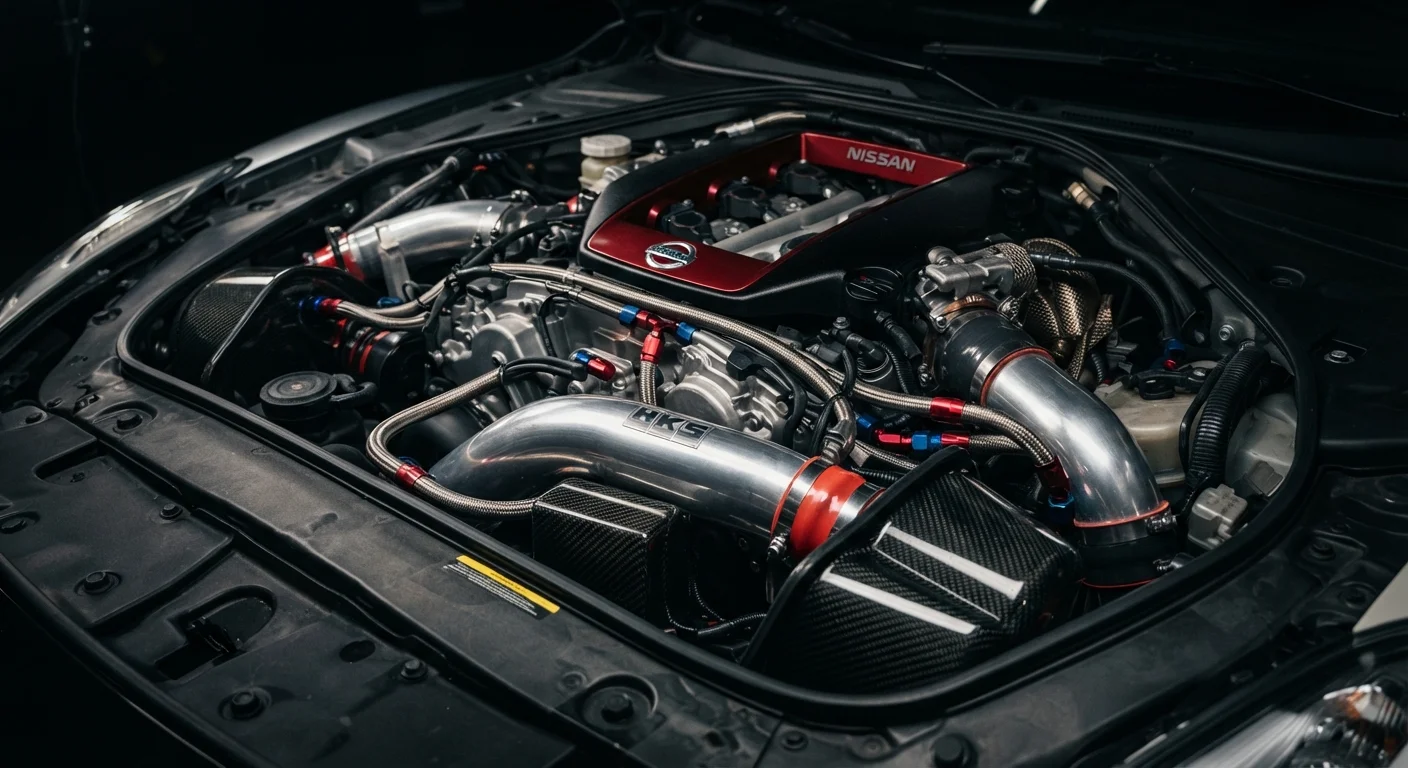
What Performance Upgrades Actually Target
Performance modification is a broad term that covers changes to four core vehicle systems: the powertrain, the suspension and chassis, the braking system, and the aerodynamic profile. Each system has distinct variables that can be altered, and each responds differently to modification. Understanding the system you're working with - and what specific variable you're trying to change - is the foundation of any informed build.
The powertrain encompasses everything that generates and delivers power: the engine, its air and fuel delivery systems, the transmission, and the drivetrain. Suspension modifications affect ride height, spring stiffness, damping control, and geometry. Braking upgrades target stopping force, fade resistance, and heat management. Aerodynamic changes manipulate airflow to reduce drag or increase downforce. For a broader look at how these systems define a vehicle's character, see what makes a vehicle a performance car.
10-15%
Typical power gain from ECU tuning alone
Independent dyno testing across various applications suggests ECU remapping can yield 10-15% output increases on turbocharged engines with factory-conservative maps.
~30%
Reduction in brake fade with upgraded rotors
Larger, slotted, or vented rotors increase thermal dissipation capacity significantly, with performance brake system manufacturers citing meaningful reductions in fade under repeated hard-stop conditions.
1-3°
Camber adjustment range for track alignment
Performance alignment setups commonly run 1-3 degrees of negative front camber to maximize tire contact patch during cornering, compared to near-zero on most factory street alignments.
Engine and Powertrain Modifications
Most enthusiasts think of engine mods first - and for good reason. Airflow is the foundation of combustion power, so many common upgrades focus on getting more air in and exhaust gases out more efficiently. Intake upgrades, high-flow air filters, and performance exhaust systems all operate on this principle. Increasing air volume and reducing backpressure allows the engine to combust fuel more effectively across its RPM range.
Engine management tuning - adjusting the calibration of the engine control unit (ECU) - is one of the more substantive modifications available for modern vehicles. By modifying fuel maps, ignition timing, and boost targets (on turbocharged engines), tuners can unlock power that the manufacturer intentionally left on the table for reliability, emissions, or market differentiation reasons. For a detailed look at forced induction specifically, how a turbocharger forces more power from a smaller engine covers the mechanics of boost and intercooling.
It's worth noting that engine modifications rarely act in isolation. Gaining meaningful power from intake improvements typically requires matched fuel delivery and ignition tuning. The cascade effect is real - and worth planning for before committing to any single component. Understanding that cascade effect can save significant cost down the line.
“Every modification you make to a performance vehicle is a compromise. The question isn't whether it has trade-offs - it does. The question is whether those trade-offs align with how you actually drive the car.”
— Carroll Smith, Motorsport engineer and author of 'Prepare to Win' and 'Tune to Win'
Suspension, Handling, and Braking
Speed is only useful if the vehicle can be controlled - which is why chassis and suspension modifications matter as much as powertrain gains for most real-world driving. Lowering springs or coilover systems reduce ride height to lower the center of gravity and can firm up spring rates, reducing body roll through corners. Upgraded sway bars (anti-roll bars) limit chassis lean without affecting straight-line ride quality as dramatically as stiffer springs alone.
Alignment geometry - particularly camber, caster, and toe settings - directly affects tire contact patch during cornering and straight-line stability. These are often adjusted as part of a suspension build but are frequently overlooked as standalone performance variables. For a thorough breakdown of the handling modification landscape, handling modifications worth understanding before you commit covers trade-offs in detail.
Braking upgrades typically target either thermal capacity or friction coefficient. Larger rotors dissipate heat across a greater surface area, reducing brake fade under repeated hard stops. Performance brake pads increase friction but may require higher operating temperatures to perform optimally - a consideration for vehicles primarily used in daily commuting versus track environments.
Match the Modification to the Use Case
Before committing to any suspension upgrade, clarify whether the vehicle is used primarily on the street, at track days, or in autocross. Coilovers optimized for circuit use - very stiff, low ride height - can make a daily-driven car unpredictable on rough pavement and harsh over expansion joints. Suspension modifications involve genuine safety trade-offs that matter most when conditions are imperfect.
Aerodynamics and What the Numbers Mean
Aerodynamic modifications work by manipulating air pressure around the vehicle's body. Downforce - the aerodynamic force pushing the vehicle into the road surface - increases mechanical grip without adding vehicle weight. Spoilers, wings, diffusers, and splitters all contribute to this effect, though their impact varies considerably by vehicle speed and shape. At street speeds, many bolt-on aerodynamic parts produce marginal measurable downforce; their value increases substantially at higher sustained velocities.
Drag reduction is the counterpart concern. A lower drag coefficient means less resistance at speed, which directly affects top-end performance and fuel economy. Smooth underbody panels, carefully shaped side mirrors, and flush body elements all reduce turbulent airflow. Aerodynamics in high-performance vehicles explains how these principles shape real-world capability in purpose-built cars.
The key distinction for enthusiasts: aerodynamic modifications designed for track-level downforce often increase drag in the same motion, which can reduce straight-line top speed. Understanding this trade-off - and matching aero setup to the intended use case - is what separates informed builds from appearance-driven modifications. If you're ready to take the next step, a grounded starting point for your first modification can help you prioritize intelligently.