The Fundamental Difference: Hitch Design
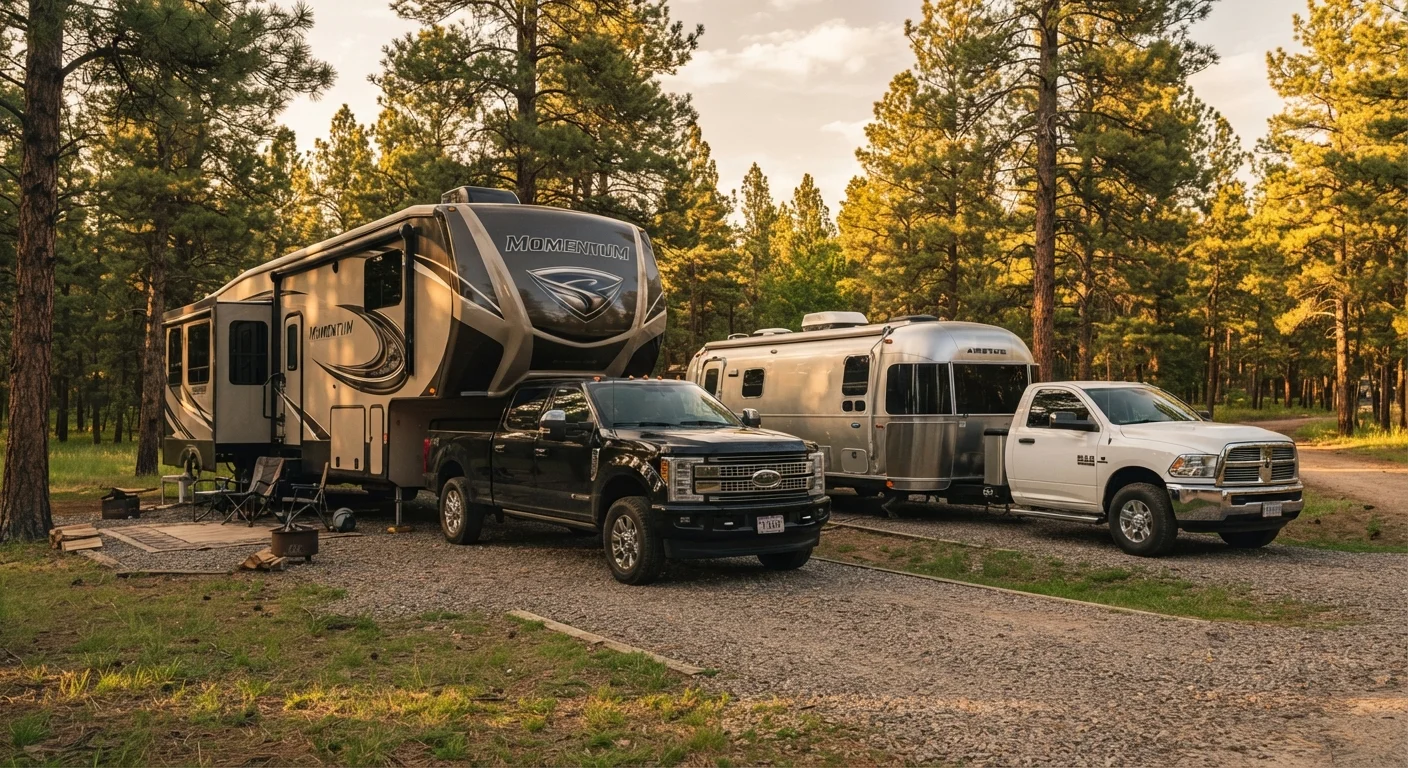
The most defining distinction between a fifth wheel and a travel trailer is how each one connects to the tow vehicle. A fifth wheel uses a kingpin - a large steel pin mounted on the front underside of the trailer - that locks into a horseshoe-shaped coupling mounted in the bed of a pickup truck. This hitch style places a significant portion of the trailer's weight directly over the truck's rear axle, which is the primary reason fifth wheels are so stable on the highway.
A travel trailer connects via a conventional ball hitch at the rear of the tow vehicle. The trailer's coupler clamps onto the ball, and a weight-distribution hitch (required for heavier trailers) uses spring bars to redistribute tongue weight across all axles. While properly configured ball-hitch setups perform well, they are inherently less rigid than a kingpin connection and more susceptible to sway in crosswinds or when passed by large trucks.
The practical consequence: fifth wheels require a pickup truck with an appropriate bed length - typically a 6.5-foot or longer bed for standard kingpin placement - whereas travel trailers can be towed by a broader range of vehicles, including SUVs, crossovers, and trucks. Understanding payload versus towing capacity ratings is essential before pairing any trailer to a tow vehicle.
| Criterion | Fifth Wheel | Travel Trailer |
|---|---|---|
| Hitch Type | Kingpin in truck bed | Ball hitch at rear bumper |
| Tow Vehicle Required | Pickup truck (typically ¾-ton or 1-ton) | SUV, crossover, or truck |
| Towing Stability | High - over-axle weight transfer | Moderate - sway management needed |
| Interior Ceiling Height | 7-8 ft (main area) | 6.5-7 ft (typical) |
| Floor Plan Layout | Bi-level with separated bedroom | Single level, varied configurations |
| Weight Range (GVWR) | ~10,000-22,000+ lbs | ~2,000-15,000+ lbs |
| Typical Price Range | Higher average cost | Broader range, lower entry point |
| Slide-Out Capacity | Up to 4-5 slides common | Typically 1-3 slides |
Interior Space and Layout Considerations
Fifth wheels gain a structural advantage from their bi-level design. The forward section - which sits over the truck bed - typically houses the master bedroom or a large bathroom, creating a naturally separated private space. Interior ceiling heights in fifth wheels commonly reach 7 to 8 feet in the main living area, a noticeable upgrade over most travel trailers, which average 6.5 to 7 feet. That extra headroom contributes significantly to a residential feel during extended stays.
Travel trailers, being entirely ground-level, offer uninterrupted floor plans that some users prefer for accessibility and flow. Many travel trailer floor plans are well-suited for families with children, offering bunk bed arrangements and open living areas. They also tend to be lighter - ultra-lite travel trailers can weigh under 3,000 lbs unloaded - making them a practical choice when tow-vehicle capacity is limited.
Both categories support slide-out rooms, which dramatically expand interior living space when parked. Fifth wheels tend to accommodate more slide-outs due to their greater overall length and structural rigidity, while travel trailers typically offer one to three slides depending on size. For more on how RV classes shape the ownership experience, see our comparison of motorhome versus towable RV ownership models.
~35%
Share of towable RV shipments that are fifth wheels
According to RVIA shipment data, fifth wheels consistently represent a significant share of annual towable RV unit production in the US.
7-8 ft
Typical fifth wheel interior ceiling height
Most fifth wheel manufacturers cite main-area ceiling heights of 7 to 8 feet, compared to 6.5 to 7 feet in typical travel trailers.
Under 3,000 lbs
Unloaded weight of ultra-lite travel trailers
Many lightweight travel trailer models are designed specifically to remain within the towing capacity of half-ton trucks and capable SUVs.
Tow Vehicle Requirements and Real-World Compatibility
Fifth wheels are almost exclusively the domain of pickup trucks. A three-quarter-ton (2500-series) or one-ton (3500-series) truck is required for mid-to-large fifth wheels, which can have gross vehicle weight ratings (GVWR) exceeding 20,000 lbs. Even lighter fifth wheels - those in the 12,000-15,000 lb range - typically require at least a half-ton truck with specific towing packages and bed configurations. The fifth-wheel hitch hardware itself adds 200-400 lbs of payload demand before the trailer is even considered.
Travel trailers span an enormous weight range. Lightweight pop-up campers and compact trailers can be towed by many crossover SUVs; mid-range travel trailers (6,000-10,000 lbs GVWR) suit half-ton trucks; and large travel trailers approach three-quarter-ton territory. This flexibility is a genuine advantage for buyers who want to match an existing tow vehicle. Our article on RV classes and their tow vehicle requirements breaks down these pairings in detail.
Regardless of trailer type, never exceed your tow vehicle's rated capacities. Manufacturers publish both maximum towing capacity and payload capacity - both figures constrain what you can safely haul. See our guide on matching truck capability to recreational use for broader context on truck selection.
Toy Hauler Versions Exist in Both Classes
Both fifth wheels and travel trailers are available in toy hauler configurations, which feature a rear garage bay for motorcycles, ATVs, or bicycles alongside standard living quarters. Fifth wheel toy haulers tend to offer larger garage capacities, while travel trailer toy haulers are generally more tow-vehicle accessible. See our overview of how the toy hauler class works for a deeper look at this hybrid format.