Why RV Internet Is Different from Home Internet
Connectivity at a fixed address means one provider, one infrastructure, and predictable performance. Life on the road means trading that predictability for flexibility - and accepting that your internet situation will change every time you move. Understanding this fundamental difference helps RVers set realistic expectations and build smarter systems.
Whether you're a weekend traveler or a full-timer, your connectivity needs tie directly to how and where you travel. If you're still figuring out which RV fits your style, see our guide to matching RV class to travel style - your rig choice often affects where you can park, which directly shapes your connectivity options.
The three main internet solutions for RVers are cellular data, satellite internet, and campground Wi-Fi. Each has a distinct coverage profile, cost structure, and performance ceiling.
Cellular Data: Fast Where Coverage Exists
Cellular data plans - used via a smartphone hotspot or a dedicated mobile router - are the default choice for most RVers. Major US carriers have built out strong coverage along interstates and around population centers, making cellular practical for a large portion of typical travel routes.
Performance varies significantly by carrier, location, and network congestion. Rural areas, mountain corridors, and public lands often have spotty or no signal. A cellular signal booster (an external antenna paired with an amplifier) can improve weak signals but cannot create coverage where none exists.
Test Before You Commit to Hardware
Before purchasing a cellular router or satellite dish, spend at least one or two trips using your smartphone hotspot to understand your actual coverage gaps. Many RVers over-invest in hardware before identifying their real connectivity pain points. Starting lean and upgrading based on observed needs saves both money and dashboard clutter.
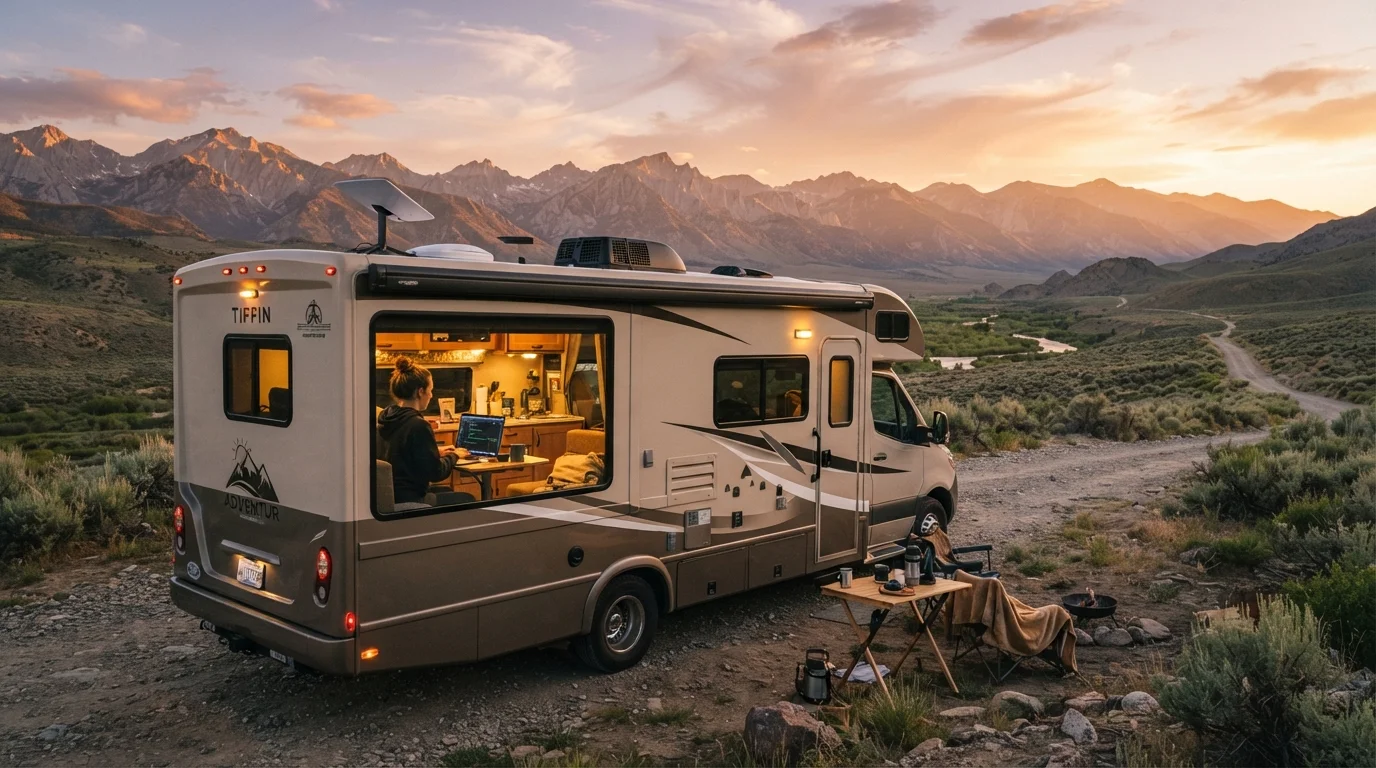
For remote workers, managing cellular data alongside power and workspace ergonomics is a layered challenge. Our article on working remotely from an RV covers these realities in depth.
- Strengths: Low latency, widely available in developed areas, plans from multiple carriers allow comparison
- Limitations: Data caps, deprioritization during network congestion, dead zones in rural and backcountry locations
Satellite Internet: True Anywhere Coverage
Satellite internet has undergone a significant shift with the emergence of low-Earth orbit (LEO) constellations, which deliver notably lower latency than traditional geostationary satellite systems. LEO-based options have made satellite a practical consideration for RVers who regularly park in areas with no cellular coverage.
The trade-offs remain real: equipment costs are substantial, monthly service fees are higher than comparable cellular plans, and some satellite services have geographic or in-motion restrictions that require careful review before purchase. Mounting hardware also requires a clear sky view - dense tree cover can interrupt signal.
| Cellular Data | Satellite (LEO) | Campground Wi-Fi | |
|---|---|---|---|
| Coverage area | Strong near towns and highways | Near-universal including remote areas | Only at campground facilities |
| Typical latency | Low (20-60ms) | Low-moderate (25-60ms LEO) | Variable, often high |
| Equipment cost | Low-moderate (router/booster) | High (dish and hardware) | None required |
| Monthly cost | Moderate ($50-$150+) | High ($100-$200+) | Usually included in site fee |
| Reliability | Consistent in coverage zones | High, weather-dependent | Unreliable under heavy load |
| Best use case | Primary connection on-route | Off-grid and backcountry stays | Low-bandwidth backup only |
For those exploring boondocking - where satellite may be the only viable option - see our comparison of boondocking vs. campground living for a fuller picture of what off-grid camping demands.
Campground Wi-Fi: A Supplemental Option at Best
Nearly every commercial campground advertises Wi-Fi, but the quality varies enormously. Shared networks serving dozens or hundreds of rigs simultaneously rarely deliver speeds sufficient for video calls, large file transfers, or streaming. Campground Wi-Fi is best treated as a fallback for low-bandwidth tasks - checking email, light browsing - rather than a primary connection.
Security is also a concern on open campground networks. Using a VPN (virtual private network) when connecting to shared hotspots is a reasonable precaution for anyone handling sensitive data.
~2.2M
Estimated full-time RVers in the US
The RV Industry Association has estimated that millions of Americans now use RVs as a primary or extended-stay residence, driving demand for reliable mobile internet.
72%
RVers citing internet as a top concern
Surveys conducted by RV travel communities consistently identify connectivity as one of the top practical challenges for both part-time and full-time RV travelers.
Internet costs are one component of the broader financial picture of RV living. Our breakdown of the hidden costs of full-time RV living covers how connectivity expenses stack up alongside fuel, campsite fees, and maintenance.
Building a Layered Connectivity Strategy
Most experienced full-timers settle on a combination of two solutions rather than relying on any single method. A typical setup pairs a cellular plan on one or two carriers with a satellite option for gap coverage. Carrier diversity matters: in any given region, one network may outperform another, so carrying a secondary SIM or router that accepts multiple carriers increases reliability.
Before investing in hardware, map your anticipated travel routes against carrier coverage maps and identify the regions where you'll spend the most time. Travelers who stick primarily to the Sun Belt corridor have different needs than those who spend time in the Pacific Northwest or the Great Plains. The RV community can also be a valuable source of real-world signal reports - something explored in our look at RV communities and campground networks.
There is no universally correct setup, but there is always an optimal one for your specific travel pattern. Start with cellular, assess your coverage gaps after a few months, and add satellite only if your travel style genuinely takes you beyond cellular reach on a regular basis.