Why Education Is Often Optional - But Rarely Unnecessary
Boating regulation in the United States is largely administered at the state level, and requirements vary widely. Many states mandate safety education only for operators under a certain age - commonly 14 to 18 - leaving adult newcomers free to take the helm with no formal instruction whatsoever. That gap between legal permission and practical readiness is where most preventable incidents originate.
According to the US Coast Guard's annual recreational boating statistics, operator inexperience and inattention consistently rank among the top contributing factors in reported accidents. Formal education directly addresses both. Courses approved by the National Association of State Boating Law Administrators (NASBLA) meet a standardized curriculum that covers far more than the rules of the road.
Before you even start thinking about what vessel suits your needs - see our guide to boat categories for context - understanding how to operate one safely is the more pressing starting point.
State Requirements Vary Significantly
As of the most recent legislative cycles, the majority of US states require boating safety education only for younger operators, with age thresholds ranging from 12 to 18 depending on the state. Some states are phasing in broader requirements for all operators over time. Check your state's boating law administrator for the current rule in your jurisdiction before assuming no education is needed.
What These Courses Actually Cover
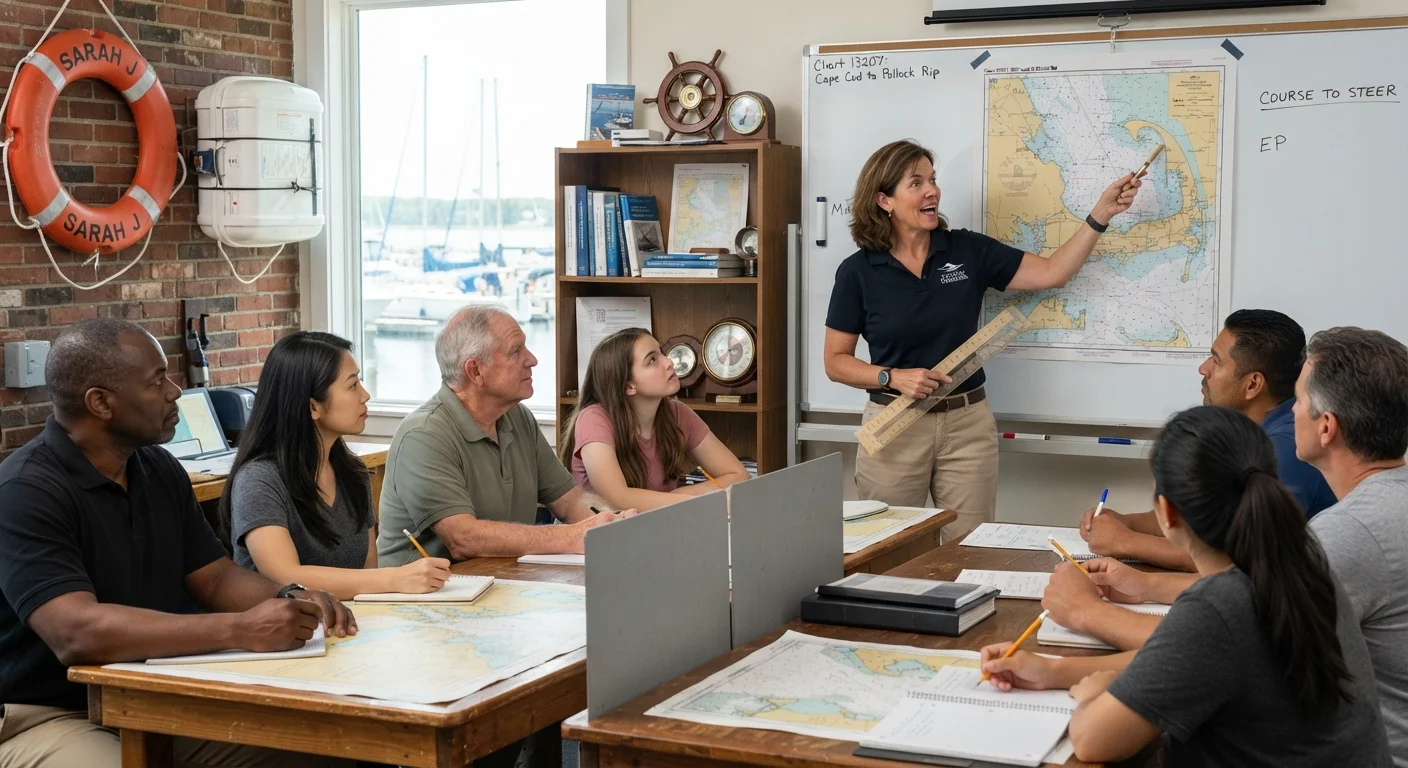
A NASBLA-approved boater education course typically spans four to eight hours, available in both classroom and online formats. The curriculum is structured around four core areas:
- Navigation rules (COLREGs/Inland Rules): Right-of-way situations, lighting requirements, sound signals, and how to read channel markers and buoys. These rules govern every vessel on US waters and are not intuitive without study.
- Required safety equipment: Federal law mandates specific gear based on vessel length and type. Courses explain exactly what qualifies - including life jacket classifications, fire extinguisher ratings, and visual distress signals. For a detailed breakdown, see what safety gear boaters are required to carry.
- Emergency procedures: Man overboard response, capsizing protocol, distress signaling, and VHF radio operation. These are low-frequency, high-stakes scenarios where trained muscle memory matters.
- Environmental stewardship: Discharge regulations, no-wake zones, and marine protected area rules - violations of which carry federal penalties.
Separating fact from assumption is also a course benefit. Common boating myths - such as the belief that alcohol affects judgment less on the water - are addressed directly, often with data.
75%+
Accidents involving operators with no safety instruction
US Coast Guard recreational boating accident reports consistently show that the large majority of fatalities involve operators who had received no formal boating education.
~8 hrs
Typical time to complete an approved course
Most NASBLA-approved boater education courses - including online formats - can be completed in four to eight hours, often in a single sitting.
Pros and Cons of Completing a Boater Education Course
Weighing the decision to enroll? Here is an honest breakdown of what you gain and what the limitations are.
Fills critical knowledge gaps not covered by experience
Navigation rules, right-of-way conventions, and equipment requirements are rarely self-taught. Formal instruction provides a structured framework that trial-and-error on the water cannot replicate safely.
Directly addresses leading causes of boating accidents
Operator inexperience is among the most frequently cited factors in US Coast Guard accident reports. Courses target exactly this deficiency with structured, scenario-based content.
May reduce marine insurance premiums
Many insurers offer discounts to boaters who complete a NASBLA-approved course. The reduction varies by provider but is a tangible financial benefit on top of the safety value.
Certification is valid across state lines
A NASBLA-approved boater education card is recognized nationally, which matters for boaters who trailer to different bodies of water or cruise across state boundaries.
Online formats require minimal time commitment
Most courses can be completed in a single day at a pace that suits the learner, removing the scheduling barrier that deters many prospective students.
Classroom knowledge doesn't substitute for on-water practice
Understanding docking procedures in theory is very different from executing them in current and wind. Education courses are a starting point, not a substitute for supervised time at the helm.
Course quality can vary between providers
While NASBLA sets curriculum standards, the depth of instruction and quality of instructors varies. Online formats in particular may offer less opportunity for questions and scenario discussion.
State-specific rules may not be fully covered
Local regulations - speed limits, no-wake zones, registration rules - differ by state and sometimes by individual waterway. A national curriculum may not capture every local nuance relevant to your home waters.
No formal assessment of on-water competence
Passing a written exam demonstrates knowledge retention, but it does not validate boat-handling skill. Boaters who complete a course may still need mentored experience before operating independently.
Practical Considerations Before You Enroll
Most states offer free or low-cost online courses through providers that meet NASBLA standards. The BoatUS Foundation and the US Coast Guard Auxiliary both offer widely recognized programs. Upon completion, boaters receive a certificate or boater education card that is valid nationally - though some states have additional local endorsements.
If you plan to operate different vessel types, note that some courses are more relevant to powerboats while others include sailboat-specific content. Knowing which boat category you'll be operating before enrolling helps you choose a curriculum that matches your actual use case.
Finally, completing a course before your first time on the water - rather than after an incident forces the issue - is the approach that makes the most practical sense. What to expect your first time on the water is a useful companion read once your education foundation is in place.