What Makes a Toy Hauler Different From Other RVs
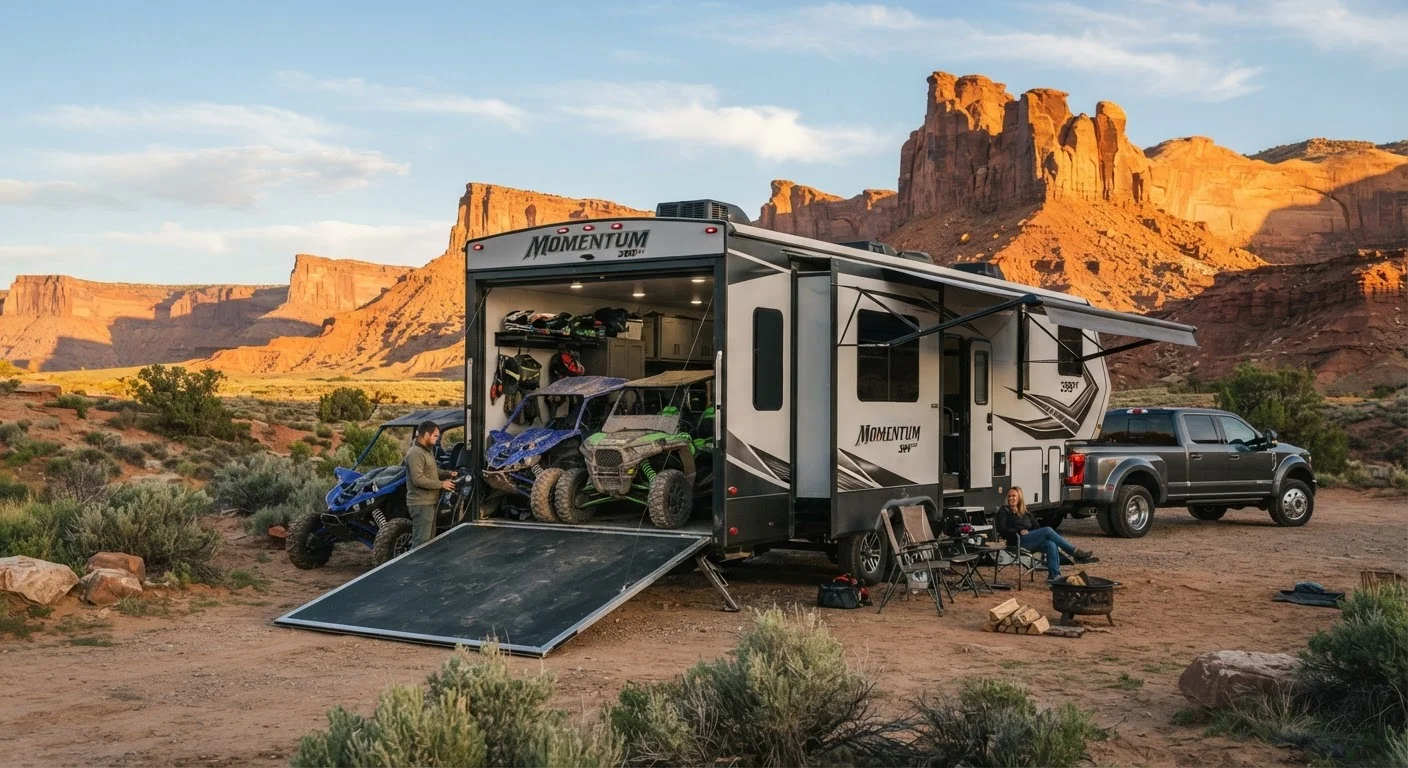
Within the broader RV landscape - which spans Class A motorhomes to compact pop-up campers - the toy hauler occupies a unique position as a purpose-built hybrid. Rather than maximizing interior living space from wall to wall, a toy hauler reserves a substantial portion of its length for a sealed cargo garage at the rear. That garage connects to the outside world through a heavy-duty ramp door that folds down for loading and unloading.
The defining characteristic isn't the ramp itself, but the structural commitment behind it. Toy hauler floors in the garage section are reinforced to support the weight of motorcycles, ATVs, side-by-sides, or other heavy recreational gear. The garage walls are typically lined with tie-down anchor points, and the space is separated from the living quarters by a partition wall with a pass-through door.
To understand where toy haulers fit within the full spectrum of RV types, the RV class system explained is a useful starting point. Toy haulers aren't their own standalone class - they're a subtype that exists across multiple classes.
8-16 ft
Typical toy hauler garage length
Garage bay dimensions vary by manufacturer and floor plan; larger fifth-wheel toy haulers commonly offer garage lengths at the upper end of this range.
1,500+ lbs
Added weight from two full-size ATVs
Cargo weight directly impacts GVWR and tow vehicle requirements; actual figures depend on specific vehicle models being transported.
3 formats
Toy hauler configurations available
Toy haulers are produced as travel trailers, fifth wheels, and motorhomes - each with different hitch, space, and cost profiles.
The Two Main Toy Hauler Formats: Towable vs. Motorized
The majority of toy haulers are towable units - either travel trailers or fifth wheels. Travel trailer toy haulers use a standard ball hitch and are generally lighter, while fifth-wheel toy haulers attach via a kingpin hitch mounted in a pickup truck bed, offering improved stability and often greater interior height. For a direct comparison of those two towable formats, see fifth wheel vs. travel trailer.
Motorized toy haulers are less common but exist primarily on Class A and Class C platforms. These units incorporate a garage into a self-propelled vehicle, eliminating the need for a separate tow vehicle - though they come with significantly higher acquisition and operating costs.
Regardless of format, the loaded weight of a toy hauler changes substantially when the garage carries equipment. A pair of full-size ATVs can add 1,500 lbs or more to the unit's gross weight. That figure directly affects what tow vehicle is required - a factor the tow vehicle requirements guide addresses in detail. Truck capability matters here - explore the trucks overview for context on towing platforms.
Check Payload Before You Load
Every toy hauler lists a garage floor weight rating and a total cargo carrying capacity (CCC) in its specifications. These are separate numbers. The floor rating tells you how much weight the garage structure can support in one place; the CCC tells you the total additional weight the entire unit can handle beyond its base curb weight. Confirm both figures against the actual weight of your gear - with fuel in the tanks - before every trip.
How the Garage Space Functions at Camp
One of the practical advantages of the toy hauler format is what happens to the garage once you've arrived at your destination and unloaded your equipment. The ramp door, when lowered and supported, becomes a covered patio surface - a feature that adds usable outdoor living space that conventional RVs don't offer.
Inside the garage, most toy haulers include provisions for converting the space into additional living quarters. Fold-down sofas, murphy beds, removable furniture systems, and modular storage allow the garage to function as a second sleeping area, a recreation room, or an overflow lounge depending on the trip's needs.
This conversion capability is central to why toy haulers attract buyers even on trips without cargo. The layout trade-offs unique to toy haulers explores how designers balance garage flexibility against the living space that gets compressed into the forward section.
Who the Toy Hauler Format Suits - and Where It Falls Short
Toy haulers are well-matched to riders and outdoor recreation enthusiasts who want to bring motorized gear to trailheads, race events, or remote desert camping. The combination of onboard accommodations and secure gear transport removes the logistics of trailering equipment separately while also booking separate lodging.
That said, the format involves genuine trade-offs. Living space per foot of overall length is lower than in a standard travel trailer or fifth wheel of equivalent size, because the garage consumes 8 to 16 feet of the unit's total length. For travelers who prioritize residential-style interiors, slide-outs, or gourmet kitchen setups, a conventional floor plan may serve better.
Weight is the other constant consideration. Toy haulers run heavier than comparable non-hauler trailers even when empty, and the garage's rated cargo capacity must never be treated as an afterthought. Overloading the garage floor is a structural and safety concern. Always verify both the garage floor weight rating and the unit's GVWR (Gross Vehicle Weight Rating) before loading cargo.
For readers still weighing which RV category fits their travel habits, the RV class and travel style matching guide and the class-by-class RV reference both provide useful comparative context. Interior layout considerations across RV types are also covered in the layouts hub.
“The toy hauler concept essentially solved a logistics problem that powersports enthusiasts had wrestled with for decades - how to get your gear to the trail and have somewhere comfortable to sleep when you get there. Everything about the design flows from that single problem statement.”
— RVs & Campers Editorial Team, Recreational Vehicle Content Specialists